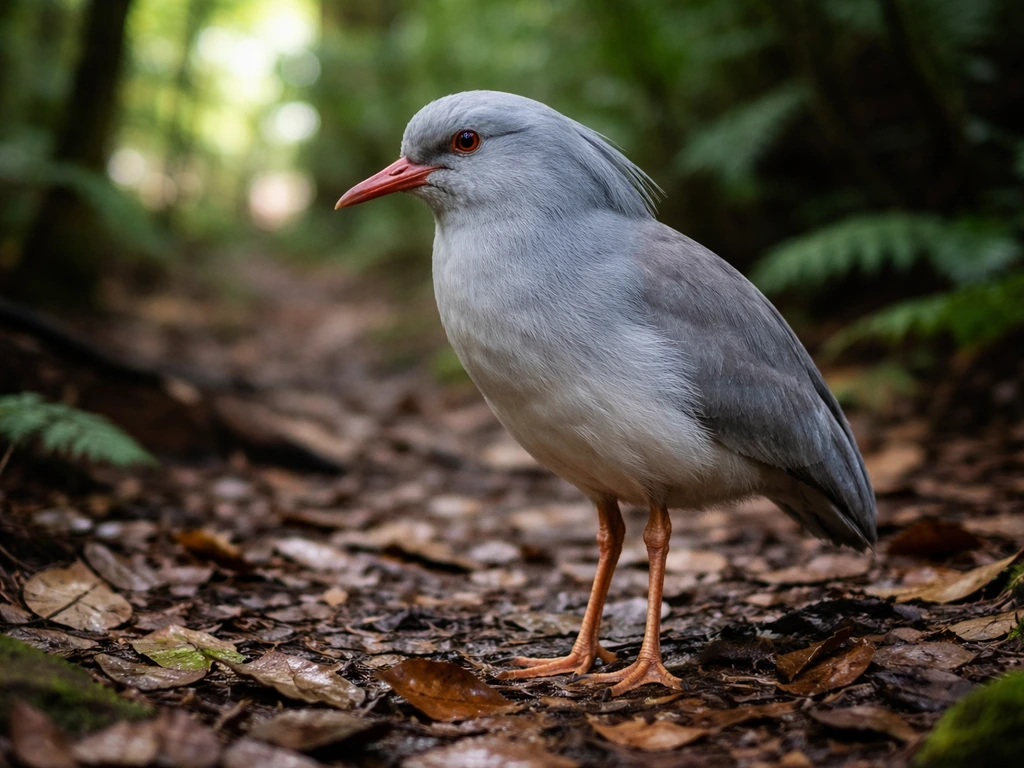
The kagu (Rhynochetos jubatus) is not extinct. It is alive in the wild today, but it is in serious trouble. The species survives on New Caledonia's main island, Grande Terre, where it holds on in a handful of protected forest strongholds. Its population has been declining for decades, and without ongoing conservation work, extinction is a real possibility. So the honest answer is: not extinct, but genuinely threatened and still losing ground.
Is Kagu Bird Extinct? Current Status, Evidence, and Recovery

Maya Hennessy
29 Apr 2026
The kagu's status right now

The kagu is listed on the IUCN Red List as Endangered. EDGE of Existence also lists the kagu (Rhynochetos jubatus) as Endangered, reflecting its high extinction risk listed on the IUCN Red List as Endangered. BirdLife International, which maintains species factsheets aligned with IUCN assessments, flags the population trend as a continuing decline in mature individuals. That is not the same as extinct, but it is the direction things move before a species slips into Critically Endangered or worse. There is no current IUCN designation of Extinct (EX), Extinct in the Wild (EW), or the provisional label Critically Endangered (Possibly Extinct), which means scientists have enough verified sightings and survey data to confirm wild birds are still out there.
The confusion about whether the kagu is extinct is understandable. It is a flightless, ground-dwelling bird found nowhere else on Earth, it has nearly vanished from much of its historic range, and it went completely extinct on the nearby Ile des Pins roughly 3,000 years ago following human colonisation. When a bird has that kind of track record, people reasonably wonder if the story is already over. It is not, but the margin is thin.
Where the kagu lives and what it actually needs
Every known wild kagu today lives on Grande Terre, the main island of New Caledonia, which covers about 16,000 square kilometres. The species is not spread evenly across that island. It concentrates in two types of rainforest habitat sitting on very different soil types: ultramafic soils (low in nutrients, high in heavy metals, and relatively isolated from human settlement) and non-ultramafic soils (richer in food resources but also closer to populated areas and their accompanying feral dogs). blank" rel="noopener noreferrer">The two main conservation strongholds are Parc Provincial de la Rivière Bleue (PPRB) and Parc Provincial des Grandes Fougères (PPGF), where active protection measures are in place.
The kagu is a dietary specialist in the leaf litter and soil layer of humid forest. It feeds on worms, snails, insects, and lizards, using its remarkable sense of smell, unique among birds, to locate prey underground. It needs intact forest with an undisturbed ground layer, low predator pressure, and enough territory per breeding pair to raise a chick (they typically raise only one per year). All of that makes it extremely sensitive to any change at ground level.
Why the kagu declined: dogs, habitat loss, and a slow accumulation of pressures

Dogs are the single biggest documented threat to kagu survival in the wild. A 2025 study published in the Journal of Ornithology confirmed that domestic and feral dogs (Canis lupus familiaris) are the only known significant predator of kagus, and that dog control directly shapes where kagu populations are stable versus crashing. This is not a minor nuisance. A roaming dog can kill multiple kagus in a single night, and because the kagu is flightless and slow to reproduce, losses are very hard to recover from.
What about cats, pigs, and rats? A 20-year study found no evidence that feral cats or feral pigs predate adult kagus. Black rats have been observed killing hatchlings in rare cases, and corvids or goshawks occasionally take eggs, but across more than 400 documented breeding attempts those events were unusual. The bigger structural threats are dogs, habitat loss, and forest fragmentation, which have steadily reduced the area of suitable forest and pushed populations into smaller, more isolated patches.
Human activity has driven both problems. Deforestation for agriculture and mining (New Caledonia has significant nickel deposits) has reduced and fragmented kagu forest. Settlement and land use bring domestic dogs into previously wild areas. The species was also captured for zoos and the exotic pet trade in the early twentieth century, which added direct pressure on an already small population. By the early 1980s, the situation had become critical enough that conservationists began organised intervention.
Extinct versus threatened: why the distinction matters
In everyday language, people often use 'extinct' loosely to mean 'basically gone' or 'I never see it anymore.' In conservation science, extinct means something very specific: no reasonable doubt that the last individual has died. That strict meaning is also why people ask how did the Kauai bird go extinct, since the same standard is used when declaring extinction last individual has died. The IUCN Red List uses strict criteria for that label, and the kagu does not meet them. There are verified, living wild birds being monitored in protected areas right now.
The IUCN also acknowledges that extinction is hard to confirm precisely, since the death of the last individual is almost never witnessed. That is why they use provisional categories like Critically Endangered (Possibly Extinct), or CR(PE), for species where surveys have not found individuals but cannot rule them out. The kagu is not in that category either. It sits at Endangered, with a known wild population, active breeding confirmed, and survey data collected as recently as 2025. Rare, declining, and at serious risk are all accurate. Gone from the wild is not.
It is worth noting the comparison with other species on this site. The kakapo, another flightless bird people sometimes believe is extinct, is in a similar situation: genuinely alive, intensively managed, and far from safe. Some birds discussed on this site, like many of the Kauai forest birds, have crossed the line from severely threatened to confirmed extinct.
Some Kauai forest birds have crossed the line from severely threatened to confirmed extinct, so their fate can be very different from the kagu Is Kauai bird still alive. Some Kauai forest birds, unlike the kagu, were pushed from severe decline all the way to confirmed extinction. The kagu has not crossed that line yet, which is precisely why current conservation work is so important.
What conservation is actually doing
Organised kagu conservation began in earnest in the early 1980s when Yves Letocart launched a captive-breeding program and simultaneously began a stray-dog eradication effort inside Rivière Bleue Provincial Park. That combination of captive insurance and wild-habitat protection has been the template ever since. By 1991, when researcher Hunt conducted early population work in the park, the kagu population in and around Rivière Bleue was estimated at around 600 individuals, a number that reflected the impact of those early interventions.
Today, conservation work in the two main provincial parks centres on controlling dogs through trapping and community engagement with local dog owners, releasing captive-bred birds to supplement wild populations, protecting nesting sites, and monitoring breeding success. The ultramafic forest zones have become particularly important because their relative isolation from human settlement gives birds a buffer from dog predation. Rangers and researchers track individual birds to measure breeding rates, survival, and territory use.
Recovery would look like a stable or increasing population trend confirmed across multiple survey cycles, with breeding success high enough to offset adult mortality, and the geographic range of the species holding steady or expanding back into previously occupied habitat. The population is not there yet. The trend is still declining, which means current efforts are slowing deterioration more than reversing it.
How scientists verify the kagu is still out there
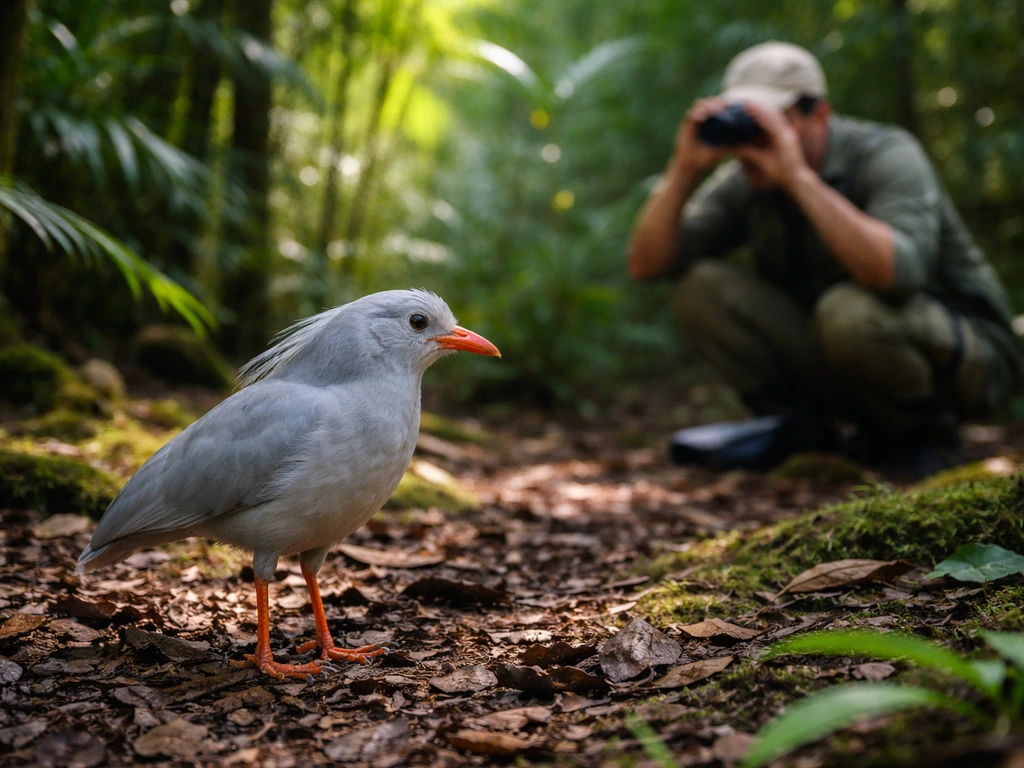
The 2025 Journal of Ornithology study that mapped kagu distribution across Grande Terre used 15,095 kagu observations to build density and distribution models. That is a substantial dataset, built through systematic field surveys, point counts, and opportunistic sightings compiled over time. Field teams walk transects through rainforest, record bird detections by sight and sound (the kagu has a distinctive call), and use GPS-tagged individuals to track movement and territory.
Captive populations in New Caledonian parks and overseas zoos provide a separate line of evidence, but wild population monitoring is the scientific backbone of the status assessment. The fact that researchers can model density distribution across two distinct ecoregions, distinguish between stronghold areas and depleted zones, and track 15,000-plus observations means this is not a species being assumed to exist. It is being actively counted and mapped.
The IUCN Red List assessment process requires periodic re-evaluation using this kind of field evidence. When population size estimates change, trend data update, or new surveys reveal shifts in range, the category can change. That is how a species moves from Endangered to Critically Endangered, or in better outcomes, from Endangered toward Vulnerable. The kagu's current Endangered status reflects the best available evidence as of the most recent assessment.
What to do next: where to check and what to watch for
If you want to stay current on the kagu's status, here are the most reliable sources and the specific updates worth tracking:
- IUCN Red List (iucnredlist.org): Search 'Rhynochetos jubatus' for the current Red List category, population estimates, and the most recent assessment year. Any category change from Endangered to Critically Endangered would be a significant warning sign.
- BirdLife International DataZone (datazone.birdlife.org): BirdLife maintains the species factsheet used in IUCN assessments for birds. Check the 'Population trend' field and any updates to the assessment history section.
- Journal of Ornithology and other peer-reviewed ornithology journals: New field studies, like the 2025 density distribution paper, provide the ground-truth data behind Red List assessments. Google Scholar searches for 'Rhynochetos jubatus' will surface recent publications.
- Province Sud and Province Nord (New Caledonia's provincial governments): These are the agencies administering the parks where kagus live. Conservation program updates sometimes appear in their official communications.
- Zoo and aquarium breeding program updates: Institutions holding captive kagus, including several European zoos, occasionally publish breeding success reports that reflect the health of the captive safety-net population.
The specific developments worth watching are: any IUCN reassessment that changes the category, reports from Rivière Bleue or Grandes Fougères parks about dog control effectiveness or breeding season outcomes, and new population estimates from field surveys. A stabilised or improving population trend, confirmed over two or more survey cycles, would be the clearest evidence that conservation efforts are genuinely working. Until that happens, the kagu remains one of those species where the answer to 'is it extinct? To learn whether the quetzal bird is extinct, check the latest IUCN assessments and recent field monitoring reports is it extinct.
</a> You can also learn more about whether the quetzal bird is extinct and what conservation efforts mean for its survival is it extinct? . ' is 'not yet,' and that 'not yet' depends entirely on the work happening right now on a single island in the South Pacific. If you are comparing bird-extinction timelines across species, this is a good moment to review whether the quetzal bird <a data-article-id="8775743D-D8C5-49CC-B8E6-63E5CB708D01">is the quetzal bird extinct.
FAQ
How can scientists be confident the kagu is still alive if it is so hard to see?
They rely on repeated field surveys that combine call detection, transect walks, and spatial modeling, plus tracking of GPS-tagged individuals in the stronghold parks. One-off sightings are not enough for a status decision, and the current category is based on verified wild presence across survey cycles.
What would have to happen for the kagu to be labelled Critically Endangered (Possibly Extinct) or extinct?
Those labels would require extensive, well-designed surveys across the known habitat and any remaining suitable areas that fail to detect kagus. For “extinct,” the standard is essentially no reasonable doubt that the last individual has died, which is never concluded from a single negative survey.
Why did the kagu become extinct on Ile des Pins but not on Grande Terre?
The article notes the kagu is extremely sensitive at ground level and that dogs are the key predator. Differences in how introduced predators and habitat changes occurred likely drove the contrast, with Grande Terre now benefiting from ongoing dog control and protected forest strongholds.
Are dogs the only reason the kagu population is declining?
Dogs are the single biggest documented predator, but the decline is also tied to habitat loss and fragmentation, which reduces territory, increases isolation, and makes dog pressure harder to manage. In practice, dog control and habitat protection are treated together as linked interventions.
Do cats, pigs, or rats threaten kagus enough to matter for recovery planning?
The long-term evidence summarized here suggests cats and pigs have not shown significant predation on adult kagus. Black rats can kill hatchlings rarely, and other predators are occasional egg predators, so recovery strategies still focus most heavily on dog control and safeguarding the ground layer during breeding.
How many breeding opportunities does a kagu have each year, and why does that affect recovery chances?
Kagus typically raise one chick per year, which means each breeding loss has a large impact on population growth. That low reproductive rate is why rapid, repeated adult mortality from roaming dogs can be especially damaging and difficult to replace.
What does “population stable” mean in this conservation context?
It is not just that kagus are occasionally seen. The article describes stability as an unchanged or improving trend confirmed across multiple survey cycles, with breeding success high enough to offset adult deaths and with the occupied range holding steady or expanding.
If captive-bred kagus are released, does that automatically mean the wild population is recovering?
Not automatically. Releases can help, but the status still depends on whether released birds survive, breed successfully, and whether dog pressure and habitat fragmentation allow wild breeding to keep working without increasing adult mortality. Monitoring outcomes after releases is therefore critical.
How often are surveys updated, and when could the Red List category change?
The IUCN requires periodic re-evaluation, and category updates typically occur after new population estimates, updated trend data, or discoveries of meaningful range shifts. In other words, a change can happen when the evidence base improves enough to show a real shift, not just short-term variation.
What is the most common misunderstanding people make about “extinct” for species like the kagu?
People often use “extinct” in a casual sense meaning “I do not see it anymore.” For conservation, extinct has a strict evidentiary meaning, and a species can still be alive and monitored even if it is rare, localized, and difficult to detect.