The Hawaiian mamo, Drepanis pacifica, went extinct around 1898. That's the date most authoritative sources converge on, including Britannica, the Bishop Museum, and the U.S. Fish and Wildlife Service's own Species of the Month summary. A second last-record date of 1899 also appears in some references, tied to a report of a native Hawaiian hearing the bird's call near Kaʻunana. The last physical specimen, however, was collected in 1892 by a collector working for naturalist Henry Palmer, making 1892 the end of the documented specimen record, with 1898 and 1899 representing the final field observations.
When Did the Mamo Bird Go Extinct? Date and Causes

Maya Hennessy
18 May 2026

Which mamo are we talking about?
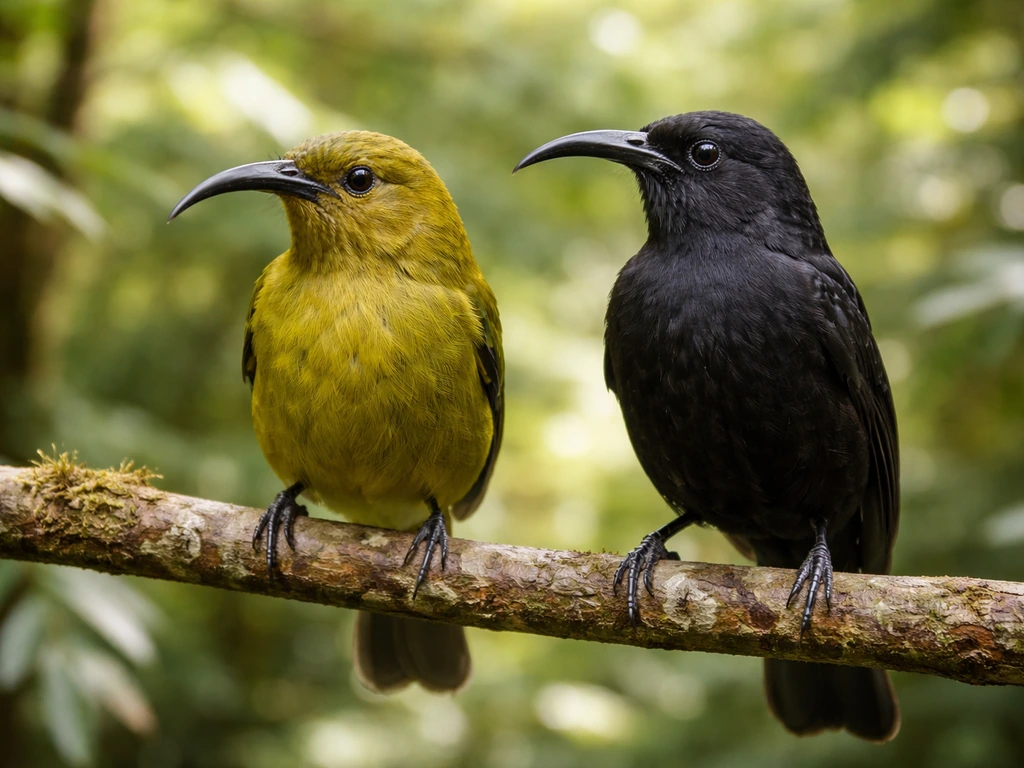
"Mamo" can actually refer to more than one Hawaiian bird, so it's worth pinning down the species before going further. The Hawaiian mamo, Drepanis pacifica, is the one most people mean, and it's the bird described by J.F. Gmelin in 1788. It was endemic to the Big Island of Hawaiʻi, living in the upland forests above Hilo and other interior regions. It belonged to the family Drepanididae, the Hawaiian honeycreepers, a remarkable group of birds that evolved into dozens of specialized forms across the Hawaiian archipelago.
The other mamo worth knowing about is the black mamo, Drepanis funerea, which was endemic to Kauaʻi and survived slightly longer, with its last confirmed sighting in 1907. Bishop Museum’s endangered-species page for mamo-related taxa discusses the black mamo (Drepanis funerea) and its last confirmed sighting blank" rel="noopener noreferrer">black mamo, Drepanis funerea. If you've seen the date "1907" attached to a mamo extinction, that's the black mamo. This article focuses on Drepanis pacifica, the Hawaiian mamo from the Big Island, which is the species most commonly searched and the one with the 1898 extinction date.
What "extinct" actually means here (and why it matters)
The IUCN defines a species as Extinct (EX) when there is no reasonable doubt that the last individual has died. That sounds clean in principle, but in practice, especially for island birds in the 19th century, the evidence is almost never a single moment. What we usually have is a last confirmed sighting, a last collected specimen, and sometimes an unverified report after that. Each of those produces a slightly different "extinction date," which is why you'll see 1892, 1898, and 1899 all cited for Drepanis pacifica depending on which record a source is using.
"Functional extinction" is a related but different concept. A species is functionally extinct when its population has dropped so low it can no longer play its ecological role, even if a few individuals still exist. For a nectar-feeding bird like the mamo, that threshold was probably crossed well before the last individual died. By the time collectors were scrambling to obtain specimens in the 1880s and 1890s, the population was almost certainly already too small and fragmented to sustain itself. So while 1898 is the extinction date, the species was effectively doomed years earlier.
The extinction timeline: what the records actually show

Working through the timeline chronologically gives the clearest picture of how the mamo disappeared.
- 1779: The mamo was first documented by naturalists on James Cook's expedition, providing the earliest Western record of the species.
- 1860s: A collector named James Mills, based in Hilo, obtained specimens, suggesting the bird was still present in the Big Island's forests at that point.
- ~1876: French naturalist Théodore Bailleu collected specimens, one of the later mid-century records.
- 1892: Henry Palmer's collector obtained the last known physical specimen. This is the final date in the museum specimen record, and some syntheses cite Greenway (1967) as the source for this benchmark.
- 1898: An observation was recorded above Hilo near Kaumana in July of that year. FWS attributes this to Greenway (1967) as well, and it's the date most summary sources, including Britannica and Bishop Museum, use as the official extinction year.
- 1899: A report, attributed to a native Hawaiian who heard the bird's call near Kaʻunana, appears in some accounts including Rothschild's historical compilation. FWS cites Pratt et al. for this record. It's less verified than a physical sighting but is included in some databases as the final possible record.
The FWS Species of the Month document settles on "Extinct, 1898" as its official summary. That's the most practical date to use when citing a single year. If you need to acknowledge the full range of uncertainty, the honest answer is: last specimen 1892, last credible sighting 1898, last reported contact 1899.
Why the mamo disappeared: the real drivers
The mamo's extinction wasn't caused by any single event. The case of the ortolan is similar in spirit to how wildlife protection laws address practices that harm rare birds, which is why it is widely discussed as illegal to hunt in many places. Many people ask what killed the elephant bird, but the mamo’s decline shows how multiple human-driven pressures can combine to wipe out an island bird species 1898. It was the compounding effect of several pressures that hit Hawaiian birds almost simultaneously after sustained Western contact in the late 18th and 19th centuries.
Feather hunting and collection

The mamo was intensely targeted for its brilliant yellow feathers, which Hawaiian royalty had used for centuries to make ceremonial cloaks and helmets. A single garment could require thousands of birds. Western collectors added a second wave of pressure: museums and private collectors in Europe and America paid for specimens, and by the late 1800s, collectors were actively hunting the remaining population. The FWS Species of the Month explicitly identifies feather hunting and collection as a key factor in the mamo's decline. Only 11 known specimens survive in museum collections worldwide, which tells you how rare the bird had become by the time anyone was keeping systematic records.
Habitat destruction
The mamo depended on upland native forests, particularly areas with the flowering plants its curved bill was adapted to reach. As ranching, agriculture, and logging cleared those forests through the 19th century, the bird's habitat shrank. Britannica notes that habitat destruction contributed to the extinction of at least eight original Hawaiian honeycreeper species. For the mamo, confined to the Big Island, there was no other island to retreat to.
Introduced predators
Rats, cats, and mongooses arrived with Western ships and settlement and devastated ground-nesting and low-nesting birds across Hawaiʻi. Hawaiian birds had evolved with no land mammal predators and had no behavioral defenses against them. Ecological modeling of Hawaiian honeycreeper declines consistently identifies predation by introduced mammals as one of three major collapse drivers alongside disease and habitat loss.
Avian malaria and introduced disease

This is probably the most devastating factor, and it's worth understanding how it worked. Mosquitoes were not native to Hawaiʻi. They arrived in the early 1800s, likely in water barrels from ships. With mosquitoes came avian malaria and avian pox, diseases to which Hawaiian honeycreepers had virtually no evolved immunity.
USGS research has documented that introduced mosquitoes and the diseases they carry had a profound effect on Hawaiian honeycreepers and likely contributed to the extinction of multiple species. Mortality from avian malaria can exceed 90% in some susceptible populations. By the late 1800s, when the mamo's last records were being made, this disease system was already in full effect in the lower forests, pushing surviving birds higher in elevation where the climate was cooler and mosquitoes less abundant.
For the mamo, with its already-stressed population, there was nowhere left to go.
A quick comparison: Hawaiian mamo vs. black mamo
| Feature | Hawaiian Mamo (Drepanis pacifica) | Black Mamo (Drepanis funerea) |
|---|---|---|
| Island | Big Island of Hawaiʻi | Molokaʻi |
| Last specimen | 1892 | 1907 |
| Commonly cited extinction year | 1898 | 1907 |
| Notable feature | Yellow feathers used in royal cloaks | Mostly black plumage, long curved bill |
| Primary extinction drivers | Feather hunting, disease, habitat loss, predators | Similar pressures, slightly later collapse |
The huia bird from New Zealand, which went extinct around 1907 as well, is another useful comparison point if you're researching the broader pattern of island bird extinctions in the late colonial era. For context, the huia bird in New Zealand also disappeared around the same era, with extinction typically dated to about 1907. The drivers are remarkably consistent: introduced species, habitat loss, and human exploitation.
How scientists settle on an extinction date (and why sources disagree)
The reason you'll find 1892, 1898, and 1899 floating around in different references comes down to which type of record each source prioritizes. GBIF’s Drepanis pacifica listing also reflects extinction-date variation by presenting the species as extinct (1898) within the broader Drepanis treatment 1892, 1898, and 1899 floating around in different references. Specimen-based researchers cite 1892 because that's when the last physical bird was collected. Field-observation-based summaries cite 1898 because that's the last credible sighting. Reports that include oral or secondary accounts extend to 1899.
FWS is transparent about this: their media page for Drepanis pacifica explicitly lists both 1898 (citing Greenway 1967) and 1899 (citing Pratt et al.) as last-record dates from different underlying sources. Rothschild's historical compilation, available through Wikisource, discusses the same range of records including the 1892 specimen, the 1898 Kaumana observation, and the 1899 call report. A more recent compilation, citing Kittelberger et al. (2024), also acknowledges the 1898/1899 discrepancy.
There is also at least one outlier: a supplementary table in a broader review mentions an unlikely reported sighting in 1937, but this is not considered credible in the mainstream literature. When you see a date that feels suspiciously late for a well-studied extinct species, check whether it's a verified record or an unconfirmed report flagged precisely because it's inconsistent with everything else.
Where to look if you want to verify this yourself
If you want to go deeper than a summary article, here's a practical path through the sources.
- U.S. Fish and Wildlife Service species profile and Species of the Month document for Drepanis pacifica: these are the most accessible government summaries and include citations to the underlying literature (Greenway 1967, Pratt et al.) so you can trace the last-record dates to their origins.
- IUCN Red List: search Drepanis pacifica to find the formal extinction assessment, including the criteria used and the year last seen field. This is the international standard for extinction status.
- GBIF (Global Biodiversity Information Facility): search Drepanis pacifica to pull digitized specimen occurrence records. Each record includes a collection date and locality, which lets you map the specimen timeline directly.
- VertNet and MCZbase (Harvard Museum of Comparative Zoology): these aggregate and search museum specimen records across institutions. Querying Drepanis pacifica will surface the 11 known specimens with their collection dates and labels.
- Bishop Museum (Honolulu): their species pages for Hawaiian birds often include last-seen dates and historical context. Their entry for the Hawaiian mamo gives "last seen in 1898 on the Big Island."
- Rothschild's Extinct Birds (digitized via Wikisource): a historical primary source that discusses the mamo's decline in real time, including the 1892 specimen and subsequent sighting reports. Useful for understanding how contemporaries perceived the collapse.
- Birds of the World (Cornell Lab): the full species account for Drepanis pacifica, though it may require a subscription. Provides peer-reviewed synthesis of status, range, and extinction drivers.
- Springer / peer-reviewed journals: a 2025 paper in Biodiversity and Conservation on disease-driven collapse of Kauaʻi's avifauna is a good recent example of the research framing applied to Hawaiian honeycreepers broadly, with relevance to understanding mamo's extinction drivers in scientific context.
When you encounter conflicting dates in your research, ask three questions: Is this a specimen record, a field observation, or a secondary report? Who is the source citing? Is the date explicitly flagged as uncertain or unverified? Answering those three questions will resolve most apparent contradictions you'll find across databases and textbooks.
The mamo's story is a concentrated version of what happened across Hawaiʻi's forests: a bird perfectly adapted to its island home, undone within a century by a cascade of pressures it had no evolutionary preparation for. The 1898 date is the right one to cite, but the more important number might be 1892, the year the last specimen was collected, because by then the species was already, in every meaningful sense, gone. If you are wondering whether the ʻauwo bird is extinct, the mamo timeline and records show it is treated as extinct, with the commonly cited year being 1898. This same idea of extinction also applies to other birds, such as the ortolan bird, which is the ortolan bird extinct 1898.
FAQ
If I search “mamo extinction,” why do I get multiple years like 1892, 1898, and 1899 for the same bird?
Because different references use different last-record types. 1892 is the last collected specimen, 1898 is the last credible field observation used in many summaries, and 1899 comes from an additional reported contact that is treated as less solid than specimen or confirmed sighting evidence.
When writing a report, should I state 1898 or 1892 for when the mamo went extinct?
Use 1898 if you need a single commonly accepted year for extinction status. Use 1892 if your audience cares specifically about the end of the documented specimen record. A good compromise in academic writing is “extinct by 1898, with the last specimen collected in 1892.”
Does “last confirmed sighting” mean there were zero mamo after that date?
Not necessarily. “Last confirmed” means the final observation that is considered reliable in the record. It can still be followed by unverified reports, and the bird could have persisted at very low numbers for a short time, especially in remote upland areas.
What is the difference between “extinct” and “functionally extinct” for the mamo?
Extinct means there is no reasonable doubt the last individual has died. Functionally extinct means the population is too reduced to maintain its ecological role, which for a nectar-feeding species likely happened earlier than the final death event due to fragmentation and crash in numbers.
If “mamo” can refer to more than one species, how do I make sure I am using the right extinction date?
Confirm the scientific name. The Hawaiian mamo Drepanis pacifica is typically tied to 1898 (with 1892 and 1899 appearing in different record types). The black mamo Drepanis funerea is a different species, with last confirmed sighting around 1907.
Why would disease and mosquito spread push surviving mamo higher in elevation, and why did that fail?
As malaria and pox intensified in lower forests, surviving honeycreepers likely retreated to cooler higher elevations where mosquitoes were less common. For the mamo, the population was already highly stressed and fragmented, so there was likely not enough remaining habitat, breeding density, or time for recovery.
Could a late date like 1937 ever be credible for a species that mainstream sources end in the 1890s?
Usually no. If a late year appears, check whether it is an outlier based on an unverified or secondhand account, not a specimen or well-documented observation. For heavily studied island bird declines, credible late dates should align with evidence patterns across multiple record types.
What counts as “credible” evidence when sources disagree about the mamo’s final year?
Specimens generally carry the strongest weight, followed by documented field observations with identifiable context. Secondary oral reports are the most prone to uncertainty, so they often explain why a different last date (like 1899) appears alongside a specimen-based end date (like 1892).
Is it accurate to say the mamo’s extinction had one main cause?
No. The article’s account emphasizes multiple reinforcing pressures: exploitation for feathers, habitat loss from land-use change, introduced predators, and disease spread via introduced mosquitoes. The key idea is that these factors compounded, leaving little room for survival even if one pressure had not been as severe.