The bird most people are thinking of is the Flightless Cormorant (Phalacrocorax harrisi), the only cormorant species on Earth that cannot fly. It lives exclusively on two Galápagos islands, Fernandina and Isabela, and it's genuinely flightless in the strictest biological sense: its wings are too small and weak to lift its body off the ground, full stop. A close second in people's minds is the Galápagos Penguin (Spheniscus mendiculus), which also can't fly but uses its flippers brilliantly underwater. If you've just spotted something on a rocky shoreline with stubby, vestigial wings held out to dry, that's almost certainly the Flightless Cormorant. If it's a small, tuxedoed bird waddling near a beach or porpoising through the surf, you've found the Galápagos Penguin.
Galápagos Bird That Can’t Fly: ID, Reasons, and What to Do

What people usually mean by the 'Galápagos bird that can't fly'
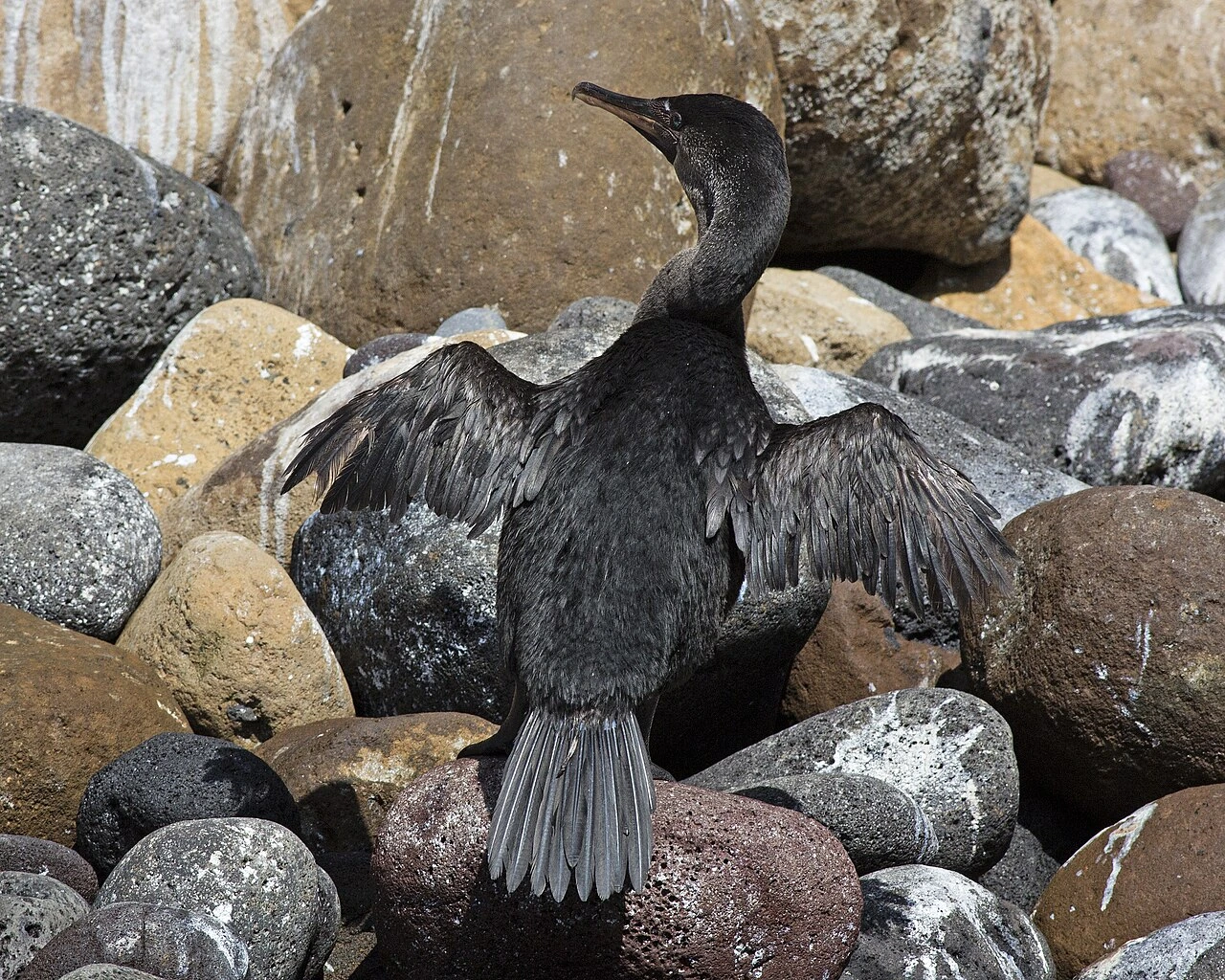
The phrase gets applied loosely to a handful of Galápagos birds, so it's worth untangling. Strictly speaking, the Flightless Cormorant is the headline species: it is the only cormorant in the world that has completely lost the ability to fly. UCLA researchers studying its evolution describe it as a "classic case of recent loss of flight," backed up by genetic work published through USGS that identified specific changes in the cormorant's genome driving the reduction in wing size and structure. When biologists or conservationists say "the Galápagos bird that can't fly," this is almost always the species they mean.
The Galápagos Penguin earns an honorable mention because penguins as a group are flightless birds, and this particular species is the only penguin found north of the equator in the wild. Both species are endemic to the Galápagos, both are endangered, and both often appear in the same conversation. A third bird that sometimes gets pulled into this discussion is the Galápagos Rail (Laterallus spilonota), a weak flier that can technically flutter short distances but functions essentially as a ground bird. Its IUCN status was recently reclassified from Vulnerable to Near Threatened based on updated 2025 population data, reflecting some recovery. But when most people search "Galápagos bird that can't fly," they are almost always referring to the Flightless Cormorant or the Galápagos Penguin.
How to identify the right species in the field
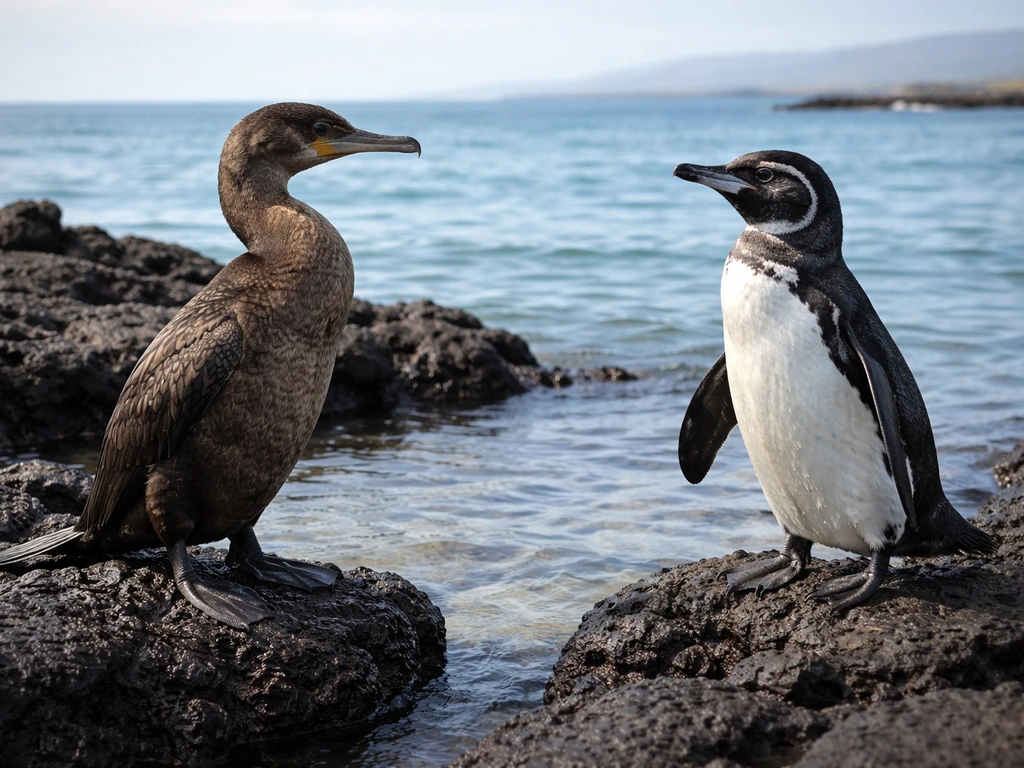
The Flightless Cormorant and the Galápagos Penguin are easy to tell apart once you know what to look for. Here's a quick breakdown of both.
Flightless Cormorant
- Size: Large and heavy-bodied, noticeably bigger than most seabirds you'll see nearby, roughly 89 to 100 cm (35 to 39 inches) long.
- Wings: Tiny, ragged-looking, and held out awkwardly when resting or drying on rocks — this is the single most diagnostic field mark. They look almost comically small for the bird's body.
- Plumage: Dark brownish-black above, slightly lighter below, with a long snake-like neck.
- Eyes: Striking turquoise-blue, visible at close range.
- Behavior: Swims low in the water, dives frequently for fish, and hauls itself onto large coastal rocks after foraging to spread and dry its vestigial wings.
- Location: Rocky coastlines of Fernandina and Isabela Islands only. If you're on any other island, it's not a Flightless Cormorant.
Galápagos Penguin
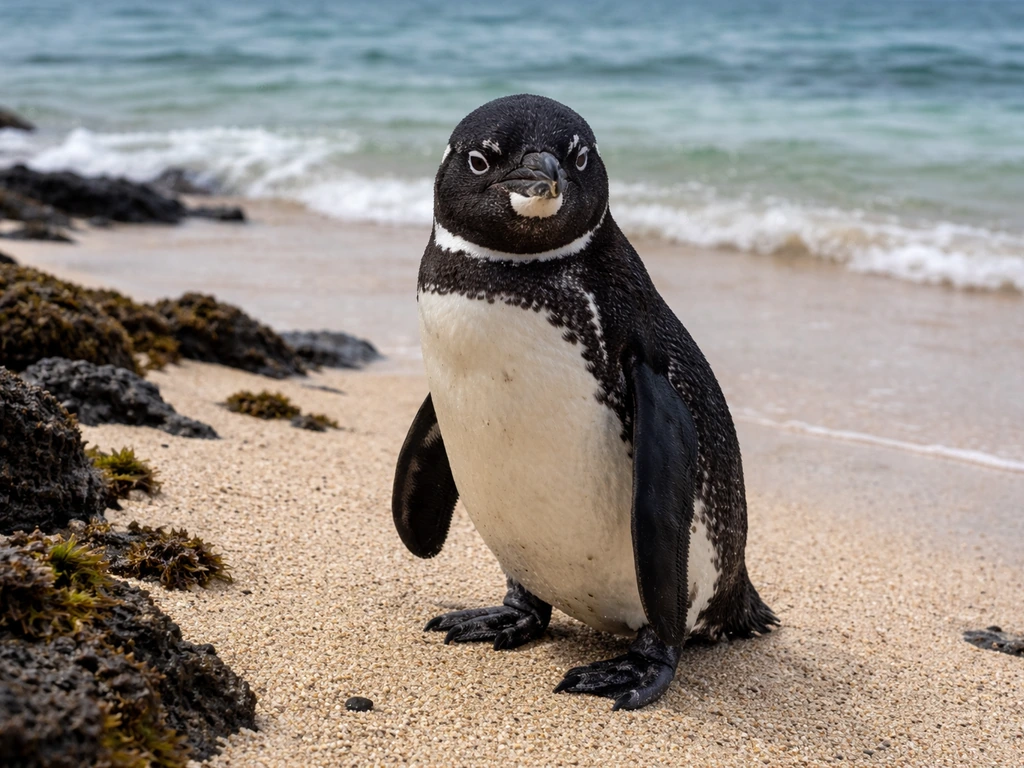
- Size: Small for a penguin, about 49 cm (19 inches) tall, making it the second-smallest penguin species in the world.
- Plumage: Classic black-and-white tuxedo pattern, but with a distinctive narrow black band across the upper chest and a black line running from the chin down to the flanks.
- Head markings: Black head with white lines running from the eye to the chin on each side.
- Behavior: Waddles awkwardly on land, rockets through shallow coastal water when hunting, and often rests in rock crevices or shaded ledges to avoid overheating.
- Location: Most common around Fernandina and Isabela, but small colonies also exist on Santiago, Bartolomé, Floreana, and the northern tip of Santa Cruz.
| Feature | Flightless Cormorant | Galápagos Penguin |
|---|---|---|
| Scientific name | Phalacrocorax harrisi | Spheniscus mendiculus |
| Body length | 89–100 cm | ~49 cm |
| Key field mark | Tiny vestigial wings held out to dry | Narrow chest band, white facial lines |
| Eye color | Turquoise-blue | Pink eye ring (bare skin) |
| Islands | Fernandina and Isabela only | Mainly Fernandina and Isabela, smaller colonies elsewhere |
| IUCN status | Vulnerable | Endangered |
Why it can't fly: island evolution and Galápagos ecology
The short version is: it didn't need to fly, so it stopped. Island evolution tends to favor energy efficiency over capabilities that go unused, and the Galápagos gave the ancestral cormorant exactly the conditions that make flight expendable. There were no land predators on Fernandina or Isabela that required fleeing into the air. Food, in the form of fish, eels, and octopus, was abundant in shallow coastal waters reachable by diving. Over generations, individuals with slightly smaller wings and stronger legs and feet had a survival and reproductive edge because they could dive more efficiently without the drag and metabolic cost of maintaining large wing structures. Natural selection did the rest.
The genetic story is fascinating. USGS-backed research published in the journal Science identified specific mutations in the Flightless Cormorant's genome tied to cilia development and skeletal growth, the same pathways involved in human skeletal dysplasias. These mutations appear to have shortened the wing bones while leaving the rest of the bird's body proportions intact. It's a precise, identifiable genetic signature of recent evolutionary loss of flight, not just a general shrinkage. This makes the Flightless Cormorant one of the most scientifically studied examples of island-driven flightlessness in the world, comparable in its scientific value to the kiwi in New Zealand or the now-extinct dodo of Mauritius. The broader pattern, where birds on predator-free islands lose flight when aquatic or terrestrial food is plentiful, appears repeatedly across the fossil and living record.
The Galápagos Penguin represents a different evolutionary path: its ancestors were already flightless before arriving in the islands (all penguins traded aerial flight for aquatic propulsion tens of millions of years ago). Its presence this far north of the typical penguin range is made possible by the cold Humboldt and Cromwell currents, which bring nutrient-rich, cooler water up to the equatorial Galápagos and make the marine environment survivable for a species that would otherwise overheat.
Habitat and range: which islands and where to look
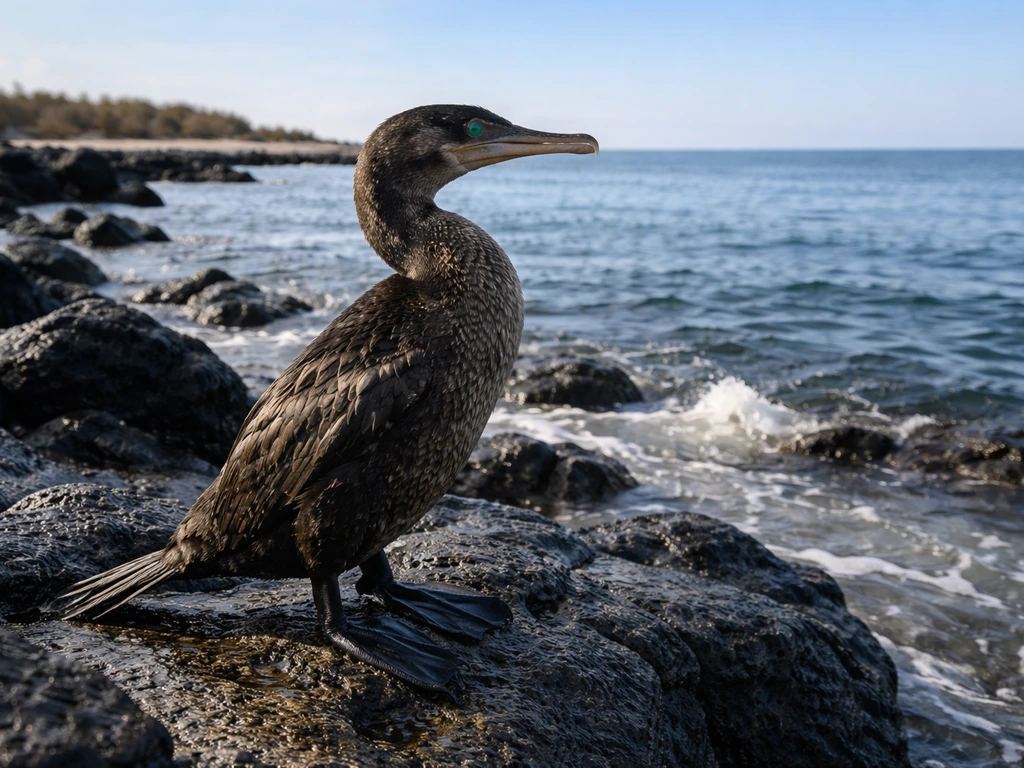
If you're visiting the Galápagos hoping to see the Flightless Cormorant, your visit needs to include the western islands. The species is restricted entirely to the rocky coastlines of Fernandina and the western coast of Isabela. There is nowhere else on Earth where it exists in the wild. eBird and Galápagos Conservancy both confirm this range is non-negotiable: if someone tells you they saw one on Santa Cruz or San Cristóbal, they've misidentified the bird. Within Fernandina and Isabela, look for calm, rocky shorelines with easy water access. The cormorants nest in small colonies on low coastal rocks and rarely move far from their nesting sites.
The Galápagos Penguin has a slightly broader footprint. Its main populations cluster around Fernandina and Isabela, where the cold upwelling water keeps fish concentrations high, but you can find smaller groups on Bartolomé (near the iconic Pinnacle Rock), Santiago, Floreana, and the northern edge of Santa Cruz. Bartolomé is one of the most reliably accessible spots for visitors on standard tour routes. Penguins there can often be observed from snorkeling tours, where you'll see them torpedo past at surprising speed.
Diet and daily behavior: what it's doing and when
The Flightless Cormorant is a dedicated coastal diver. It hunts by pursuing fish, eels, and octopus underwater, using its powerful webbed feet for propulsion rather than its wings. After a foraging bout, it hauls itself onto a large coastal rock and holds its vestigial wings out to dry, a behavior cormorants worldwide perform because their feathers are not fully waterproof. On a Flightless Cormorant, this wing-spreading posture is immediately striking because those wings look almost absurdly small against its large dark body. Breeding tends to happen after periods of food abundance, and pairs are monogamous within a season, with the male often bringing nesting material as a courtship offering.
The Galápagos Penguin feeds primarily on small schooling fish, especially sardines and mullet, and possibly crustaceans. It hunts close to shore, rarely venturing far out to sea, which makes it highly sensitive to local changes in fish availability. On land it seeks shade aggressively during the heat of the day, using rock crevices, caves, and overhangs to regulate body temperature. Early morning and late afternoon tend to be the most active foraging periods. Like all penguins, it is far more agile in the water than on land, where its upright waddle is endearing but slow.
Conservation status and main threats today
The Flightless Cormorant is listed as Vulnerable on the IUCN Red List. People sometimes ask whether the Galápagos Flightless Cormorant or other famous birds have ever gone to jail, but this is not a real or meaningful situation did big bird go to jail. Its entire global population is a few hundred to roughly 1,000 individuals at any given time, making it genuinely rare. The species' restriction to two islands is both a defining trait and its greatest vulnerability: any localized catastrophe, whether an El Niño event crashing fish stocks, an oil spill on the western Galápagos coast, or an introduced disease, could devastate the entire species in one blow. For a reminder of how rare-flight species can face sudden, life-threatening risks far from their usual range, look at the viv bird plane crash in Greenland viv bird plane crash greenland. Population dynamics research has linked its numbers directly to sea surface temperatures, with warm El Niño years causing sharp drops in breeding success and survival.
The Galápagos Penguin is listed as Endangered, with a global population estimated at fewer than 2,000 individuals. WWF documents El Niño events causing mortality rates of up to 77 percent in some years, as warming waters displace the cold-water fish schools the penguins depend on. Additional threats include bycatch in fishing nets, pollution (particularly oil), and introduced predators such as rats, cats, and dogs that prey on eggs and chicks at nesting sites. The Charles Darwin Foundation has documented introduced species predation as a serious ongoing threat, alongside the longer-term pressure of climate change shifting oceanographic conditions in the archipelago. The Charles Darwin Foundation’s 2015 Annual Report describes ongoing monitoring for the Galápagos penguin and Flightless Cormorant and highlights threats including introduced predators and potential disease blank" rel="noopener noreferrer">introduced species predation as a serious ongoing threat.
Both species serve as bioindicators for the health of the Galápagos marine ecosystem. When their numbers drop, it signals broader disruptions to the food web. This is a pattern familiar from flightless bird conservation elsewhere: island endemics with tiny ranges and small populations are disproportionately exposed to threats that continental species can absorb. The dodo, the moa, and countless other flightless birds followed a trajectory of isolation followed by sudden vulnerability when new pressures arrived. The Flightless Cormorant and Galápagos Penguin are alive today in part because the Galápagos Islands are a protected national park and UNESCO World Heritage Site, but that protection is not a guarantee.
What to do if you find one: observation, documentation, and reporting
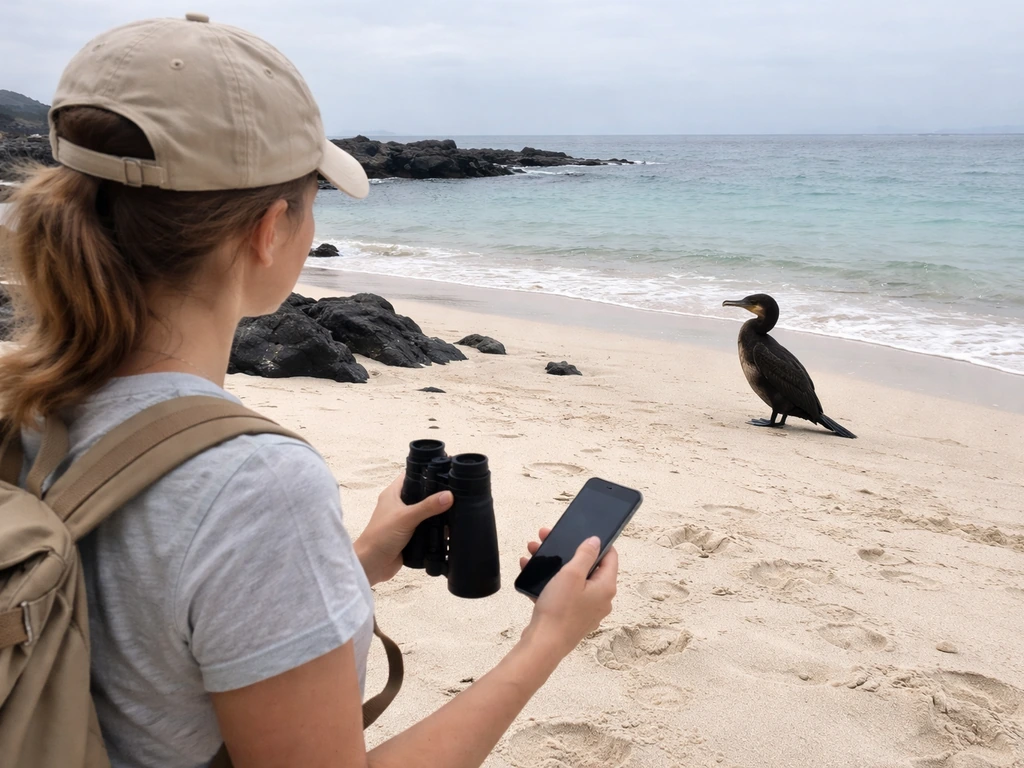
If you're in the Galápagos and you encounter a Flightless Cormorant or Galápagos Penguin, the most important rule is distance. Galápagos National Park regulations require visitors to stay at least 2 meters (about 6 feet) from wildlife at all times, and in practice, giving these birds more space is always better. Do not approach a nesting bird, do not block its path to the water, and do not attempt to touch or handle any individual. These birds have evolved without fear of humans, which makes them appear approachable, but that tameness doesn't mean interaction is harmless.
If you observe a bird that appears injured, stranded, or behaving abnormally (unable to stand, disoriented, visibly wounded, or tangled in fishing line), document it carefully without getting closer than necessary. Here's what to record:
- Exact GPS location or the name of the specific beach, cove, or island site.
- Date and time of observation.
- Photos or video showing the bird's condition, posture, and any visible injuries or entanglement.
- Number of individuals present and whether any appeared to be nesting or had chicks nearby.
- Any unusual human activity nearby (fishing gear, vessels, waste).
To report a concern, contact the Galápagos National Park Directorate (Dirección del Parque Nacional Galápagos, DPNG), which is the primary authority for wildlife management in the archipelago. The Charles Darwin Research Station on Santa Cruz Island also has staff who work on seabird and penguin monitoring and can receive reports from visitors and researchers. If you are participating in a guided tour, your naturalist guide is required by park rules to report wildlife incidents and can facilitate the process.
For birders who want to contribute ongoing data, logging your sighting on eBird with accurate location, date, and photos is genuinely useful. Monitoring programs use aggregated sighting data to track population trends, and a well-documented Flightless Cormorant or Galápagos Penguin record from a precise location adds to the long-term dataset that conservationists rely on.
The Galápagos Flightless Cormorant is one of the most remarkable birds alive on Earth right now. It's a living demonstration of how island isolation reshapes evolution at the genetic level, a bioindicator for an entire ocean ecosystem, and a species whose total global population fits comfortably in a small stadium. Treating every encounter with care, whether you're a tourist, a researcher, or a local resident, matters in a very direct way for a bird with no margin for additional pressure. If you want to see how these birds inspire real projects, you can also check the Flappy Bird Python code on GitHub for examples you can build on.
FAQ
Is there any other Galápagos bird that truly “can’t fly,” not just weakly flies?
Yes, the Galápagos Rail is often grouped into the conversation, but it is not fully flightless. It can flutter short distances, so if your ID hinges on “no flying at all,” the Flightless Cormorant is the only match. If the bird is clearly moving under its own power in the air, it is almost certainly not the species people mean by “can’t fly.”
How can I tell a Flightless Cormorant from a Galápagos Penguin in the field when I only see it briefly?
Look at wing posture and habitat use. Flightless Cormorants typically hold tiny, vestigial wings out on low rocks after diving, and they stay tied to rocky shoreline where they can reach water instantly. Galápagos Penguins are much smaller and look “tuxedoed,” they pop in and out near shore, and their movement on land is a waddling shuffle while their movement in water is fast and smooth.
If I’m on Santa Cruz or San Cristóbal, is it possible I just found a Flightless Cormorant?
It’s extremely unlikely. The Flightless Cormorant’s wild range is restricted to Fernandina and the western coast of Isabela, so sightings elsewhere are typically misidentifications. For quick checks, compare your bird to the local shoreline species on that island, then verify the island and coast you were on before assuming rarity.
What should I do if I see a Flightless Cormorant or penguin near fishing gear?
Treat it as an urgent entanglement risk. Keep your distance, do not try to free the bird yourself, and note the gear type and exact location (including which beach or coastline). Then report to the Galápagos National Park Directorate or the Charles Darwin Research Station so trained staff can respond safely.
Can I take close-up photos of these birds with a zoom lens or drone?
A zoom lens is generally fine if you stay within park rules, but drones are not appropriate because they can disrupt nesting and hunting behavior and may violate regulations. If you are getting repeated changes in the bird’s behavior (turning away, rushing toward water, leaving a nesting spot), back off immediately and recompose from farther away.
Are these birds safe to feed or “help” when they look tame?
No. Even though they can appear approachable, feeding or other interactions can harm them by altering their natural foraging, increasing disease transmission, and causing stress near nests. The safest “help” is reporting concerns and maintaining distance so they can continue normal diving or hunting.
What counts as “abnormal behavior” that I should report?
Report any bird that looks stranded or unable to function normally, such as failure to stand, obvious injury, visible bleeding, disorientation (circling or not orienting), or signs of entanglement like fishing line around the body or legs. Also note if the bird is repeatedly failing to enter the water to feed, since that can indicate injury or disruption.
What time of day gives me the best chance to see a Flightless Cormorant or a penguin actively foraging?
For penguins, early morning and late afternoon are often best because their nearshore fish hunting and land shade-seeking fit the daily heat and prey patterns. For Flightless Cormorants, sightings often increase around times when they are likely to have completed dives and haul out to dry, so watch rocky shoreline where birds surface and then hold wing-spread poses.
How do El Niño events affect what I might see during a trip?
During warm El Niño periods, food availability can drop, which can mean fewer active hunting events and potentially fewer breeding outcomes. Practically, you may see more adults but fewer chicks or less consistent behavior around nesting rocks. If your trip coincides with warmer conditions, build in extra time for shoreline observation across different days.
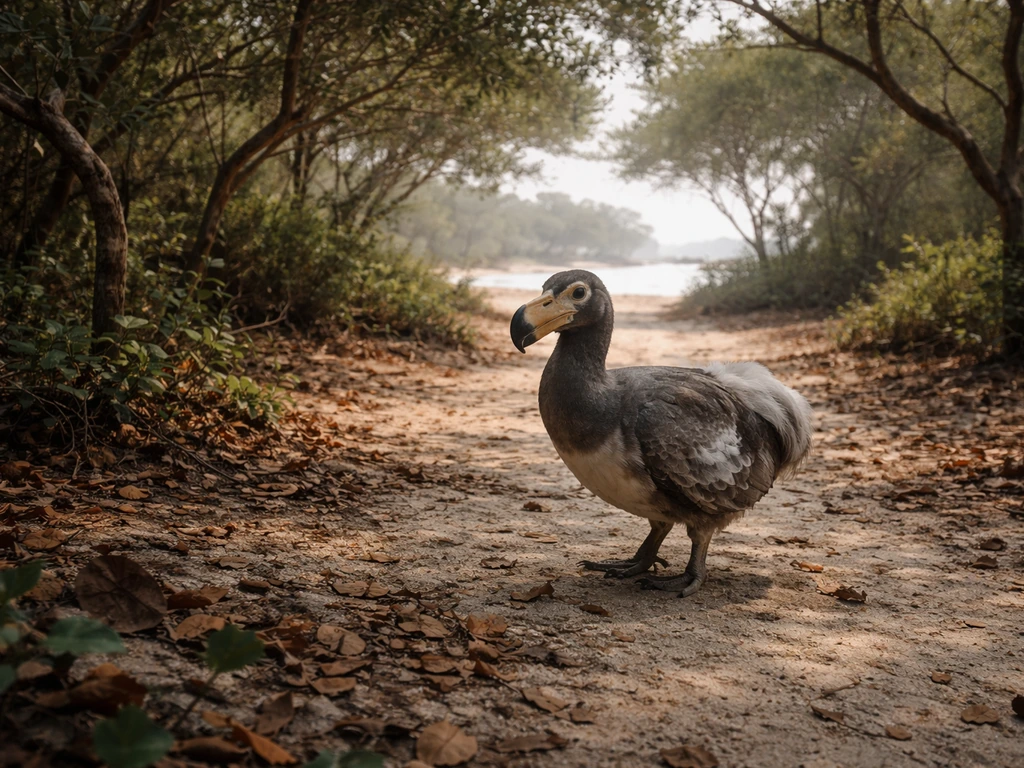
Is the Dodo Bird Still Alive? What Evidence Shows Today
Learn if any dodos could exist today, why scientists say they are extinct, and how to judge sightings reliably.