
Cacao farms can either support or seriously depress bird abundance depending almost entirely on one factor: how much shade and structural complexity the farm retains. Shade-grown cacao agroforestry with diverse canopy trees can harbor a surprisingly rich bird community, including some forest-dependent and even threatened species. Intensified, sun-grown monoculture plantations, on the other hand, strip out the habitat features birds need most and tend to support only the most adaptable generalists. The difference between these two systems is not subtle, it can mean the difference between dozens of bird species using a farm versus a handful.
Effect of Cacao Farms on Bird Abundance: What to Expect

Maya Hennessy
3 May 2026
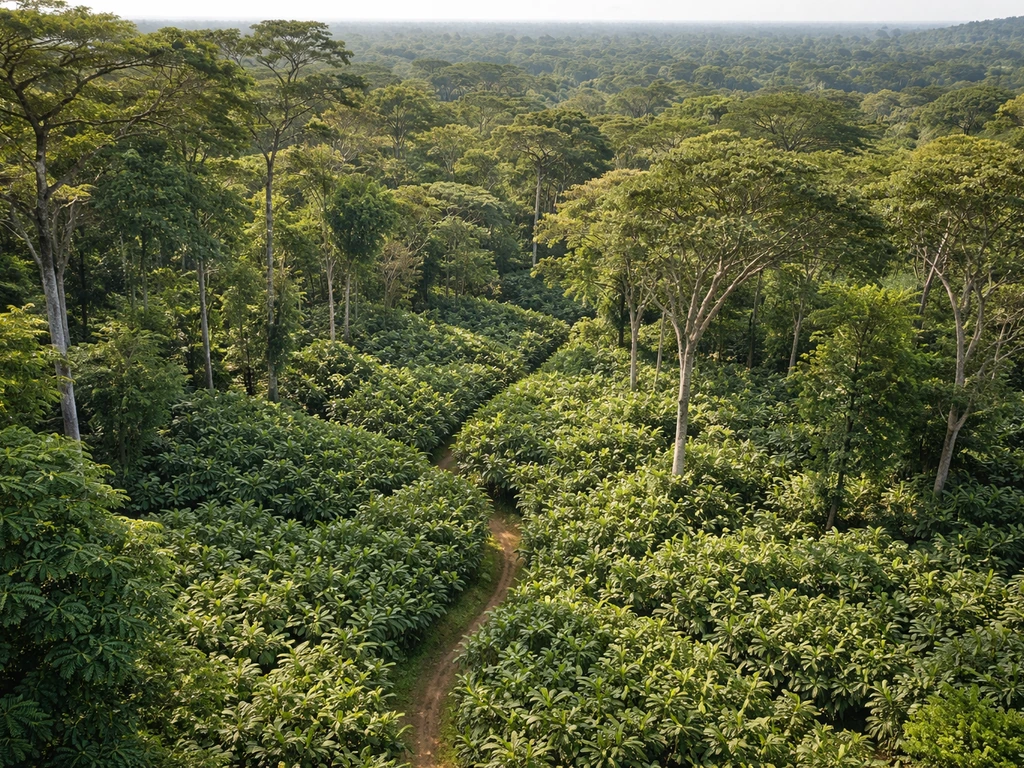
What 'bird abundance' actually means in cacao landscapes
Before diving into what cacao does to birds, it helps to be precise about what researchers mean by 'abundance,' because the word gets used loosely. In most cacao agroforestry studies, abundance is measured as detection rate, the number of individual birds recorded per unit of sampling effort, such as birds counted per point count station per visit. This is a relative abundance estimate, not a true density figure. It lets you compare across farms or time periods, but it does not tell you how many birds actually live per hectare in an absolute sense.
More rigorous studies use distance sampling or detection-correction methods to estimate actual density, which is important because different bird species and different habitat types affect how detectable a bird is, a dense canopy can make shy forest birds harder to detect, which can artificially make a habitat look poorer than it is. When you read that a cacao farm has 'higher abundance' than a nearby forest, it is worth asking whether that accounts for detectability differences or just raw counts. Most published studies are transparent about this distinction, and you should be too if you're designing your own monitoring.
Alongside abundance, researchers typically report species richness (how many species are present) and community composition (which species are there and in what proportions). These three metrics rarely tell the same story. A sun-grown cacao farm might have relatively high abundance if it is packed with a few generalist species, but low richness and a composition dominated by human-tolerant birds rather than conservation-priority ones. Shannon's diversity index is sometimes added to account for both richness and evenness. Knowing which metric you care about changes how you interpret results dramatically.
How cacao farms reshape habitat, shade, structure, and connectivity
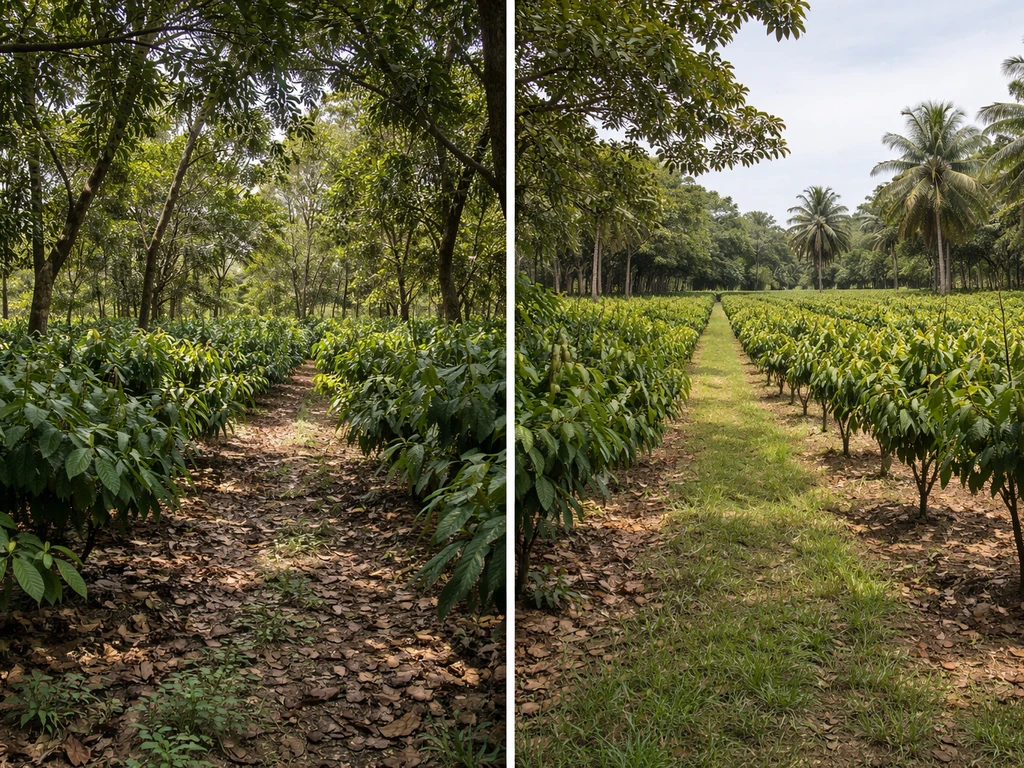
The single biggest lever cacao farming pulls on bird habitat is canopy cover. Traditional and agroforestry-style cacao is grown under a multi-layered canopy of shade trees, which creates something that functionally resembles a degraded but usable forest. Sun-grown cacao removes that overstory almost entirely, leaving a low, uniform crop layer with little vertical structure. From a bird's perspective, those two systems are almost completely different habitats.
Research in Ghana cocoa systems points to a practical benchmark: roughly 30 to 40 percent permanent canopy cover, achieved through intentional retention and planting of emergent shade trees, is a target that keeps enough structural complexity to benefit forest-associated birds. Below that threshold, the habitat value drops sharply for many species. Above it, especially with diverse native shade-tree species rather than a single timber species like Terminalia, the habitat becomes meaningfully richer.
Connectivity matters just as much as what happens inside the farm boundary. A well-shaded cacao farm embedded in a landscape with substantial surrounding forest cover will support far more forest-dependent bird species than an identically managed farm surrounded by pasture or degraded land. Multiple studies from West Africa make this explicit: local habitat structure and landscape forest cover interact, meaning that great on-farm management in an already deforested landscape delivers only partial benefits. Birds need the farm to connect to, or at least sit near, larger forest patches to function as meaningful habitat rather than a trap.
How food, nesting, and breeding shift across bird types
Insectivorous birds are the group most sensitive to canopy management in cacao systems. Studies consistently show that increased canopy closure is directly associated with greater abundance of insectivores, almost certainly because a complex, shaded canopy supports more diverse and abundant arthropod communities. The logic is straightforward: more leaf litter, more tree bark, more epiphytes, more structural niches mean more invertebrate prey. When you remove the canopy, you simplify the insect community and the insect-eating birds follow.
Frugivores and nectarivores often fare better in cacao agroforestry than insectivores because flowering and fruiting shade trees can provide food resources even in moderately managed systems. Granivores and open-country birds tend to benefit from intensification, they do well in disturbed, low-canopy environments and may actually increase in abundance as cacao is intensified, which can skew raw abundance numbers upward while the conservation value of the bird community decreases.
Breeding and nesting outcomes are more complex. Nest predation studies in cacao agroforests show that predation rates are influenced by the interaction between local structure and landscape context. One notable finding: nest predation increased with high cocoa-tree density, but only in landscapes with low surrounding forest cover. This suggests that in fragmented landscapes, denser cacao can paradoxically increase predation pressure on nesting birds, possibly by channeling predators into the remaining tree structure. In such cases, the mother bird has not returned to nest, often indicating nest failure tied to habitat disturbance or predation risk. Migratory birds using cacao farms as stopover or wintering habitat face similar tradeoffs, they need food resources and cover, but the habitat quality of a cacao farm during migration depends heavily on what structural features are present when they arrive.
Pesticides, tillage, and disturbance, the less-visible threats
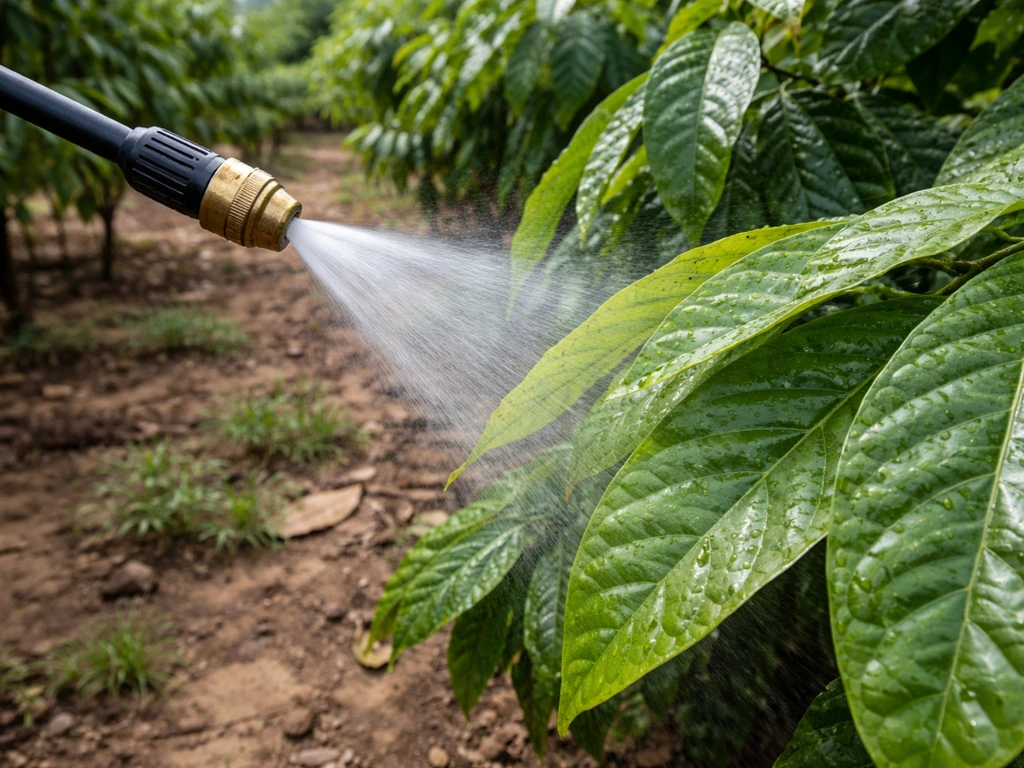
Chemical inputs in intensified cacao farming affect birds primarily through their prey base. Broad-spectrum pesticide use simplifies arthropod communities, which cascades up to reduce food availability for insectivorous birds. This is an indirect effect, but it is well-documented across agroforestry systems. Research using food-web modeling in African cocoa agroforests shows that shade management and pesticide use interact: higher shade can partially buffer the arthropod community against pesticide pressure, but heavy chemical use in low-shade systems creates a double hit, less structural habitat and less prey.
Exclusion experiments in Brazilian cacao agroforestry confirm the trophic link directly: when birds and bats are excluded from cacao plots, arthropod abundance increases and leaf damage from herbivorous insects goes up. That means the birds are actively suppressing pest insects, and anything that reduces bird presence, including pesticide-driven prey loss, weakens that biological control service. It is a feedback loop: fewer birds leads to more pest pressure, which often leads to more pesticide use, which leads to fewer birds.
Noise, traffic, and human disturbance from intensive farm operations also reduce bird use of farms. Forest-dependent species, which are often the most conservation-relevant, tend to be the most disturbance-sensitive. Frequent machinery use, harvesting activity near nesting areas, and the general level of human presence on intensive farms can push these species to the margins even when the physical habitat structure looks adequate.
What the research actually shows, the big patterns
Across the published literature, the pattern is consistent enough to state with confidence: shade-grown cacao agroforestry retains substantially more bird species richness and higher abundance of forest-associated birds than sun-grown monoculture. Meta-analyses comparing cocoa land uses to baseline habitats find that mixed-shade agroforestry supports bird communities that are compositionally distinct from those in high-intensity systems and closer to those in forest patches. That is a real conservation benefit, not just a talking point.
The tradeoff that shows up repeatedly is between generalists and specialists. Forest specialists, the birds most likely to include threatened or range-restricted species, decline with intensification. For context on threatened species outcomes, see also whether is sparrow bird extinct and what that signals about bird population declines. Generalists can actually increase. When forest cover in the surrounding landscape is low, even low-intensity cacao can act as compensatory habitat for forest birds that have nowhere else to go. Point-count work in West African cocoa agroforests links forest bird species richness to an interaction between canopy volume and the proportion of surrounding forest, with low-forest landscapes allowing low-intensity cocoa to act as compensatory habitat while high-forest landscapes reduce the added value of more forest-like cocoa blank" rel="noopener noreferrer">low-intensity cacao can act as compensatory habitat in landscapes with low forest cover. But when forest cover is high, adding more forest-like cacao does not necessarily increase total species richness because the forest itself is already doing that job. The implication is that the conservation value of shade-grown cacao is highest in already-fragmented, deforested landscapes, which, unfortunately, describes many of the world's major cacao-producing regions.
A 2025 study from Amazonian cacao agroforestry adds nuance to the landscape interaction: local canopy cover and landscape tree cover together drive shifts in trophic composition, with declines in omnivores and open-area insectivores as systems become more forested in character. This confirms that the effects are not linear and that different bird functional groups respond to the local-landscape interaction in different ways. There is no single number that captures it all, which is exactly why monitoring design matters.
How to measure bird abundance on a cacao farm
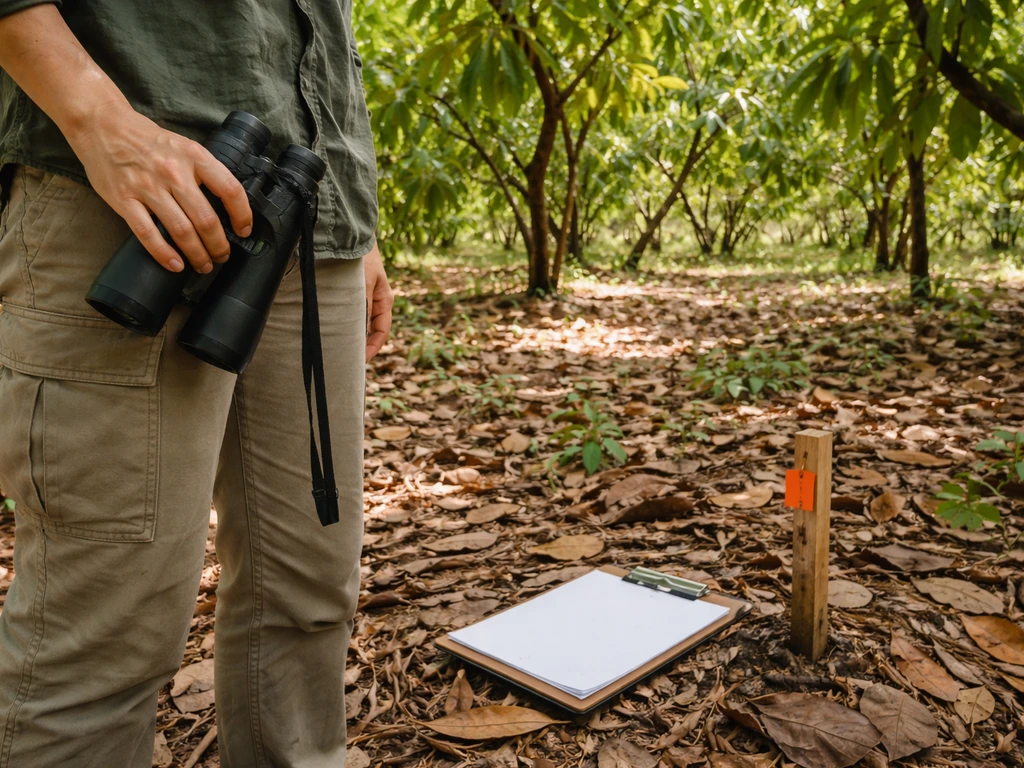
If you want to assess what is actually happening to birds on a specific cacao farm or landscape, point counts are the standard starting method. An early study protocol for bird community comparisons in forest versus cacao plantations used point-count style sampling at fixed sample points and included habitat variables such as canopy height and ground cover collected at those points point-counts are the standard starting method. Set up fixed-radius point count stations across the farm, spaced at least 150 to 200 meters apart to minimize double-counting the same individuals. At each station, record all birds detected by sight or sound during a fixed time window, typically 5 to 10 minutes. Do this at dawn during the breeding season when detectability is highest, and repeat across multiple visits to account for day-to-day variation.
For more rigorous density estimates, use distance sampling: record the distance to each detected bird and use the resulting detection function to model how detectability drops with distance. This lets you convert encounter rates into estimated densities, which are more meaningful for comparing across habitats. It requires more effort and statistical expertise, but even basic distance sampling is achievable with free software like Distance (from the University of St Andrews) and a team willing to do pilot runs.
Citizen-science platforms like eBird can supplement structured surveys for relative abundance and occurrence patterns, particularly if you want to place your farm-level findings in a broader regional context. eBird's modeled relative abundance products control for search effort and detection variables, making them genuinely useful for landscape-scale comparisons. Just keep in mind that eBird data cannot give you absolute density estimates, the platform itself is explicit about this limitation.
Whatever method you use, report more than one metric. Record species richness, relative abundance by functional group (insectivores, frugivores, generalists), and note any species of conservation concern detected. Tracking composition over time is often more informative than tracking total abundance, because total abundance can stay stable while the community shifts from specialist to generalist species, a change that looks neutral in one number but represents real conservation loss.
| Method | What it measures | Effort level | Best for |
|---|---|---|---|
| Fixed-radius point counts | Relative abundance, species richness | Low to moderate | Baseline surveys, repeated monitoring |
| Distance sampling point counts | Estimated density with detectability correction | Moderate to high | Comparing across habitats or management types |
| Transect walks | Relative abundance along routes | Low | Large-area coverage, pilot surveys |
| eBird checklists | Occurrence and modeled relative abundance | Low | Regional context, long-term trends |
| Mist-netting | Recapture data, demographic info | High | Species-specific population studies |
Management actions that actually move the needle for birds
The most impactful single action is retaining and planting diverse native shade trees, targeting at least 30 to 40 percent canopy cover with multiple species and vertical layers. A single-species shade regime (like planting only one timber tree uniformly) delivers far less habitat value than a structurally diverse canopy even at the same overall cover percentage. Native species are preferable to exotic timber species because they support more native arthropod communities and provide more appropriate nesting resources for local bird species.
Riparian buffers along streams and drainage channels are disproportionately valuable. These strips of native vegetation act as movement corridors for birds traveling between forest patches and provide nesting and foraging habitat in a narrow but highly used zone. Even a 20 to 30 meter buffer of mixed native vegetation along waterways can dramatically increase the farm's connectivity value in a fragmented landscape.
Reducing pesticide and herbicide inputs, especially broad-spectrum insecticides, protects the arthropod prey base that insectivorous birds depend on. Integrated pest management approaches that rely partly on biological control (including birds themselves) are consistent with both conservation and productivity goals. The food-web research from African cacao systems suggests that combining shade retention with reduced pesticide use delivers win-win outcomes for bird communities and pest suppression, more so than either intervention alone.
Formal certification programs like the Smithsonian's Bird-Friendly certification set concrete targets for farms to meet: minimum canopy cover percentages, a required number of different tree species per hectare, and a majority of native species in the shade layer. A certified cacao program in Panama's Cerro La Vieja region links these farm-level standards explicitly to protection of forest corridors and nearby forest patches. This kind of integration between farm management and landscape conservation planning is exactly the model that bird conservation science supports.
- Retain and plant diverse native shade trees to reach at least 30 to 40 percent canopy cover
- Prioritize structural diversity in the canopy, not just total cover percentage
- Maintain riparian buffers of native vegetation along waterways (20 to 30 meters minimum)
- Reduce or eliminate broad-spectrum insecticides, especially during breeding season
- Connect farm shade trees to nearby forest patches wherever possible
- Consider Bird-Friendly or equivalent certification as a framework with clear, measurable targets
- Monitor bird communities annually to track whether management changes are working
What this means for threatened birds and conservation planning
In biodiversity hotspots, the Upper Guinea forests of West Africa, the Atlantic Forest of Brazil, the Chocó of Colombia and Ecuador, cacao farming happens in landscapes that also contain some of the world's most threatened bird species. The question is not just whether birds use cacao farms in the abstract, but whether the specific birds at risk of extinction can persist in cacao-dominated agricultural matrices. This includes flightless bird that is extinct species, which illustrates how quickly specialized birds can disappear when habitat and connectivity break down. One example of what this can mean in practice is when you ask what bird is almost extinct and whether its habitat can persist in human land use birds at risk of extinction. The answer, based on current research, is conditional: they can, but only in well-managed shade agroforestry systems that maintain meaningful connectivity to forest remnants.
The Gola Rainforest landscape in Sierra Leone and Liberia illustrates this clearly. The region is a recognized Important Bird Area in the Upper Guinea forest hotspot, and the surrounding agricultural matrix includes cocoa farms. Research from these West African cocoa agroforests confirms that forest-dependent bird communities, including species associated with threatened or near-threatened status, can use well-shaded cocoa farms as supplementary habitat, but that landscape forest cover remains the dominant driver of whether those communities persist in the long run. Shade-grown cacao buys time and connectivity; it does not replace intact forest. For updates on species that are especially vulnerable, like flightless birds, see flightless bird news.
This connects to a broader pattern relevant to anyone following the fate of tropical birds globally. The mechanisms driving bird loss in cacao landscapes, habitat simplification, reduced food availability through pesticide use, fragmentation, and nest predation pressure, are versions of the same drivers behind wider population declines and, at the extreme end, extinction. Historically, high concentrations of DDT were also linked to sharp declines in bird populations, largely due to reproductive failures that reduced successful breeding how did high concentrations of DDT affect bird populations. The causes of bird extinction are rarely a single factor, and cacao farming's effect on birds sits on that same continuum: managed well, it can slow habitat loss; managed poorly, it accelerates it.
For conservation groups working in cacao-producing regions, the practical implication is to treat well-managed shade cacao agroforestry as a genuine conservation tool, not a compromise, but to pair farm-level work with landscape-level forest protection. Investing in shade-tree retention and chemical reduction on farms surrounded by degraded land will deliver smaller returns than the same investment in a landscape where forest patches still exist to anchor bird communities. Prioritizing farms near remaining forest for the most intensive management upgrades, while pushing for landscape-level protections elsewhere, is how the conservation math adds up.
If you are working in one of these regions today, the most useful thing you can do alongside habitat improvement is start monitoring. Documenting which species are present, tracking changes in insectivore abundance, and noting whether any species of conservation concern are using the farm gives you the evidence base to make the case for management investment, and to catch negative trends before they become irreversible losses.
FAQ
How can I tell whether a cacao farm is helping birds or just looking good on paper?
Ask which abundance metric was used and whether detectability was addressed. If results come only from simple counts, a shaded farm might look “better” partly because dense canopy changes how easily birds are heard or seen. Pair counts with at least one approach that accounts for distance or detection, and track species composition over time, not only totals.
Does higher bird abundance on a cacao farm always mean better conservation value?
No. Intensified systems can boost numbers of adaptable generalists while forest-associated species decline. A practical check is to record functional groups, especially insectivores and frugivores, and note whether conservation-priority species are present or disappearing even when overall counts stay stable.
What canopy cover target should I use if my farm is not in Ghana?
Use 30 to 40 percent permanent canopy cover as a starting benchmark, but treat it as a range. The bigger driver is structural complexity, so aim for multiple native shade-tree species and multiple canopy layers, not just a single percentage. If you can, measure both canopy cover and vertical structure, then compare across plots on your farm.
Will birds move between forest patches and cacao farms if the surrounding land is heavily degraded?
They may use the farm as supplemental habitat, but persistence depends on landscape context. If forest cover around the farm is very low, even well-shaded cacao may not sustain forest specialists long-term. The decision aid is simple: prioritize stronger management upgrades on farms closer to remaining forest, and treat cacao as time-buying connectivity rather than a full replacement for intact habitat.
Do insectivorous birds respond faster than frugivores after changing farm management?
Often yes. Insectivores are tightly linked to arthropod availability, which changes quickly with shade structure and pesticide use. If you reduce broad-spectrum insecticides or add shade-tree complexity, watch insectivore trends in the first breeding season, then check whether frugivore and nectarivore patterns follow later as food resources stabilize.
How can pesticide changes affect birds if I never see fewer birds after spraying?
Bird responses can lag and be masked by overall abundance changes. Even if counts look similar, insect communities may be simplified, shifting the diet base and eventually reducing insectivore performance. To catch this early, combine bird monitoring with indicators like prey-sensitive functional group abundance and careful notes on timing, product type, and application intensity.
Is nest predation a “minor” issue compared with habitat loss in cacao systems?
It can be decisive for breeding success, especially in fragmented landscapes. Some studies find higher predation linked to dense cacao when surrounding forest cover is low, which suggests predators may be funneled into remaining tree structure. If you can, monitor breeding outcomes indirectly through breeding-site use and nest failure signals, not only adult bird abundance.
Do I need to worry about noise and traffic even on well-shaded cacao farms?
Yes, disturbance can push forest-dependent species away even when habitat structure is present. If machinery use is frequent near nesting areas or harvest is concentrated during breeding, conservation-priority birds may avoid otherwise suitable microhabitats. A mitigation step is to create quieter zones near high-value shade patches and plan operational timing away from peak breeding activity.
Can I use eBird data to estimate bird density on my farm?
Not reliably. eBird products are designed for relative abundance and occurrence patterns, and they do not provide absolute density estimates. If your goal is density comparison across habitats, you will need structured surveys with distance sampling or detection-correction methods, then optionally use eBird to broaden spatial context and detect regional trends.
What monitoring design mistakes most often lead to misleading conclusions?
Common pitfalls include using too few visits, mixing seasons, counting over unequal time windows, and placing point-count stations too close together (increasing double-counting). Also, avoid interpreting “higher abundance” without checking whether detectability differed between shaded and sun conditions. Standardize station spacing, time, and effort, and report richness plus functional-group composition.
How do I prioritize shade-tree plantings if my farm already has some shade?
Target diversity and layering first. Instead of adding only more canopy cover, add native species that build different strata and niches, and consider emergent trees that create a varied canopy. Also prioritize near riparian areas, because buffers along streams and drainage channels often provide disproportionate benefits as movement corridors and nesting habitat.
Are riparian buffers worth it if my farm is far from intact forest?
They can still help, but they do not fully solve the landscape limitation. In degraded surroundings, buffers may become one of the best “safe routes” for movement and a small area of higher-quality habitat, increasing local use by birds. Plan buffers of mixed native vegetation, ideally tens of meters wide, and monitor whether forest-associated species use them compared with non-buffer plots.
Next Articles
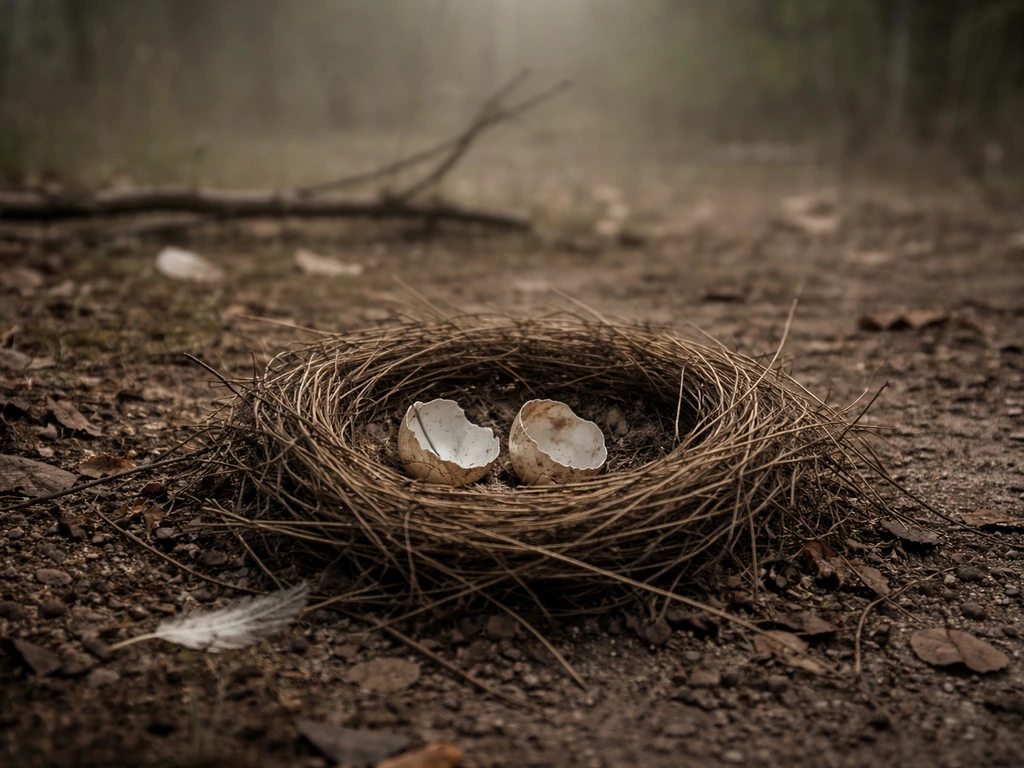
How High Concentrations of DDT Affected Bird Populations
DDT harms birds by thinning eggshells and reducing hatchlings, causing breeding failures, declines, and possible recover
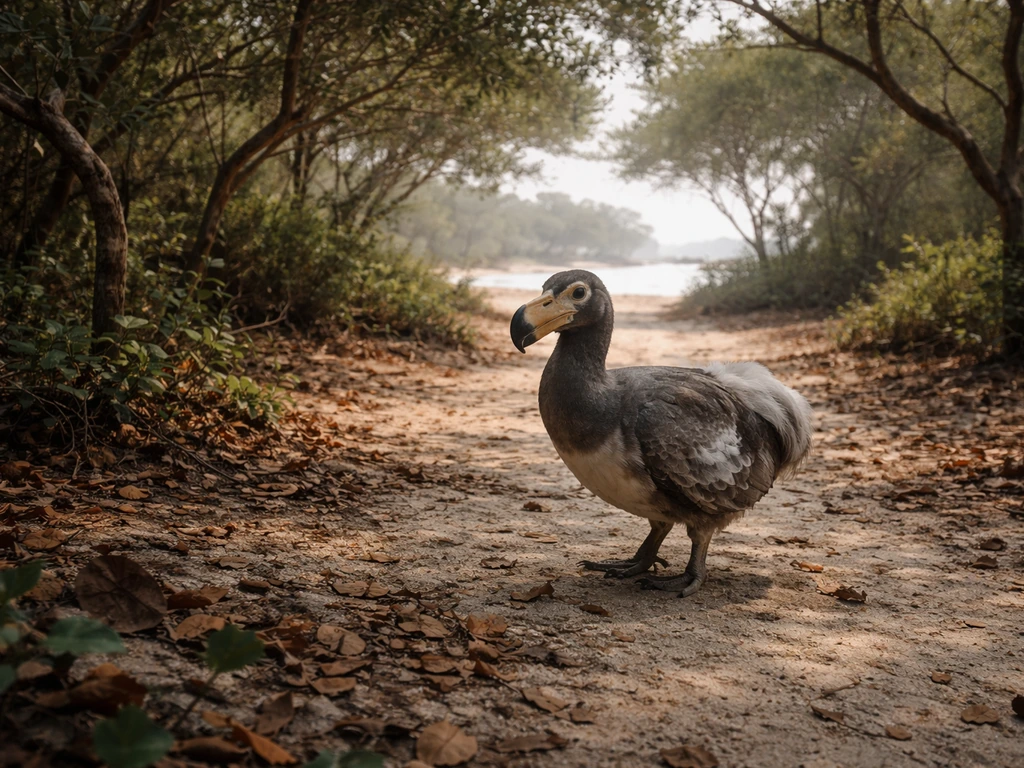
Is the Dodo Bird Still Alive? What Evidence Shows Today
Learn if any dodos could exist today, why scientists say they are extinct, and how to judge sightings reliably.
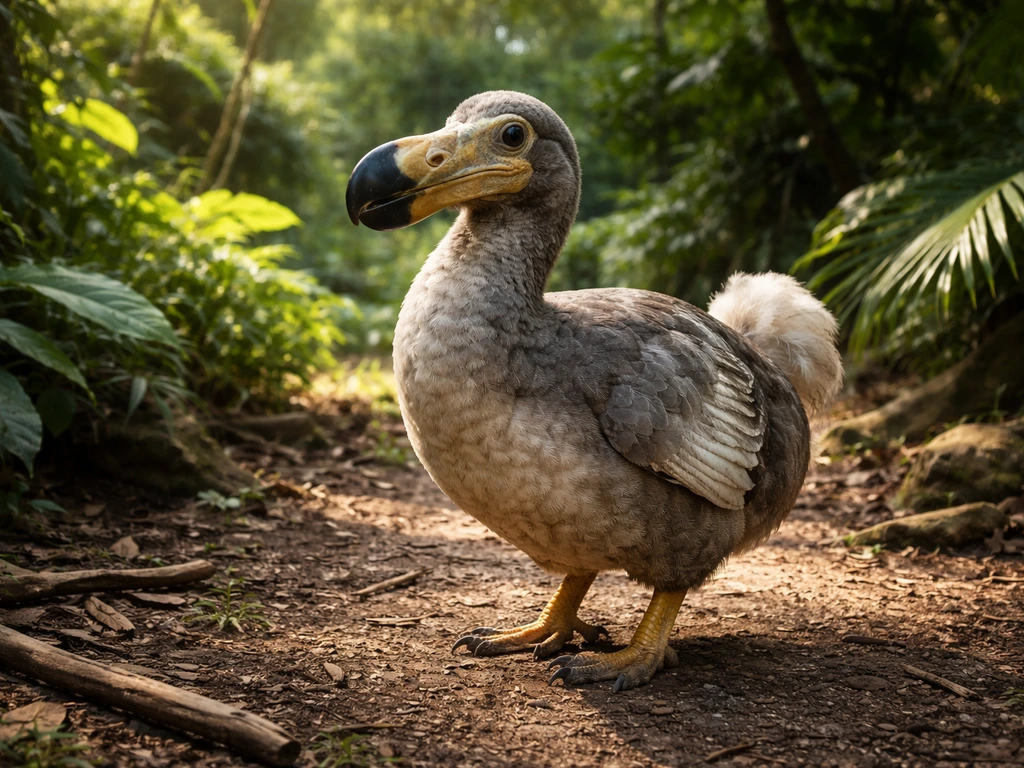
Does Dodo Bird Still Exist? Answer and Extinction Facts
No, dodo birds are extinct. Learn when, why, where they lived, and how evidence confirms it.