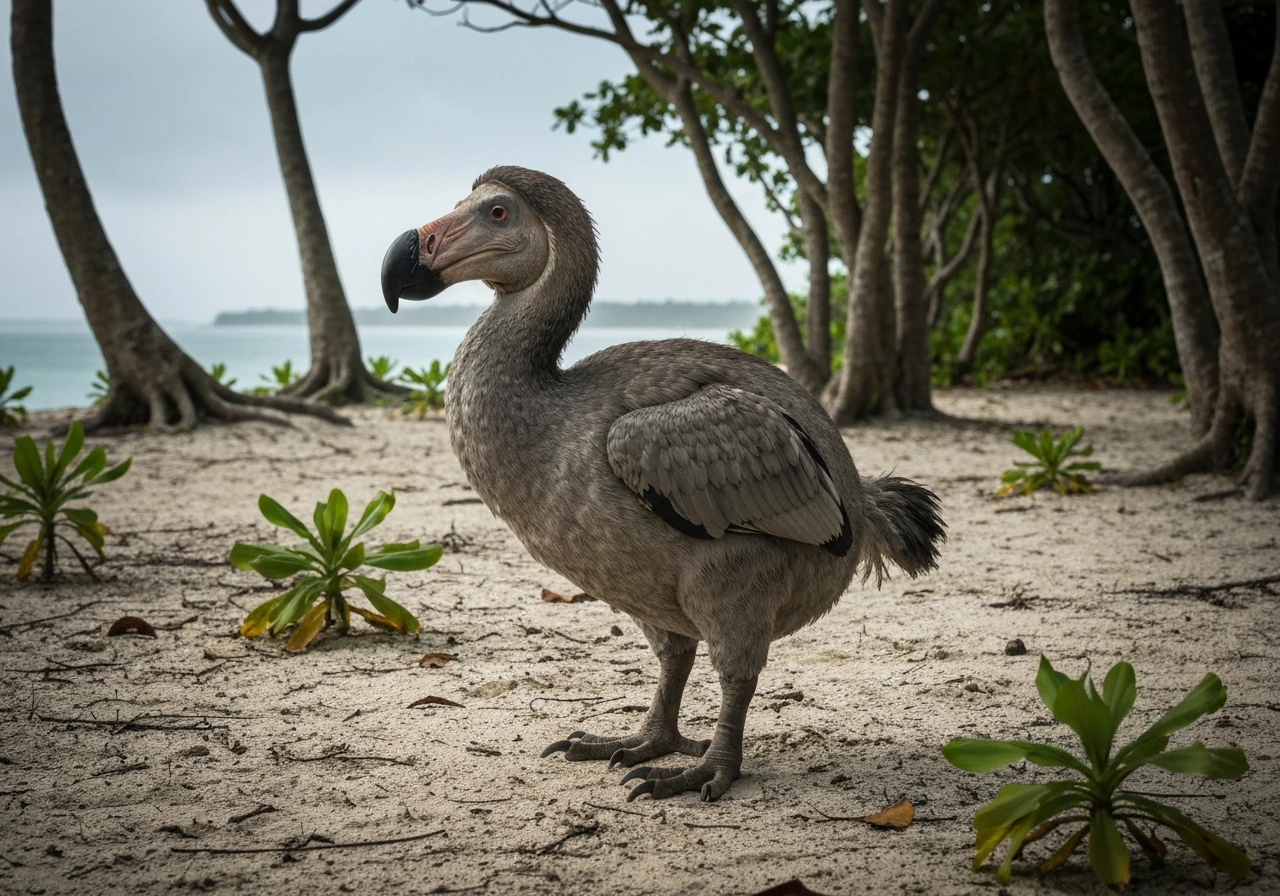
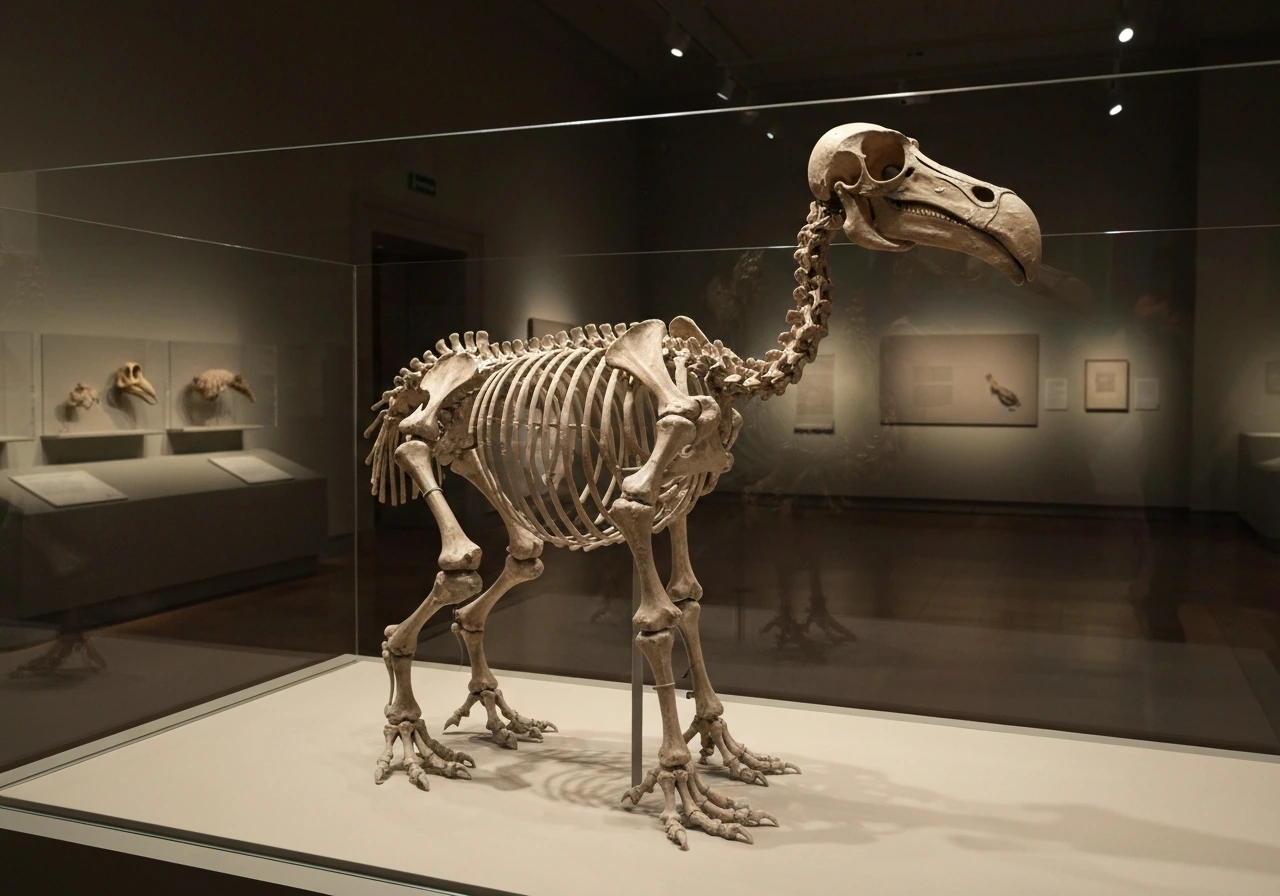
What makes this especially interesting is how thoroughly adapted to ground life the dodo became. This was not a bird that retained vestigial flying ability or used its wings for balance and short bursts of speed. It was a committed, full-time terrestrial bird that walked, foraged, and lived entirely on the ground of Mauritius. If you have ever wondered whether the dodo was real or whether it fits neatly into the flightless bird category alongside ostriches and kiwis, the short answer is yes on both counts. If you are now wondering whether a dodo bird is dangerous to humans, the short answer is also covered in a related guide on whether “is the dodo bird dangerous to humans”.
What the dodo's skeleton tells us about flight
The most revealing piece of evidence comes from the dodo's sternum. In birds that fly, the sternum has a deep, blade-like ridge running along its midline called the keel (or carina). This keel is the anchor point for the pectoralis and supracoracoideus muscles, the powerhouses of a bird's wingbeat. The bigger and more prominent the keel, the more muscle can attach, and the more powerful the flight. The dodo's sternum had no functional keel. Modern 3D-scan analysis of the Thirioux specimen, the only known complete dodo skeleton and housed in Port Louis, Mauritius, confirms this directly. Without a keel, the dodo simply had no structural foundation for the muscles that powered flight.
Beyond the sternum, the wings themselves tell the same story. The dodo's wing bones were blank" rel="noopener noreferrer">small and reduced relative to its body size, giving it what researchers describe as little winglets rather than proper wings. Descriptions from both historical accounts by early sailors and modern skeletal studies consistently portray these as tiny, almost pen-like appendages. The Animal Diversity Web, which documents comparative vertebrate anatomy, notes this wing reduction explicitly alongside the sternum findings. Interestingly, this pattern is sometimes compared to penguins, which also have dramatically modified wing skeletons, though penguins repurposed theirs into flippers, while the dodo's wings appear to have lost functional purpose almost entirely.
One nuance worth keeping in mind: having reduced wings does not mean having no wings. The dodo retained small wing structures, and some researchers think they may have served minor roles such as balance or social display. But powered, sustained flight? Absolutely ruled out by the anatomy.

This is one of the more fascinating methodological questions in paleontology: how do you determine whether a bird that has been extinct for roughly 350 years could fly? The answer is comparative osteology, which is essentially a careful, systematic comparison of bone shapes and proportions between the extinct species and modern birds with known locomotor abilities.
Researchers look at two main categories of skeletal evidence. First, they examine wing proportions relative to body size, checking whether the humerus, ulna, and other wing bones fall in the range typical of flighted birds or instead match the reduced proportions seen in flightless taxa. Second, and most decisively, they analyze sternum and keel morphology. Research published in BMC Biology confirms that flight capability strongly correlates with a prominent sternal keel and a large associated muscle-attachment area. When you plot known flightless species against flighted ones on these metrics, they cluster into distinct groups. The dodo falls firmly in the flightless cluster.
A similar approach has been applied to fossil ducks and other extinct Anatidae, where skeletal proportions alone can quantitatively discriminate flightless lineages from flighted ones, as documented in work published in The Auk. One quantitative example of this osteological approach comes from The Auk, which analyzes skeletal proportions in fossil Anatidae to discriminate flightlessness skeletal proportions alone can quantitatively discriminate flightless lineages from flighted ones. The point is that flightlessness leaves a clear, measurable skeletal signature, and the dodo's skeleton broadcasts that signature loudly. Historical written accounts from Dutch sailors who encountered dodos in the late 1600s also describe the birds' small, nonfunctional wings, and these accounts align neatly with what the bones show.
Why the dodo stopped flying in the first place
Flight is expensive. It demands a huge investment in muscle mass, bone architecture, cardiovascular capacity, and caloric intake. For a bird living on an island like Mauritius, where there were no native mammalian predators to flee from, that investment stopped paying off evolutionarily. If you are wondering whether a dodo bird is a mammal, the answer is no, because it is a bird in the dodo lineage is a dodo bird a mammal.
When predators are absent and food is available on the ground, any random individual that happened to invest less energy in flight apparatus and more in body mass and terrestrial foraging had a survival advantage. Over generations, selection pressure shifted away from flight and toward ground-adapted traits.
This is the standard ecological explanation for island flightlessness, and it applies to the dodo with particular clarity. A review of the dodo's ecosystem published in Taylor and Francis highlights that Mauritius represented exactly this kind of predator-poor island environment, where the cost-benefit calculation for flight simply did not favor maintaining it. The result, over evolutionary time, was a bird that grew heavier, developed sturdy legs for walking, and gradually lost the skeletal architecture needed for powered flight.
It is worth noting that this same pattern of island-driven flightlessness has played out on islands around the world, repeatedly and independently. Mauritius was not a unique case. It was simply one of the most dramatic examples, partly because the end result (the dodo) became so iconic after its extinction.
The dodo alongside other flightless birds
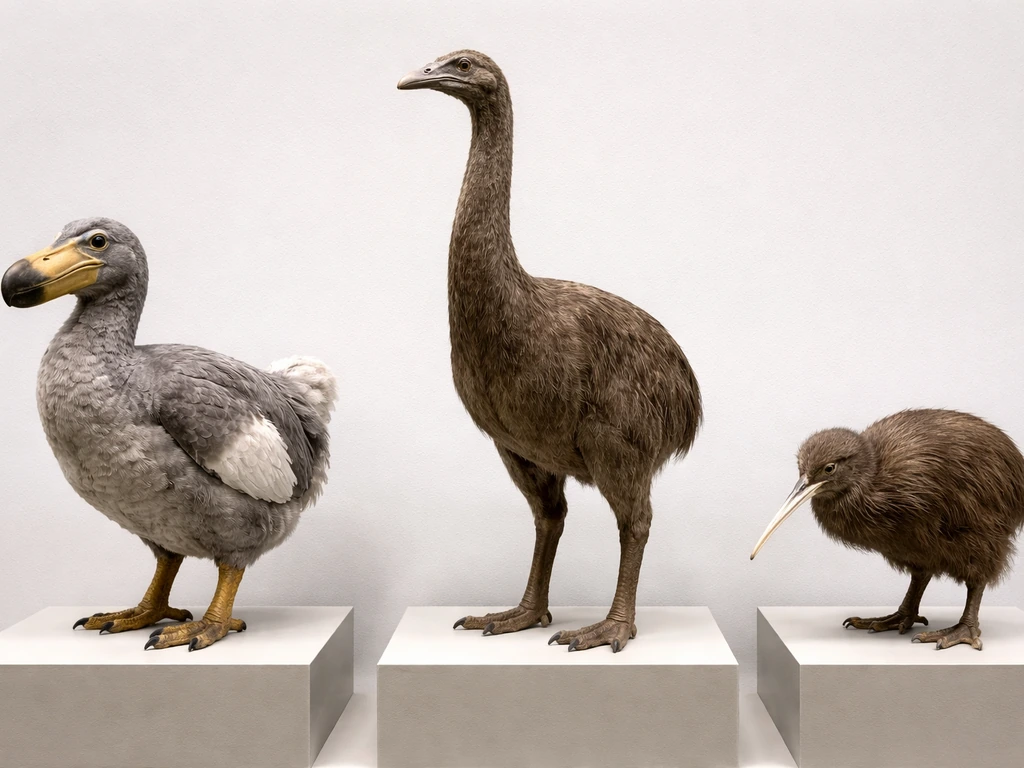
Comparing the dodo to other flightless birds helps put its anatomy and evolution into sharper context. The moa of New Zealand and the kiwi are two useful reference points, both because they are well-studied and because they illustrate that flightlessness is not a single, uniform condition, it can evolve along different skeletal pathways.
| Feature | Dodo | Moa | Kiwi |
|---|
| Sternal keel | Absent or non-functional | Absent (ratite) | Absent (ratite) |
| Wing structure | Reduced winglets present | Wings essentially absent | Tiny vestigial wings |
| Body size | ~10–18 kg (heavily built) | Up to 230 kg (largest species) | 1.3–3.3 kg (small) |
| Habitat | Ground-foraging, Mauritius | Ground-foraging, New Zealand | Ground-foraging, New Zealand |
| Extinction status | Extinct (~1680s) | Extinct (~1400–1600s) | Endangered (extant) |
| Flight-loss driver | No island predators, abundant ground food | No predators, island isolation | No predators, island isolation |
The moa, like the dodo, is extinct and was a large, fully terrestrial bird. It belongs to the ratite lineage, a group that includes ostriches, emus, and rheas, all of which share a flat sternum without an effective ventral keel. The dodo is not a ratite, it evolved from pigeon-like ancestors, but it arrived at similar anatomical conclusions through a parallel evolutionary route. The kiwi is particularly interesting because it retains tiny vestigial wings, much as the dodo did, and shares the island predator-free origin story. Kiwis are still alive today, making them a useful living reference for understanding how a bird can be thoroughly ground-adapted without being anatomically helpless.
One more comparison worth making is the dodo versus its closest relative, the Rodrigues solitaire, which lived on the nearby island of Rodrigues. Studies of the solitaire's sternum suggest its keel was more developed than the dodo's, raising interesting questions about wing use in that species, possibly including wing-based combat or display behaviors. This shows that even among closely related island birds, flightlessness is not a single fixed endpoint but a spectrum, and the skeletal details matter when making these distinctions.
Myths about the dodo worth clearing up
The dodo has accumulated a remarkable number of myths, some of which directly affect how people think about whether it could fly or how capable it was as an animal. Here are the most common ones, and what the evidence actually says.
Myth: the dodo was helpless and barely moved
This is probably the most persistent misconception. The image of the dodo as a sluggish, bumbling creature comes partly from caricatures and partly from misreading historical accounts. Modern paleontological work, including analysis by researchers like Delphine Angst, corrects this directly. The dodo was a well-adapted ground bird with robust legs built for walking and running.
It foraged actively, navigated its environment effectively, and was physically capable in its ecological niche. Was the dodo bird smart? Like many animals adapted to predator-free life, it was more about ground survival than intelligence in the way we usually mean it. It was not helpless, it was simply evolved for a predator-free environment, and that made it catastrophically vulnerable once humans and their companion animals arrived.
Myth: the dodo had no wings at all
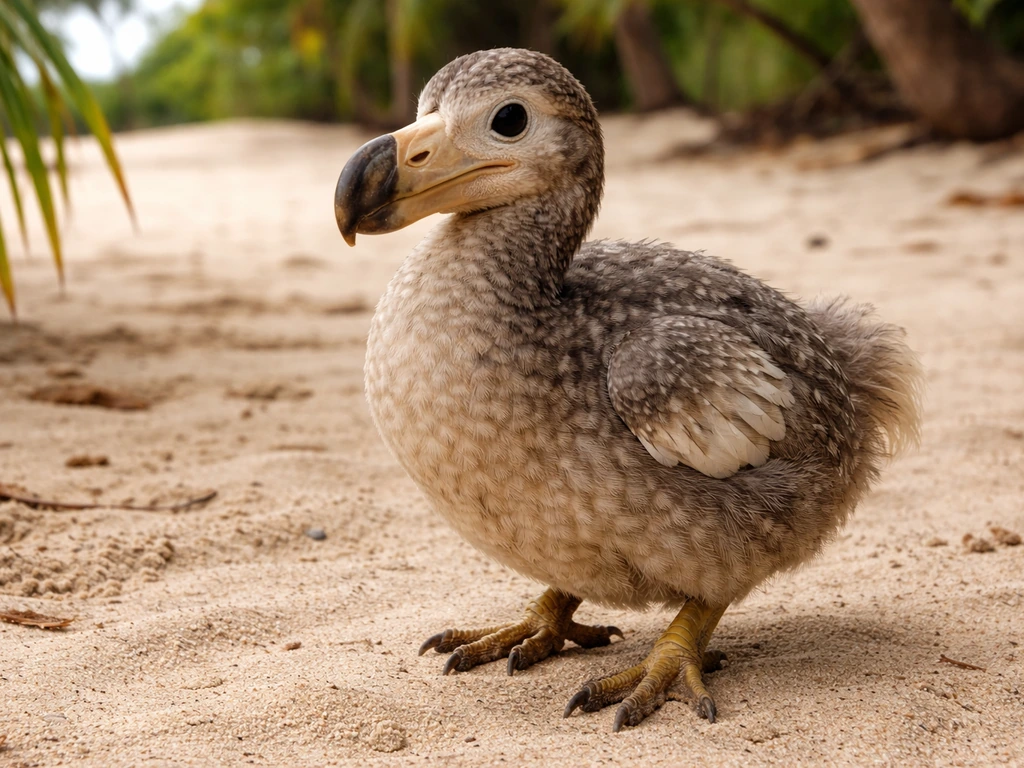
The dodo had wings. They were small, reduced, and incapable of powered flight, but the bones were there. Early sailors' descriptions of the wings as pen-like or stubby are actually reasonably accurate, and they align with what skeletal analysis confirms. Saying the dodo had no wings is like saying a kiwi has no wings, technically wrong, and it obscures what is actually a more interesting evolutionary story about gradual reduction rather than total absence.
Myth: the dodo was just too fat to fly
This one oversimplifies the causation. Yes, the dodo was heavily built, with weight estimates ranging from roughly 10 to 18 kilograms. But the weight was a consequence of the same evolutionary pressures that reduced flight ability, not a separate cause of it. The skeletal architecture, specifically the absent sternal keel and reduced wing bones, is the structural reason for flightlessness. The body mass followed from the same ecological conditions. A heavier body without flight apparatus is what you get when an island bird loses selection pressure for flight over thousands of generations.
Myth: we don't really know what the dodo was like
Researchers actually know quite a lot about the dodo. The Thirioux specimen provides a complete skeletal reference. Historical accounts from Dutch sailors and traders, compiled in 19th-century scholarly works, describe the bird's appearance and behavior in detail. 3D scanning technology has allowed modern scientists to analyze the anatomy with precision that was impossible even a few decades ago.
The picture of the dodo that emerges from all this evidence is detailed, consistent, and scientifically grounded. Questions about the dodo, including whether it was dangerous, how it defended itself, or whether it was related to dinosaurs, are also well-addressed by modern research, and those threads connect naturally to what we know about its anatomy and behavior. In other words, questions like “can a dodo bird kill you” are less about flight and more about how its anatomy and behavior would have affected people up close.
Because the dodo was flightless and ground-adapted, researchers also examine how it defended itself when threatened how did the dodo bird defend itself. If you are wondering whether the dodo bird is dangerous, the best evidence suggests it was not a predator, but rather a ground-adapted bird vulnerable to human contact is the dodo bird dangerous.
Because the dodo could not fly and was adapted to life on the ground, it was not typically an aggressive predator, so the chances of it seriously harming you are low can a dodo bird kill you. Many people also ask whether a dodo bird is a dinosaur, but it is not; it is a bird in the dodo lineage.
What to look for if you want to go deeper
If the dodo's flightlessness has you curious about how scientists evaluate extinct birds more broadly, there are a few specific things worth understanding. First, whenever you encounter a claim about whether a fossil bird could fly, look for discussion of sternum and keel morphology, that is the single most reliable skeletal indicator. Second, pay attention to wing-bone proportions relative to body size, which researchers can now measure quantitatively and compare to databases of known locomotor categories. Third, consider the ecological context: island birds without native predators are strong candidates for flightlessness, and that context should inform how you interpret skeletal evidence.
For the dodo specifically, museum collections and 3D-scan databases are increasingly making raw skeletal data accessible. The Natural History Museum in London and the collections in Port Louis, Mauritius, hold key specimens. If you are exploring conservation or natural history references more broadly, prioritizing sources that distinguish between skeletal evidence and historical anecdote will give you the clearest picture of what we actually know versus what has been embellished over centuries of storytelling.