A dodo and a chicken are not the same kind of bird, and they are not even close relatives. The dodo (Raphus cucullatus) belonged to the order Columbiformes, making it a distant cousin of pigeons and doves. The chicken (Gallus gallus domesticus) belongs to the order Galliformes, the same group as turkeys, pheasants, and quails. Despite both being ground-dwelling birds of roughly comparable size, their evolutionary lineages diverged hundreds of millions of years ago, and their life histories could hardly be more different: one is extinct, the other is arguably the most abundant bird on the planet.
Dodo Bird vs Chicken: Key Differences and Why One Survived

Maya Hennessy
13 May 2026
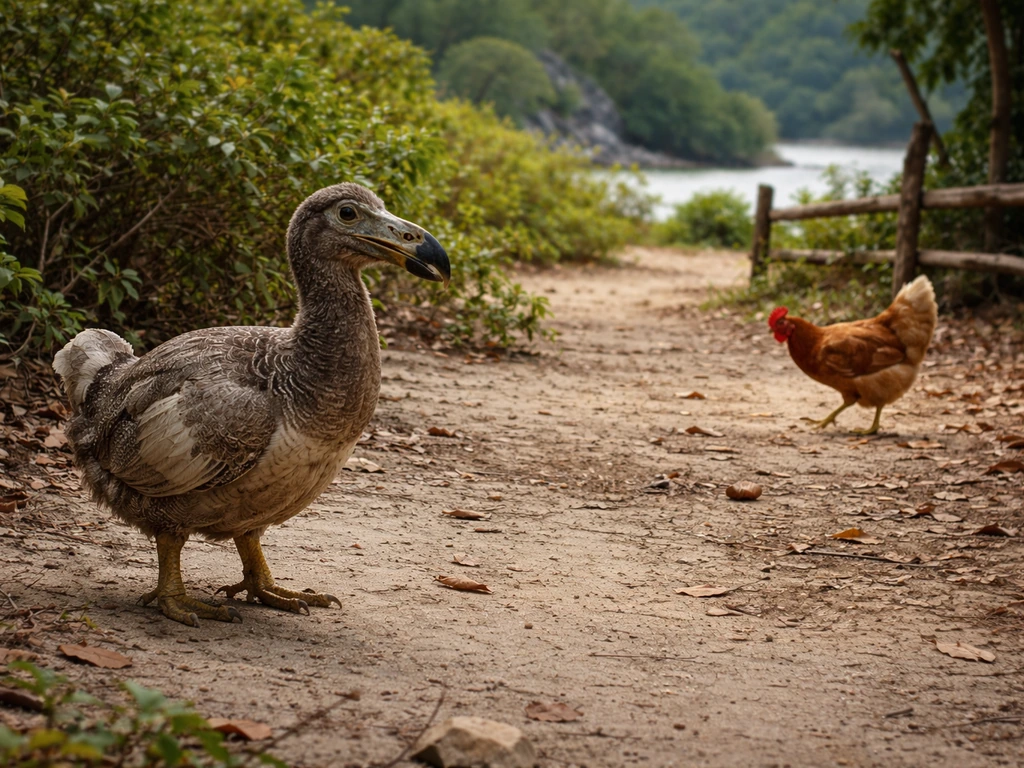
Are a dodo and a chicken the same kind of bird?
The short classification answer is no. The dodo is classified in family Raphidae within order Columbiformes, while the domestic chicken sits in family Phasianidae within order Galliformes. The Animal Diversity Web account for the dodo (Raphus cucullatus) also lists it as belonging to order Columbiformes and family Raphidae classified in family Raphidae within order Columbiformes.
Modern genetic work, including mitochondrial genome studies comparing dozens of pigeon and dove species, places the dodo's closest living relative as the Nicobar pigeon, not anything in the chicken family. So when people casually call the dodo a 'big, dumb chicken,' they are getting the biology completely wrong. The resemblance is superficial: both birds are stout, both spend a lot of time on the ground, and both have relatively small wings compared to their body mass.
But that is roughly where the similarity ends.
It helps to think of Columbiformes and Galliformes as two entirely separate branches of the bird family tree. Chickens share more in common, evolutionarily speaking, with a wild turkey or a peacock than they do with a dodo. And the dodo has more in common, genetically, with the pigeons you see in any city square than with any farmyard bird.
Dodo vs chicken: appearance, size, diet, and behavior
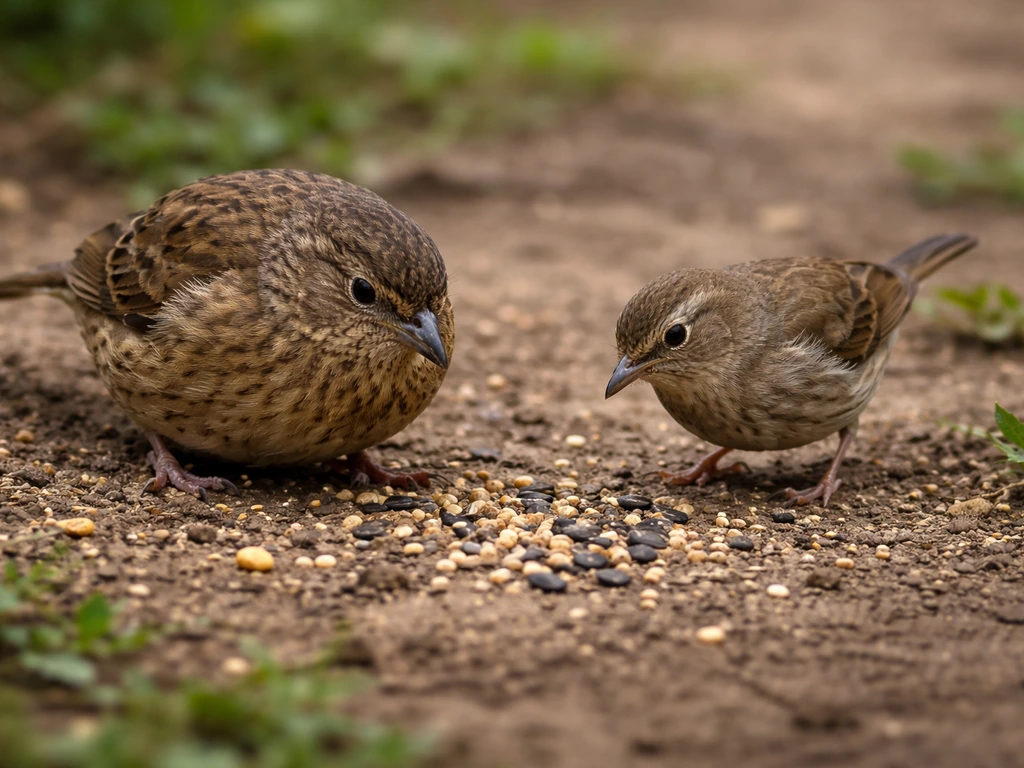
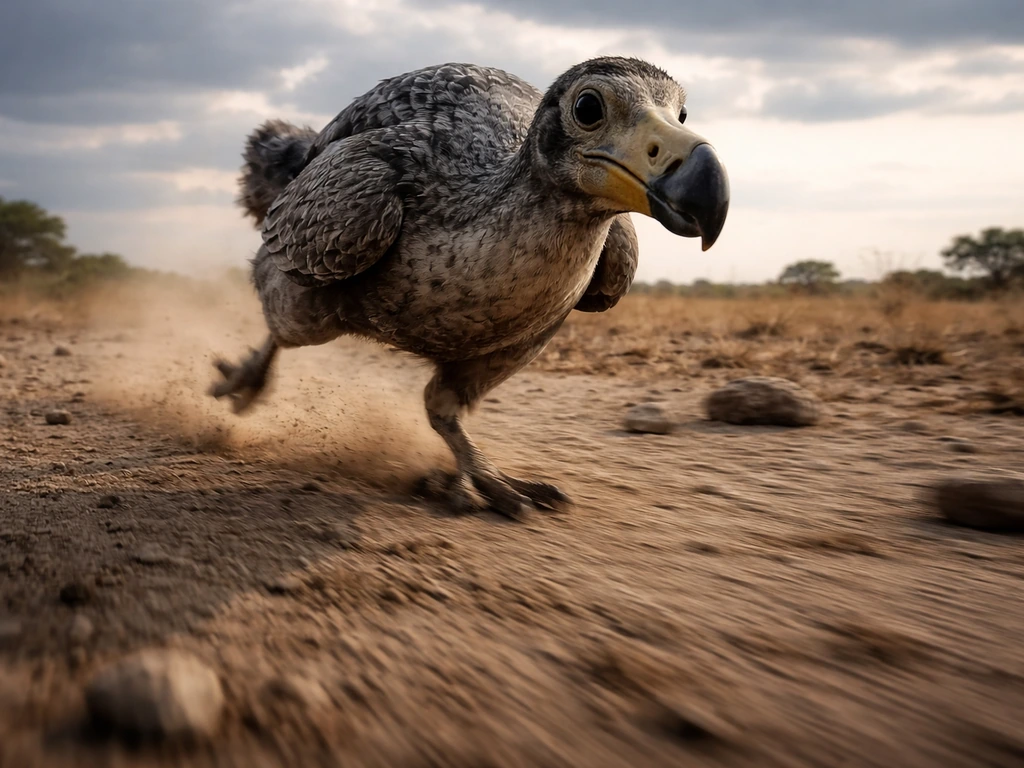
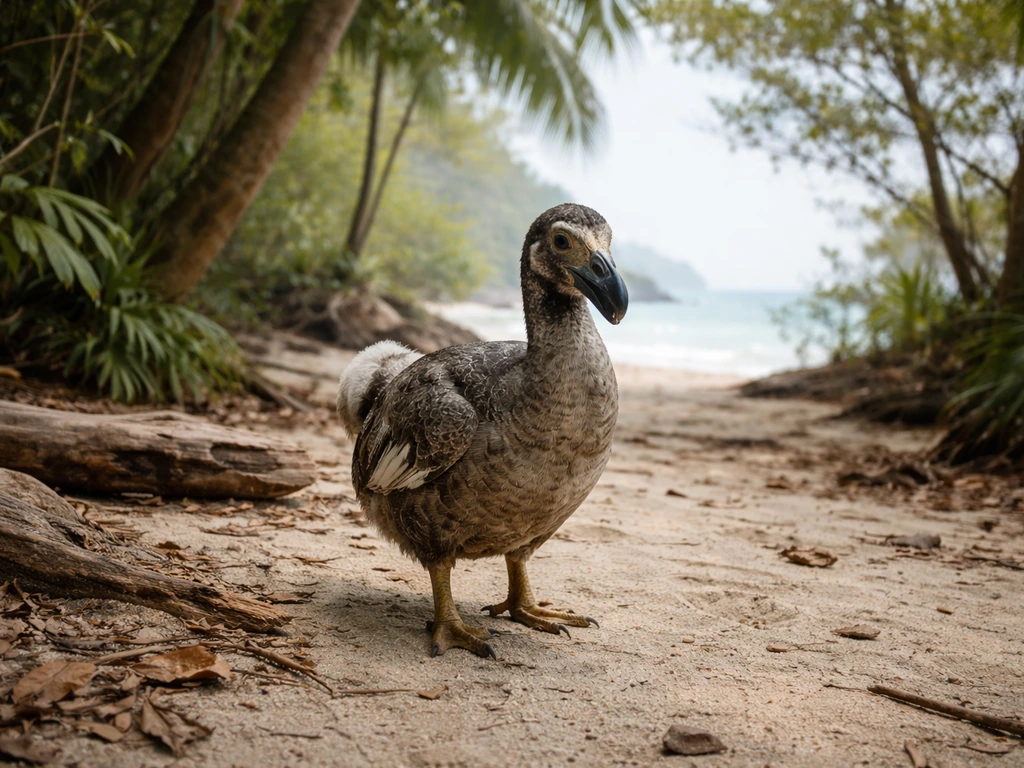
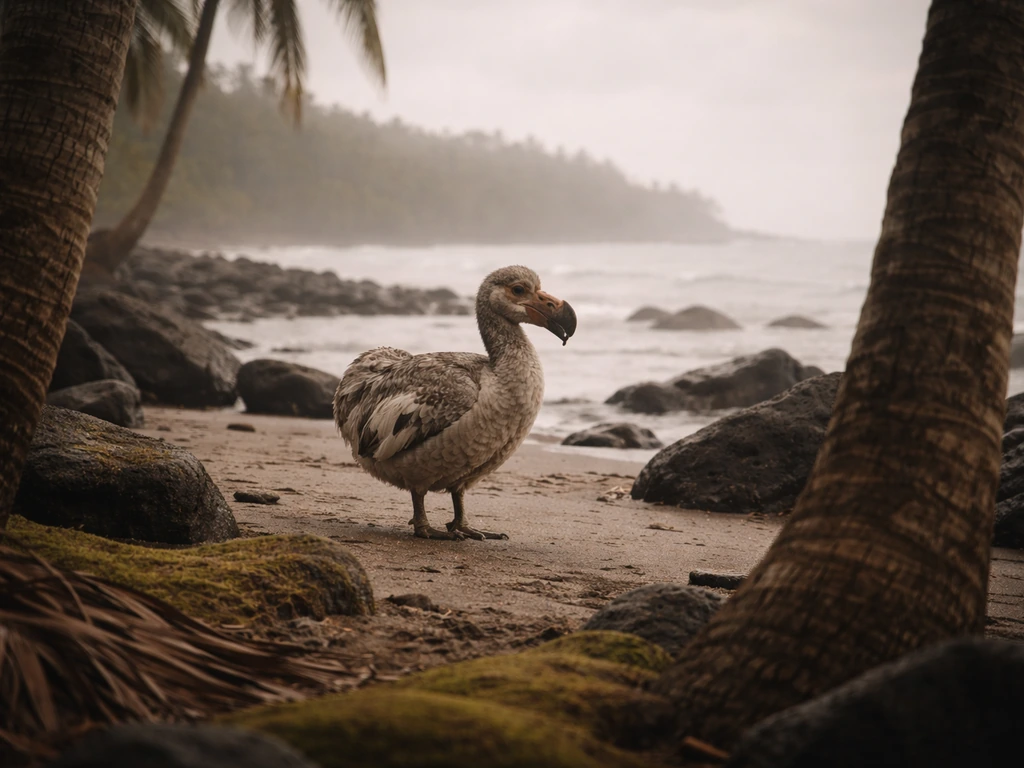
Looking at the two birds side by side, the differences in body plan are immediately obvious. The dodo was a large, robust bird estimated to have weighed somewhere between 10 and 18 kg (roughly 22 to 40 lb) in life, though estimates vary depending on the reconstruction. Its most distinctive feature was a large, hooked beak that was proportionally oversized relative to the skull, along with a rounded, almost bulbous body on short, thick legs. The domestic chicken, by comparison, is considerably lighter, typically ranging from about 2.6 to 4.5 kg (roughly 5.7 to 9.9 lb) depending on breed, with a sleek, upright posture, a fleshy comb and wattles on the head, and unfeathered legs in most breeds.
Diet-wise, both birds were primarily ground foragers, but for different reasons and in very different ecosystems. The dodo, living in the forests of Mauritius, fed mainly on fruit, and its large beak was adapted over time to deal with the readily available food sources on the island. The Oxford University Museum of Natural History notes that the dodo nested on the ground and ate fruit, and that its beak adaptations coincided with the evolution of its flightlessness.
The chicken's foraging strategy is quite different: domestic and free-range chickens scratch and peck at the ground for seeds, insects, and plant material. Research on free-range broiler chickens confirms that pecking and scratching is the defining foraging behavior across all rearing periods and seasons, essentially the core activity of a chicken's day.
Behaviorally, chickens are social, active during daylight, and spend a significant portion of their day foraging, dust-bathing, and perching to sleep at night. The dodo, based on accounts from sailors and the limited physical evidence available, appears to have been relatively fearless of humans, likely because it had evolved in isolation with no large mammalian predators. That fearlessness, as we will get to shortly, contributed directly to its extinction.
| Trait | Dodo (Raphus cucullatus) | Chicken (Gallus gallus domesticus) |
|---|---|---|
| Order | Columbiformes | Galliformes |
| Family | Raphidae | Phasianidae |
| Closest living relative | Nicobar pigeon | Red junglefowl |
| Weight | ~10–18 kg (22–40 lb) | ~2.6–4.5 kg (5.7–9.9 lb) |
| Beak | Large, hooked, proportionally oversized | Short, pointed, typical fowl beak |
| Primary diet | Fruit (forest floor foraging) | Seeds, insects, plant material |
| Flight ability | Completely flightless | Short bursts only |
| Status | Extinct (~1662–1690) | Domesticated, globally abundant |
Wings, locomotion, and what the skeleton tells us
This is where the comparison gets genuinely interesting from a natural history perspective. The dodo had wings, but they were essentially vestigial, described in early accounts as 'little winglets. The NCSE document describes how the dodo’s wings were reduced to [vestigial “little winglets”](https://ncse. ngo/sites/default/files/pdfs/RNCSE30.
4. pdf) rather than functional flight wings, especially compared with flighted relatives. ' The skeleton backs this up: the pectoral girdle and wing bones in the dodo were substantially reduced and more gracile compared to flighted pigeons, and crucially, the sternum lacked the deep keel that powered flight requires. In volant (flying) birds, a large, cranially projected sternal keel provides the attachment surface for the powerful flight muscles.
Flightless birds, including the dodo, show a dramatically reduced keel. So flight was not just behaviorally absent in the dodo; the anatomical infrastructure for it had been gradually dismantled over generations of island life.
Chickens occupy a middle ground that often surprises people. They are not fully flightless, but they are far from strong fliers. Studies on laying hens show they can perform short vertical jumps between perches, and in practice, chickens can achieve short bursts of flight, mainly to escape immediate danger or reach an elevated roost. Their wingspan runs roughly 60 to 90 cm, but the flight muscles and wing-to-body ratio do not support sustained or long-distance flight. Selective breeding for meat and egg production over thousands of years has made modern breeds even less aerodynamic than their ancestor, the red junglefowl, which is a somewhat more capable flier.
The dodo's flightlessness, by contrast, was a complete evolutionary commitment. Mauritius had no terrestrial predators before humans arrived, so there was no survival pressure to maintain the energetically expensive machinery of flight. The island's abundant ground-level fruit meant a heavy, ground-based lifestyle was not only viable but efficient. The dodo's anatomy reflects millions of years of that selection pressure, and it is a textbook example of how island isolation reshapes bird biology. If you are curious about the dodo's ground speed, see also how fast can a dodo bird run as a related comparison to its flightlessness.
Where dodos lived vs where chickens live now

The dodo's entire world was the island of Mauritius, a volcanic island in the Indian Ocean. To learn where the dodo bird lived, look to Mauritius in the Indian Ocean. It lived in the island's forests, nesting on the ground and relying on the fruit-rich environment that its isolation had created. Early Portuguese sailors reportedly encountered the bird around 1507, and accounts from Dutch sailors in subsequent decades described a bird completely unafraid of humans. That geographic confinement to a single island meant the dodo's total global population was always limited, and any serious disruption to Mauritius's ecosystem threatened the entire species.
Chickens tell a completely different geographic story. Genetic and archaeological evidence indicates that domestic chickens were first derived from the red junglefowl in Southeast Asia, with domestication occurring well before 6000 BC and establishment in China by around that time. From there, chickens spread westward and northward, eventually reaching Europe and, through colonial and trade networks, every inhabited continent. Today, the domestic chicken exists in virtually every country on Earth, a direct result of its utility to humans and the deep entanglement between chicken biology and human agriculture.
Human impact: why one bird vanished and the other took over the world
The dodo's extinction and the chicken's global dominance are, in a way, two sides of the same coin: human behavior. The dodo disappeared because of it, and the chicken thrived because of it.
The last confirmed sighting of a living dodo was recorded in 1662 by Volkert Evertsz, though statistical modeling of historical sighting records suggests the species may have persisted until around 1690. The extinction was driven by a combination of direct overhunting by sailors (who found the fearless birds easy to catch), the introduction of dogs, pigs, cats, and rats to Mauritius, and habitat destruction. The introduced animals raided ground nests and competed for food resources that the dodo depended on. Britannica frames it plainly as a human-induced extinction, and it is one of the most well-documented early examples of humans wiping out a species through a combination of over-harvesting and ecological disruption.
The chicken's survival story is the opposite trajectory. Humans domesticated red junglefowl because they were useful: as food, as sources of eggs, and in some cultures, for cockfighting. That utility meant humans actively protected, bred, and transported chickens across the globe. Chickens did not survive despite human contact; they flourished because of it. The domestication process, which involved multiple lineages of red junglefowl in Southeast and East Asia based on mitochondrial genome evidence, produced a bird so integrated into human food systems that it is now effectively insulated from extinction in the way wild species are not.
What scientists actually learn by comparing these two birds
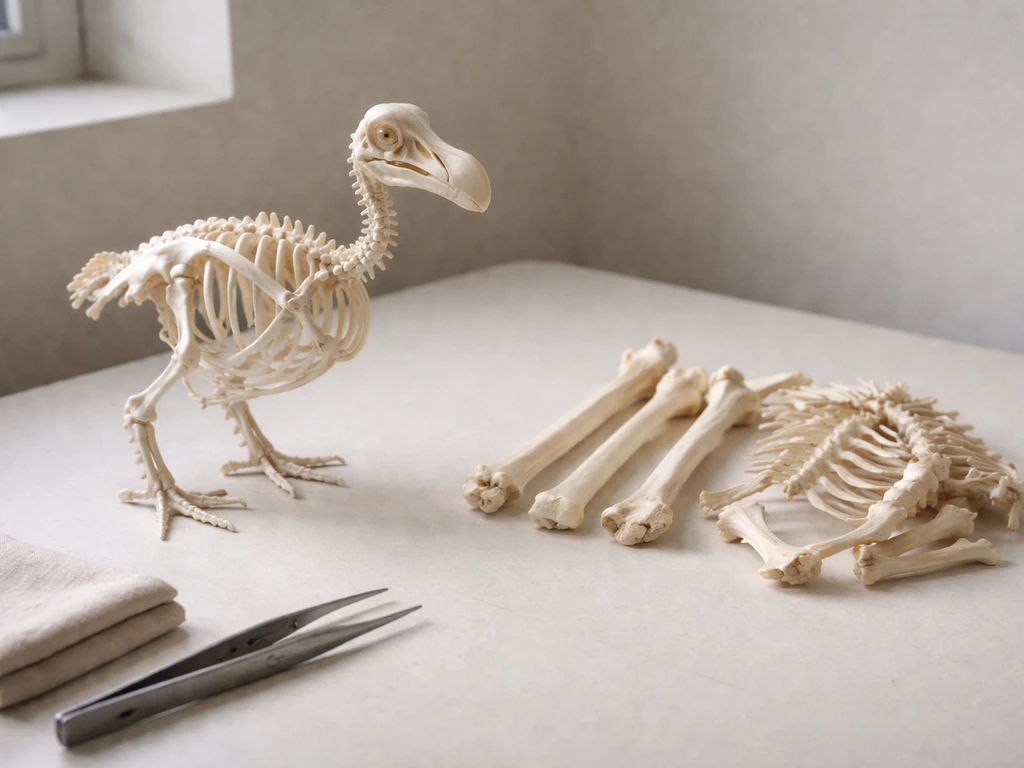
You might wonder why comparing an extinct island pigeon relative to a domesticated farmyard bird is scientifically worthwhile. It turns out, quite a lot can be learned. The dodo is a powerful case study in how island isolation drives rapid anatomical change, specifically the loss of flight-related structures when selection pressures are removed. By comparing dodo skeletal anatomy to that of living Columbiformes, researchers can track exactly which bones were reduced, in what sequence, and what developmental mechanisms drove those changes. The dodo's reduced sternum keel and vestigial wing bones are a concrete, preserved record of evolution in action.
Comparing the dodo's ecology to domesticated birds like chickens also helps conservation scientists think about extinction vulnerability. The dodo had a very small geographic range, low reproductive pressure from predators (which meant slow behavioral adaptation to new threats), and complete dependence on a single island ecosystem. Chickens have the opposite profile: broad geographic spread, high reproductive rate, and tight integration with human support systems. Laying out these contrasts helps researchers identify which traits make a species resilient versus fragile when humans enter the picture.
There is also an ongoing ecological story here. Research published in Nature Communications, discussed by the Natural History Museum, found that the dodo's extinction had downstream effects on Mauritius's plant life, because the dodo was a key seed disperser for certain large-fruited trees. The loss of the dodo did not just remove a bird; it disrupted a plant-animal relationship that had co-evolved over millions of years. That kind of cascading effect is something conservation biologists now look for whenever a keystone species disappears.
Myths and misconceptions worth clearing up
There are a handful of persistent myths about both birds that are worth addressing directly, because they show up constantly in casual conversation and even in some published material. If you have heard claims that a dodo bird verdict proves the dodo was just a kind of chicken, this article’s taxonomy and genetics sections explain why that conclusion is incorrect misconceptions.
- The dodo is basically a big chicken. It is not. As covered above, the dodo was more closely related to pigeons than to any galliform bird. The physical resemblance, a stout ground-dwelling bird with small wings, is convergent evolution, not shared ancestry.
- The dodo had no wings at all. Wrong. The dodo had wings; they were just reduced and non-functional for flight. The Animal Diversity Web explicitly notes that the dodo had wings that were 'not used for flight,' which is very different from having no wings. The skeleton preserves them clearly.
- The dodo went extinct because it was too stupid to survive. This is one of the most unfair characterizations in natural history. The dodo showed no fear of humans because it had evolved in an environment with no mammalian predators. That is adaptive behavior for its original context, not stupidity. It simply had no evolutionary preparation for the specific threat humans represented.
- Chickens cannot fly at all. Chickens are not flightless in the technical sense. They can and do perform short bursts of flight, jump between perches, and reach elevated roosts. They are poor sustained fliers, but the complete loss of flight structures seen in the dodo does not apply to chickens.
- The dodo went extinct in 1662. The 1662 date of Volkert Evertsz's sighting is the last confirmed record, but statistical modeling suggests the species may have persisted until around 1690. The exact extinction date is genuinely uncertain, and the 1662 figure is often presented with more precision than the evidence supports.
- The dodo was a slow, lazy, overfed bird. Early sailor illustrations exaggerated the dodo's rotundity, partly because captive specimens were overfed. The Oxford University Museum notes that soft-tissue remains, including the Oxford Dodo (the only surviving dodo soft tissue in the world), have helped researchers correct these distorted depictions and produce more accurate reconstructions.
Where to go from here
If this comparison has sparked genuine curiosity, there are a few directions worth exploring. The dodo's anatomy and evolutionary biology are well-documented in peer-reviewed literature, and the Oxford University Museum of Natural History holds the best-preserved physical remains, including soft tissue, so their online resources and published research are a strong starting point for understanding what the bird actually looked like. For the ecological side, looking into the Mauritian ecosystem and the cascading effects of the dodo's extinction on native plant species gives a much richer picture of why single-species extinctions matter beyond the loss of the animal itself.
On the chicken side, the domestication genetics literature is surprisingly fascinating. The mitochondrial genome studies tracing chicken lineages back through Southeast Asia reveal a domestication story that is far more complex and regionally varied than the simple 'one time, one place' narrative most people assume. Understanding that history helps contextualize why the chicken became the world's most common bird while the dodo did not survive contact with the same civilization.
If you want to keep exploring dodo biology specifically, it is worth reading about how big the dodo actually was, whether and why it lost the ability to fly, and how it compares to other large flightless birds like the ostrich. Each of those comparisons adds another layer to understanding what made the dodo a unique evolutionary product of island life, and what that tells us about the birds we still have a chance to protect. If you are also browsing dodo bird news, note that modern documentaries and science updates often revisit the dodo versus chicken comparison to explain evolution and extinction.
FAQ
Is the “dodo was just a chicken” idea scientifically correct?
No. There is no scientific basis for treating the dodo as a type of chicken or for using it as a “proof” that evolution never separated bird lineages. The dodo and chicken belong to different orders, and genetic evidence places the dodo’s closest living relatives among pigeons rather than any galliform bird group.
Why do people keep saying “dodo bird vs chicken” is basically the same animal?
The common label usually comes from superficial similarities, like short, stout bodies and ground habits. When you compare anatomy in detail, the dodo’s reduced flight structures (especially the sternum keel) and its pigeon-like ancestry make the resemblance misleading rather than indicative of close relation.
Are chickens actually flightless the way many people assume?
Modern chickens can still fly briefly, but that is not the same as the ancestral capacity for sustained flight. If you see a chicken “taking off,” it is typically a short burst for escape or to reach a perch, and selective breeding for productivity can further reduce aerodynamic ability.
What’s the real anatomical difference behind “dodo vs chicken flight”?
Because their wings and flight muscles are only part of the story. The dodo had evolutionary reductions in the core skeletal support system for flight, while chickens have a different body design that still supports short vertical hops and limited escape flights.
Did the dodo and chicken eat the same kinds of foods?
Dodo and chicken diets overlap at the category level (both forage on the ground), but the mechanics and food sources differ. The dodo was adapted for fruit in a very specific island environment, while chickens rely heavily on pecking and scratching to find seeds, insects, and plant material.
Was the dodo fearless of everyone, or only humans?
The dodo is often described as fearless mainly in the context of humans and the predators humans brought to Mauritius. The key point is that the bird evolved without the types of threats that would train strong avoidance behaviors, so it became unusually easy to capture.
Does the chicken’s survival mean every chicken population is permanently secure?
Don’t confuse “domesticated” with “safe from extinction.” Domestic chickens are widespread because humans breed and move them, but individual breeds can decline or go extinct if breeding programs collapse or diseases wipe out particular lineages.
Why does geographic range affect extinction risk so strongly here?
For the dodo, the limited range mattered because the whole population depended on one island ecosystem. For chickens, the combination of broad geographic spread and very high reproduction, plus constant human support, makes their risk profile completely different.
Did the dodo’s disappearance affect plants, or was it only the birds that were lost?
The dodo extinction likely altered plant recruitment because the bird was a key seed disperser for certain large-fruited trees. In practical terms, this is a reminder that losing an animal can change habitats indirectly, not just remove one species from the food web.
What’s the best method to compare “dodo bird vs chicken” without mixing up facts?
A helpful way to avoid mistakes is to compare taxonomy and ecology in parallel. Start with order and family placement, then compare life history traits (nesting, predator exposure, foraging method, reproduction), then evaluate how human interaction changes outcomes.
What is the one-sentence takeaway difference between dodo vs chicken?
If your goal is a quick “bottom line,” remember this: similar appearance comes from shared ground-dwelling living conditions, not close ancestry. The deeper answer is that island isolation drove the dodo toward flightlessness, while chicken domestication scaled up reproduction and human dependence.