
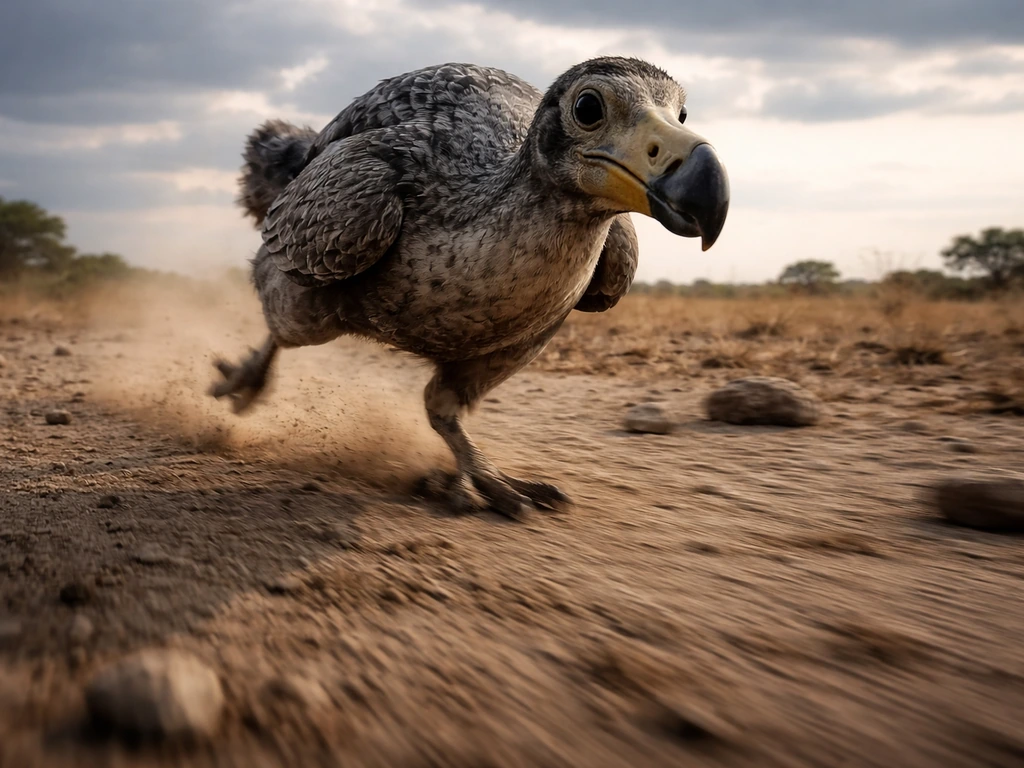
The dodo could probably run somewhere in the range of 15 to 25 kilometers per hour (roughly 9 to 15 mph) at a brisk pace or short sprint, based on the best available skeletal and biomechanical evidence. That said, no one ever clocked a living dodo, so that range comes from indirect inference rather than direct measurement. What scientists are increasingly confident about is that the old image of the dodo as a waddling, helpless bird is wrong. Recent research points to an animal that was more capable and agile than its reputation suggests.
How Fast Can a Dodo Bird Run? Speed Estimates Explained

Maya Hennessy
5 May 2026
The best speed estimates we have

Pinning down a single number is genuinely hard, but researchers have converged on a general picture. A 2024 study published in the Zoological Journal of the Linnean Society, widely reported in the science press that August, interpreted bone and tendon evidence as indicating powerful locomotor ability in the dodo. The Natural History Museum summarized the same body of work by stating that fossil and osteological evidence is consistent with dodos being relatively agile and active, not the lethargic creatures of popular imagination.
Working from that evidence, most informed estimates place a typical running dodo somewhere around 15 to 20 km/h (about 9 to 12 mph). A short burst or escape sprint might push closer to 25 km/h. For context, a brisk human jog sits around 8 to 10 km/h, so a dodo in a hurry was meaningfully faster than a person jogging. It was not going to outpace a cassowary, but it was not a slow, stumbling bird either.
Why dodos were slow to begin with (and why 'slow' is relative)
The dodo's flightlessness is the starting point for understanding its locomotion. Dodos are flightless birds, so they could not fly even if they were quick runners flightlessness. Once a pigeon ancestor colonized Mauritius, flight became metabolically expensive and provided little survival advantage on an island with no native land predators. Over generations, the wings reduced to small, vestigial stubs, and the body mass increased substantially.
Researchers using CT-based convex-hull mass estimation have put dodo body mass in the range of roughly 10 to 17 kilograms (about 22 to 37 lbs), depending on the modeling approach and which bones are used in the reconstruction. If you are wondering about the bird’s overall size as well as its speed, it helps to look at how body mass and proportions relate to how big a dodo bird was.
That size and weight matters: heavier birds require more force per stride, which tends to reduce top speed compared to lighter runners.
Mauritius itself shaped the dodo's movement style. The island's dense forest floor, with its roots, undergrowth, and uneven terrain, would have favored careful, deliberate movement over flat-out sprinting. The dodo's leg proportions, relatively short and stocky compared to fast-running birds, reflect a body designed for navigating that environment rather than open-plain speed. This does not mean the dodo was slow in an absolute sense, just that it was optimized for a different kind of locomotion than, say, an ostrich built for savanna running.
How scientists piece together the speed picture

Because no one observed a living dodo in a controlled setting, researchers use a combination of three main evidence types to estimate locomotion, and none of them alone gives a complete answer.
- Skeletal and soft-tissue analysis: Studies of dodo hindlimb bones, tendon attachment points, and muscle insertion scars allow researchers to model force production and, from there, infer plausible speed ranges. A preliminary study of dodo hindlimb myology and syndesmology (the muscles and ligaments of the leg) supports the idea that the hind legs were capable of generating significant power, consistent with the 2024 findings.
- Historical accounts: Dutch sailors who encountered dodos on Mauritius in the late 1600s left written and illustrated records. These accounts are qualitative and often unreliable as speed guides, partly because the observers had no reason to time a running bird, and partly because the same accounts have been selectively interpreted to support both 'lazy dodo' and 'active dodo' narratives over the centuries.
- Analogies with living flightless birds: Researchers compare dodo limb proportions and body mass to living flightless birds with known speeds, using biomechanical scaling methods like Froude number analysis. The Froude number relates speed to leg length and gravity, and it is commonly used to predict gait transitions and reasonable speed ranges in extinct animals. The choice of hip height or leg length as the characteristic measurement can shift the result meaningfully, which is one reason estimates vary.
Mechanical modeling adds another layer. The same general approach used to estimate maximum running speeds in extinct terror birds from musculoskeletal constraints can, in principle, be applied to dodos. The method works by asking: given the bone dimensions and estimated muscle mass, what is the maximum force the leg can produce, and what running speed does that translate to? The answer depends heavily on assumed posture, body mass, and tendon properties, all of which carry uncertainty.
Walking vs running: what the dodo was actually doing most of the time
There is an important practical distinction between top speed and typical speed. Research on living birds shows that many species use mixed gait mechanics across a speed range, rather than a clean switch from walking to running. The dodo almost certainly spent the vast majority of its time walking slowly through forest, foraging for fallen fruit, seeds, and roots. The dodo lived on the island of Mauritius in the Indian Ocean. Estimates of typical walking speed for a bird of the dodo's size and leg length come in around 3 to 5 km/h, which is a leisurely human walking pace.
Running was almost certainly reserved for moments of threat or competition. And here is the other complication: research on escape speed in animals shows that maximum sprint speed and optimal escape speed are not the same thing. An animal running at full tilt risks slipping, stumbling, or injuring itself, so the biologically useful escape speed is often somewhat below the theoretical maximum. This means that even if a dodo could briefly hit 25 km/h, it probably ran at 15 to 20 km/h in most real-world chase scenarios.
How the dodo stacks up against other flightless birds

Comparing the dodo to other flightless birds helps put its speed in perspective. That same comparison also comes up when people ask how a dodo bird vs ostrich matchup would look in terms of speed and build Comparing the dodo to other flightless birds. The dodo sits in the middle of the pack, well below the fastest flightless birds but not at the bottom.
| Bird | Estimated Top Speed | Body Mass (approx.) | Key Speed Factor |
|---|---|---|---|
| Ostrich | 70–72 km/h (43–45 mph) | 100–130 kg | Long legs, open terrain, dedicated runner |
| Cassowary | 48–50 km/h (30 mph) | 55–75 kg | Powerful legs, dense forest runner |
| Emu | 45–50 km/h (28–31 mph) | 30–55 kg | Long stride, flat terrain specialist |
| Dodo | ~15–25 km/h (9–15 mph, estimated) | 10–17 kg | Short legs, heavy body, island forest environment |
| Moa (giant species) | ~20–30 km/h (12–18 mph, estimated) | 230–250 kg (largest) | Massive body mass limits speed despite tall legs |
| Kiwi | ~12–19 km/h (7–12 mph) | 1.3–3.3 kg | Small, nocturnal, short legs, not built for speed |
The cassowary comparison is particularly interesting given that both birds lived in dense forest environments with no traditional land predators before humans arrived. The cassowary is a much larger and faster bird, but its speed comes with a correspondingly larger body built for power. The dodo's speed estimates align fairly well with the kiwi at the lower end and approach moa-level estimates at the upper end, which makes intuitive sense given the dodo's intermediate size and similar ecological niche as a forest floor forager.
If you are curious about how the dodo's body size compares more broadly, that is a separate but closely related question, as body mass is one of the biggest drivers of the speed estimates discussed here.
Why different sources give different numbers (and why that is okay)
If you search around, you will find websites quoting anywhere from 'very slow' to specific figures like 30 km/h with equal confidence. Here is why those numbers diverge, and why you should be skeptical of any single figure presented without caveats.
- Body mass uncertainty: Different studies use different bone samples and modeling methods, producing dodo mass estimates that range from around 10 kg to over 17 kg. Since speed scales with mass, a heavier estimate produces a slower predicted speed and vice versa.
- Posture assumptions: Froude-number and trackway-based speed estimates are highly sensitive to hip height. A slightly more upright or crouched posture assumption changes the characteristic leg length input and shifts the result.
- No direct observations: Unlike living birds, the dodo's speed was never measured. Every figure is an inference from physical evidence, and inference chains accumulate uncertainty at each step.
- Conflation of maximum and typical speed: Some sources report what a dodo could theoretically manage in a sprint; others describe normal foraging locomotion. These are very different numbers, and they often get mixed together.
- Historical bias: Centuries of depicting the dodo as a fat, clumsy bird influenced how researchers interpreted evidence right up until the 2000s and 2010s. More rigorous modern analysis has revised estimates upward, but older sources still circulate.
A 2020 Frontiers in Zoology study on trackway-based speed estimation made this point clearly: even for animals where footprints exist, speed estimates are sensitive to hip-height guesses and substrate properties. A recent open-access paper (available via PMC) likewise argues that equations used for speed from fossil trackways can be inaccurate because inputs like hip height are difficult to estimate reliably and because substrate compliance affects track formation trackway-based speed estimation. The dodo has no confirmed trackways, so the uncertainty is even larger. The honest answer is a range: probably 15 to 25 km/h for motivated running, with typical movement far slower. Anyone claiming a precise single figure is overstating what the evidence supports.
What this tells us about the dodo's story
The speed question connects to a bigger revision happening in dodo science. If you are looking for more dodo bird news, these new biomechanical findings explain why the species keeps getting reassessed. The 2024 research, along with a decade of earlier biomechanical work, is dismantling the idea that the dodo was a passive, dim-witted bird that practically walked into human hands. This wider shift in understanding is often discussed as the dodo bird verdict.
A bird capable of running at 15 to 25 km/h, with powerful hindlimbs and active foraging behavior, was a functional, well-adapted animal for its environment. It just happened to evolve in complete isolation from mammalian predators, which meant it had no behavioral toolkit for dealing with sailors, rats, and pigs when they arrived on Mauritius in the 1600s.
Speed was never the dodo's problem. The problem was a suddenly changed world it had no evolutionary experience with. That is a very different story than the one most people grew up hearing, and it is the reason natural historians keep returning to this bird more than 350 years after it disappeared.
FAQ
Could a dodo reach 30 km/h if it sprinted hard?
It is possible some models and popular sources land higher, but the best-supported estimates top out around 25 km/h for brief, motivated bursts. Reaching 30 km/h would require assumptions about body mass, tendon properties, and safe running posture that are not directly verified for dodos.
What would be the most realistic speed during an escape or chase?
A biologically realistic escape speed is usually below theoretical maximum sprint capability, because full-tilt running on uneven forest ground increases the risk of slipping or stumbling. That is why most scenarios converge on roughly 15 to 20 km/h rather than the upper limit.
How fast did a dodo move when it was just foraging?
Most of the time it was probably not running. Estimates for typical walking speeds for a bird with dodo-like proportions are about 3 to 5 km/h, similar to a leisurely human pace, with running reserved for short moments of threat or competition.
Is the speed estimate based on walking, trotting, or running strides?
The evidence supports multiple gaits across a range of speeds, not a single constant “run speed.” So even if a dodo can run near the top end briefly, its overall daily movement would be slower because it alternates gait patterns rather than staying at peak running speed.
Why do different websites quote wildly different numbers like 10 km/h or 30 km/h?
The main reason is they often pick one method or one set of assumptions without stating uncertainty. Estimates can swing based on assumed body mass, posture during running, tendon mechanics, and (where available) substrate or hip-height guesses, and for dodos there are no confirmed trackways from living animals to anchor the calculations.
What role does body mass play in how fast a dodo can run?
Heavier birds generally need more force per stride, which tends to reduce achievable top speed compared with lighter runners. Dodo mass estimates (about 10 to 17 kg depending on reconstruction) therefore directly influence speed ranges in biomechanical models.
Would a dodo be faster on flat ground than in its natural habitat?
Likely yes, because its leg and body proportions fit dense, uneven forest-floor movement. On flatter, firmer terrain it would reduce the penalty from roots and undergrowth, but there is still uncertainty because the exact mechanics of safe sprinting are inferred rather than observed.
How does flightlessness affect running speed?
Flightlessness itself does not set the speed limit, but it changes anatomy and energy allocation. With no need to power flight, wings became reduced and the body mass increased, which influences the leg mechanics and the balance between walking efficiency and sprint capability.
How does a dodo’s speed compare to other flightless birds in a practical way?
Estimates place the dodo below the fastest flightless birds, but not at the low end of the spectrum. In broad terms it aligns with kiwi at the lower end and approaches moa-level estimates at the upper end, reflecting its intermediate size and forest-floor forager lifestyle.
If there are no living dodo measurements, what’s the best way to interpret the numbers?
Treat any single figure as a rough summary, not a stopwatch result. The most defensible takeaway is a range, with motivated running probably in the mid-teens up to the low-mid twenties km/h, while typical movement is much slower because most time is spent walking.