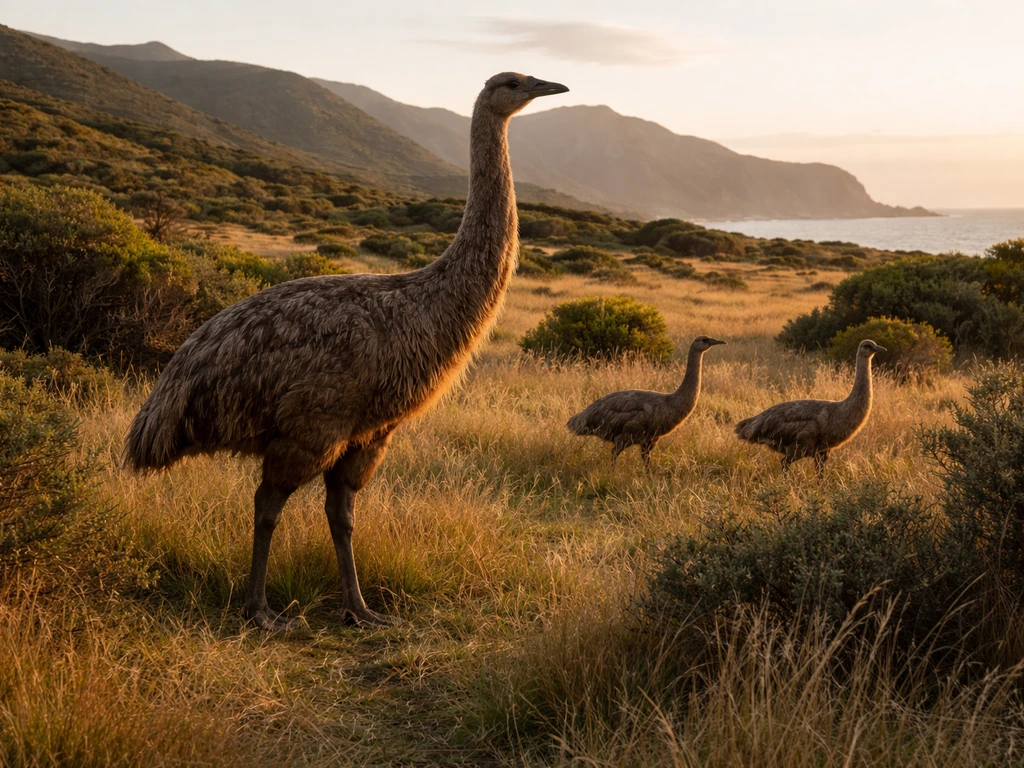
Elephant birds (genus Aepyornis, and their smaller relatives Mullerornis) went extinct roughly between 700 and 1,200 years ago, which translates to approximately 800–1300 AD in calendar years. The most evidence-based estimate, drawn from a 2021 synthesis by Hixon and colleagues using new radiocarbon dates, places the extinction window at 1200–700 cal yr BP (calibrated years before 1950). A secondary estimate, also drawn from the latest radiocarbon dates on bones and eggshell, narrows that window to roughly 800–1050 AD. Both estimates agree on the core story: elephant birds were almost certainly gone by around 1,000 years ago, and human arrival and land-use change drove them there.
When Did the Elephant Bird Go Extinct? Timeline, Causes

Maya Hennessy
21 Apr 2026
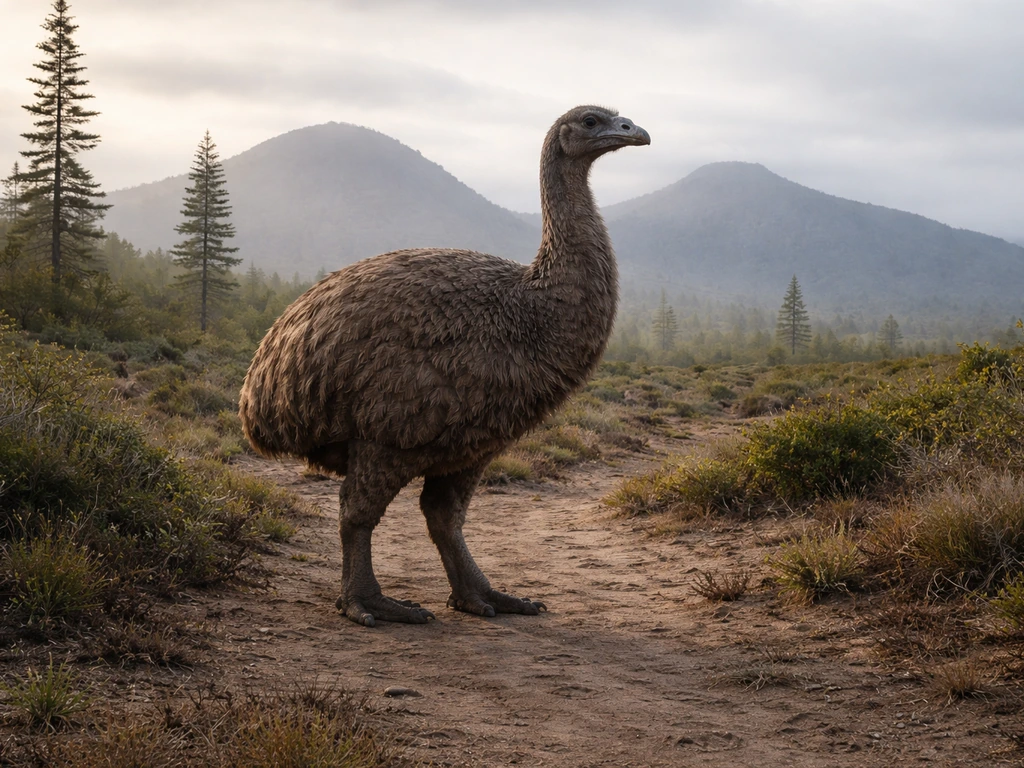
The short answer: when did elephant birds disappear?
Elephant birds were the largest birds that ever lived. Aepyornis maximus stood around 3 meters tall and may have weighed up to 500 kg. They were endemic to Madagascar, meaning they existed nowhere else on Earth. Today they are definitively extinct. No confirmed living population, no credible recent sighting, no specimens collected in the last several centuries. Given the evidence, the elephant bird is not known to have survived into modern times definitively extinct. The question is not whether they are extinct but exactly when the last individuals died.
The best current answer is a window, not a precise year. Based on radiocarbon dating of fossil bones, collagen, and eggshell, the extinction window runs from about 1200 to 700 cal yr BP (calibrated years before 1950, the conventional 'present' in radiocarbon science). In calendar years we recognize today, that range is roughly 750 AD to 1250 AD, with most of the evidence clustering around 800–1050 AD. Think of it as: elephant birds were likely present around 1,000 years ago in at least some parts of Madagascar, and almost certainly gone by 700–800 years ago.
What 'extinct' actually means in this context

The IUCN, which manages the global Red List of threatened species, draws a careful distinction between 'last seen' and 'date of extinction. In the IUCN Red List FAQ, IUCN explains that a “last seen” date indicates the species went extinct sometime between that date and when it was first listed as EX or EW on the IUCN Red List careful distinction between “last seen” and “date of extinction”.
' For many extinct species, including elephant birds, those two things are not the same. The last confirmed fossil or radiocarbon-dated specimen gives you a minimum date for survival, not the actual extinction date. The real extinction likely happened sometime after the last datable evidence, because animals rarely leave a perfectly timed final fossil.
This is where the Signor-Lipps effect becomes important. It is the well-established paleontological principle that last fossil occurrences almost always predate true extinction. The fossil and subfossil record is incomplete: not every individual gets preserved, not every bone gets found, and not every site gets sampled. So when you see a date like '1,000 years ago' attached to the last elephant bird bone, that date means we have confirmed evidence of survival up to that point, not that the species died exactly then. The true extinction date is likely somewhat later than the last dated specimen, though the gap is probably small for a large, slow-reproducing bird in a rapidly changing habitat.
The evidence trail: how researchers pin down the date
The primary dating tools for elephant bird extinction are radiocarbon (14C) dating of subfossil bones, eggshell carbonate, and preserved collagen. Madagascar's subfossil record is relatively rich: elephant bird bones have been recovered from cave deposits, lake sediments, and archaeological sites across the island's south and west, the regions where pastoralist communities arrived earliest.
Hixon et al. (2021) is the most rigorous recent synthesis of this data. The team generated new radiocarbon dates alongside stable isotope measurements, then used Bayesian calibration software (OxCal, which applies the SHCal20 calibration curve for Southern Hemisphere samples) to model the most probable extinction timing. Their output is the 1200–700 cal yr BP window cited in multiple subsequent papers. Separately, analyses of the latest radiocarbon dates from Aepyornis remains suggest survival at least to around 800–1050 AD before the population collapsed entirely.
Dating eggshell adds another line of evidence. Aepyornis eggs were enormous (a single egg could hold the equivalent of about 150 chicken eggs) and the calcite carbonate in eggshell can be radiocarbon dated directly. Peer-reviewed research has confirmed that 14C dates on eggshell carbonate generally need little correction for reservoir effects, making them relatively reliable chronological markers. A 2025 dataset covering archaeological sites across eastern Africa assessed radiocarbon dates on Aepyornis eggshell and flagged some as questionable due to methodological concerns, illustrating that not all dates are treated equally: reliability criteria such as material type, potential old-wood effects, and reservoir offsets are checked before a date enters an extinction-timing model.
A simplified evidence timeline

| Time period | Evidence type | What it tells us |
|---|---|---|
| ~2,000–1,500 years ago | Subfossil bones, coprolites, eggshell | Elephant birds widespread in southern and western Madagascar |
| ~1,200 years ago (start of decline window) | Last abundant occurrence of dated remains; livestock arrival markers | Pastoralist communities and livestock begin appearing in same sediment layers |
| ~1,000 years ago (800–1050 AD) | Latest individual radiocarbon dates on bones and eggshell | Last confirmed evidence of living animals; populations severely reduced |
| ~700 years ago (end of window) | Absence in deposits; no dated remains younger than this | Most estimates place full extinction by this point at latest |
| Historical accounts (16th–17th century) | European traveler reports of large birds or eggs | Likely describe old eggshell or cultural memory; not verified as living sightings |
Why elephant birds declined: the real drivers
Human activity is the consensus explanation for elephant bird extinction. Madagascar was one of the last large landmasses settled by humans, with evidence of human presence dating back at least 2,000 years and more sustained settlement and land-use change occurring in the last 1,500 years or so. The timing of megafaunal decline, including elephant birds, tracks closely with the expansion of pastoralist communities and their livestock across the island's south and west.
Hixon et al. (2021) specifically tested whether the arrival of introduced livestock (goats, sheep, bush pigs, and cattle) correlated with megafaunal extinction timing in Madagascar. It did. Sediment cores and archaeological deposits show livestock appearing in the same stratigraphic layers where large endemic animals, including elephant birds, begin to disappear. The mechanism is not necessarily direct competition for food: it is a package of pressures that arrived together.
- Direct hunting: elephant bird eggs were large and calorie-dense, making them high-value targets; adults were also likely hunted for meat
- Habitat conversion: pastoralists burned vegetation to create grazing land, destroying the forest and scrubland habitat elephant birds depended on
- Livestock competition: introduced herbivores competed for plant resources and disrupted existing vegetation structure
- Climate stress: mid-Holocene aridity intervals in southwest Madagascar placed additional pressure on already stressed populations, as evidenced by isotopic signals in large mammal bones from the same region
- Reproductive vulnerability: elephant birds were slow breeders; even modest increases in adult mortality or egg harvesting could push a population toward collapse
It is worth noting that climate change played a supporting role rather than the lead one. Aridity signals in the fossil record from southwest Madagascar suggest some ecological stress predating peak human impact, but the timing and scale of extinction correlates far more strongly with human settlement patterns than with any single climate event. The arrival of people, and specifically the spread of agropastoralism, is the smoking gun.
How the extinction actually unfolded

Elephant birds did not disappear overnight. The process was probably a slow squeeze that played out over two to four centuries. Here is the most plausible sequence based on the current evidence.
- Initial human contact (roughly 2,000–1,500 years ago): small forager and fishing communities arrive on Madagascar's coasts; elephant birds exist in good numbers across forested and semi-arid habitats, especially in the south and west
- Pastoralist expansion (roughly 1,200 years ago): herding communities with livestock move into southern and western Madagascar; vegetation burning increases; egg harvesting becomes systematic as human populations grow
- Population fragmentation (roughly 1,200–900 years ago): elephant bird subpopulations become isolated as habitat patches shrink between burned and grazed areas; exchange between populations decreases, reducing genetic resilience
- Collapse phase (roughly 1,000–800 years ago): surviving populations in refugia are too small to sustain themselves against ongoing hunting and habitat loss; radiocarbon dates thin out sharply during this interval, consistent with rapid population decline
- Final extinction (roughly 800–700 years ago or somewhat later): the last individuals die; no more datable remains are deposited; the ecological role of elephant birds, including large-seed dispersal for several plant species, is lost permanently
The ecosystem consequences were significant and lasting. Elephant birds were likely important seed dispersers for large-fruited plants in Madagascar. Research on megafauna loss in similar contexts shows that removing giant frugivores reduces seed dispersal, shrinks the geographic range of plant populations that depend on them, and alters forest genetic structure over subsequent centuries. The plants that co-evolved with elephant birds are still present in Madagascar today, but their dispersal ecology has been disrupted for roughly a millennium.
Why different sources give different extinction dates
If you search for 'when did the elephant bird go extinct,' you will find dates ranging from roughly 700 AD to 1700 AD depending on the source. National Geographic also notes that elephant birds have been extinct since at least the 17th century, while discussing how early extinction may have been understood in historical accounts. That spread is frustrating but explainable. Here are the main reasons for the disagreement.
- Species vs. population-level extinction: some sources cite the disappearance of the last local population; others estimate the global extinction of all Aepyornis and Mullerornis species combined, which likely did not happen simultaneously across all of Madagascar
- Radiocarbon calibration differences: older studies used earlier calibration curves (such as IntCal04 or SHCal13); newer work uses IntCal20 and SHCal20, which can shift dates by decades or more when recalculated
- Sample reliability: not all radiocarbon dates are equally trustworthy; dates flagged for potential contamination, reservoir effects, or old-wood problems skew results when included uncritically
- The Signor-Lipps effect: last occurrence dates in the fossil record systematically underestimate survival time; a date from the last known specimen is a floor, not a ceiling, for extinction timing
- Historical accounts: 16th and 17th century European references to giant birds or enormous eggs in Madagascar are sometimes interpreted as evidence of survival into the historical period, but these are generally not verified living sightings and likely reflect encounters with old eggshell or cultural knowledge
- Multi-modality in calibrated age distributions: a single radiocarbon measurement, when calibrated, often produces a probability distribution with multiple peaks rather than a clean single date, and different researchers may report different portions of that distribution
The practical takeaway is that a source citing '1000 AD' and a source citing '1300 AD' may both be correct within their own framing. The first might be reporting the last strongly dated specimen; the second might be extending the window to account for likely survival beyond the last known bone. When you see a specific year without explanation, it is worth checking what that date actually represents.
It is also worth comparing elephant bird extinction with similar cases. The moa of New Zealand went extinct within a few centuries of Polynesian arrival, following a strikingly similar pattern of hunting pressure and habitat modification. The dodo of Mauritius collapsed within less than a century of European contact in 1598. The dodo is one of the most famous cases of a bird going extinct shortly after European contact dodo of Mauritius collapsed. In both cases, the 'extinction date' given in popular sources is often the date of the last confirmed sighting, which is not quite the same as the date the population became non-viable. The elephant bird story follows the same pattern of ambiguity.
How to verify this yourself today
If you want to go deeper than a general summary, the evidence is accessible. Here is how to approach it practically.
- Start with the primary literature: Hixon et al. (2021), published in Proceedings of the Royal Society B, is the most rigorous recent study on extinction timing linked to pastoralist spread in Madagascar; it is available through Royal Society Publishing and PubMed
- Check the IUCN Red List entries for Aepyornis maximus and related species; the entries explain the extinction classification and note the difference between last known occurrence and formal extinction assessment
- Look for studies that use SHCal20 (the Southern Hemisphere radiocarbon calibration curve) rather than older curves; this matters because Madagascar is in the Southern Hemisphere and older calibrations can introduce systematic errors
- When a source gives a specific extinction year, check whether it is citing a radiocarbon date, a historical account, or a modeled extinction estimate; these three types of evidence carry very different levels of certainty
- For the most current radiocarbon datasets, the scientific data paper on eastern Africa archaeological dates (2025, Scientific Data) provides a useful example of how dates are assessed for reliability before being used in extinction models
- If you encounter references to European explorer accounts of living elephant birds, look for whether those accounts include firsthand sightings of living animals versus reports of eggs, bones, or local oral traditions; most historical references fall into the latter categories
The short confidence summary: the extinction window of roughly 800–1050 AD for last confirmed presence, extending to perhaps 1200–1300 AD for final extinction of any remnant populations, is well-supported by multiple independent radiocarbon studies using modern calibration methods. The drivers, primarily hunting and habitat destruction linked to the spread of agropastoralism, are similarly well-evidenced by the correlation of faunal and anthropogenic markers in the same sediment sequences. The uncertainty that remains is about exactly how long isolated populations may have persisted after the main population collapsed, not about whether humans caused it or whether the birds are gone.
If you are researching this topic alongside other giant extinct birds, the timeline comparisons are revealing. The terror bird (Phorusrhacidae) went extinct millions of years earlier, making it a very different kind of extinction story. The moa and dodo share the elephant bird's pattern of rapid human-driven collapse following first sustained contact. Knowing which category a species falls into helps you interpret the dates you find and the debates around them.
FAQ
Why do some sources give a single year for when the elephant bird went extinct?
Many popular dates are really “last confirmed evidence” years, such as the oldest radiocarbon-dated bone or eggshell, not the moment the last individuals died. Different studies also choose different modeling assumptions for how to bridge the gap between the last fossil occurrence and true extinction.
Is it possible the elephant bird survived until as late as 1700 AD?
It is unlikely. The best-supported radiocarbon results cluster around 800–1050 AD for last strong presence, with later timing generally treated as a small extension, not a multi-century survival. Much of the spread up to later dates comes from mixing “last seen” logic with lower-quality or differently calibrated measurements.
What does “cal yr BP” mean when you see the extinction window reported as 1200–700 cal yr BP?
“cal yr BP” is radiocarbon age after calibration, counted in years before 1950. So 1200–700 cal yr BP converts to roughly 750–1250 AD (the exact calendar-year mapping depends on the calibration curve and modeling).
How do researchers decide whether an eggshell radiocarbon date is trustworthy enough to use?
They check for issues specific to the dated material, including whether the dated carbonate is primary, and whether methodological concerns could introduce bias. Researchers also consider “old-wood” type problems when relevant (for associated materials) and evaluate potential reservoir offsets, then apply reliability criteria before including dates in extinction-timing models.
Does the last dated bone always mean the species went extinct shortly afterward?
Not necessarily. The Signor-Lipps effect predicts that the last dated specimen can predate real extinction because the fossil record is incomplete. For a long-lived, slow-reproducing bird, extinction likely followed a gradual collapse, so the gap can exist even when the gap looks small.
How can there be both a “last presence” window and a “true extinction” estimate?
“Last presence” is tied to the latest dated evidence. “True extinction” is an inferred timing that accounts for missing individuals and incomplete sampling, often using Bayesian modeling to estimate when populations likely became non-viable even if no perfectly timed final specimen was preserved.
Could climate change have caused the extinction instead of humans?
Climate likely added stress, but the strongest pattern is that the timing and geographic overlap of megafaunal decline match human settlement and land-use expansion. In practice, researchers treat climate signals as a supporting factor rather than the main driver because the correlation with anthropogenic markers is stronger.
What specifically did humans do that most affected elephant birds?
The combined pressures arriving with agropastoralism matter: direct hunting and ongoing habitat modification by people and livestock. Competition for resources can be part of the story, but the larger issue is the package of ecological changes that reduces survival and reproduction across time and space.
Why does livestock arrival tend to line up with megafaunal collapse in the same layers?
Because multiple new influences entered together. Sediment sequences and archaeological deposits often show livestock appearing in stratigraphic layers where endemic large fauna begin to decline, supporting the idea that human-mediated ecosystem change, not just a single event, drove the collapse.
Does “definitively extinct” mean there is absolutely no possibility of survival?
It means there is no credible evidence of living populations based on modern criteria, such as lack of reliable recent sightings and no confirmed specimens from recent times. It does not eliminate every theoretical possibility, but it rules out scenarios that would have left detectable evidence under reasonable survey conditions.
How long did the extinction process likely take, and how do we know?
A slow squeeze over roughly two to four centuries is a commonly inferred interpretation. The idea comes from how extinction timing is modeled from radiocarbon sequences and from stratigraphic patterns showing decline rather than an instantaneous disappearance.
If I find a specific date for elephant bird extinction online, what is the quickest way to interpret it correctly?
Look for what the date represents, last evidence versus modeled extinction. If it is given without context, assume it may reflect the last strongly dated specimen or “last seen” framing, not a true extinction-of-the-species moment.
Next Article
When Did the Moa Bird Go Extinct? Dates and Reasons
When moa went extinct, likely 1400-1450 CE, with overlapping dates by species, driven by hunting and habitat loss.