
The moa went extinct somewhere between roughly 1300 and 1440 CE, with most evidence pointing to a dramatic population collapse in the early to mid-1300s CE following the arrival of Polynesian settlers in New Zealand. That is the short answer. The slightly longer answer is that different moa species in different regions likely disappeared at different rates, so there is a range rather than a single clean date. If you are looking specifically at the giant moa (genus Dinornis), current radiocarbon evidence places its extinction firmly within that same 1300–1440 CE window. No credible scientific evidence supports moa surviving past the mid-1400s CE.
When Did the Moa Bird Go Extinct? Dates and Reasons

Maya Hennessy
20 Apr 2026
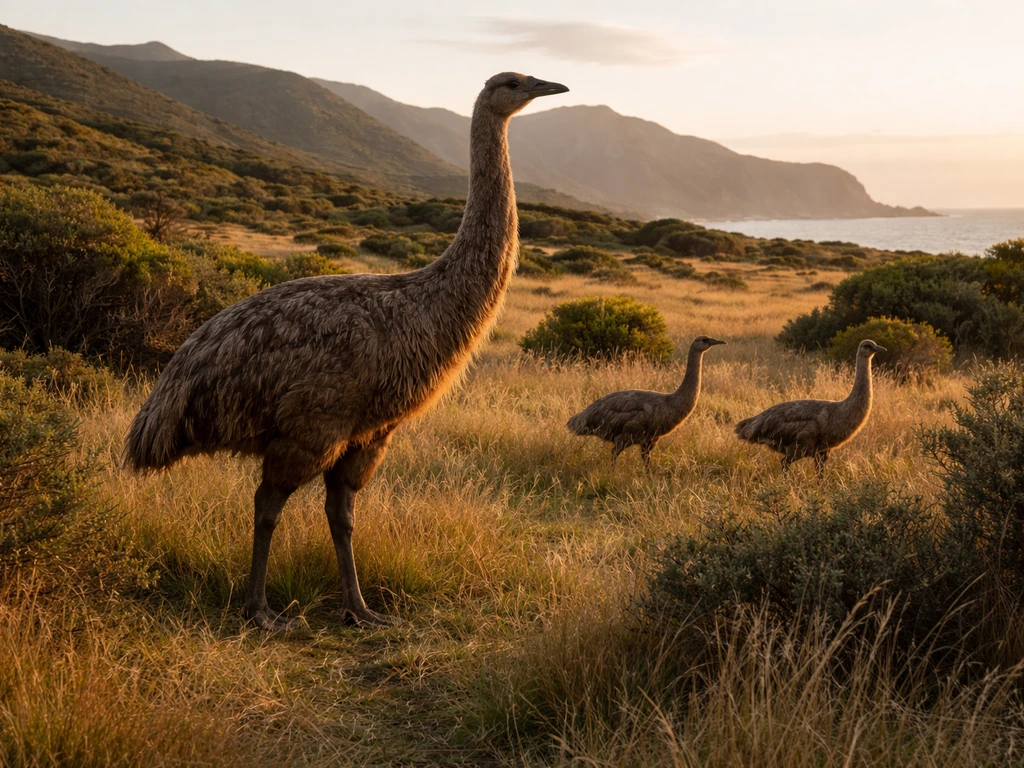
What exactly was the moa (and which one is the 'giant moa')?
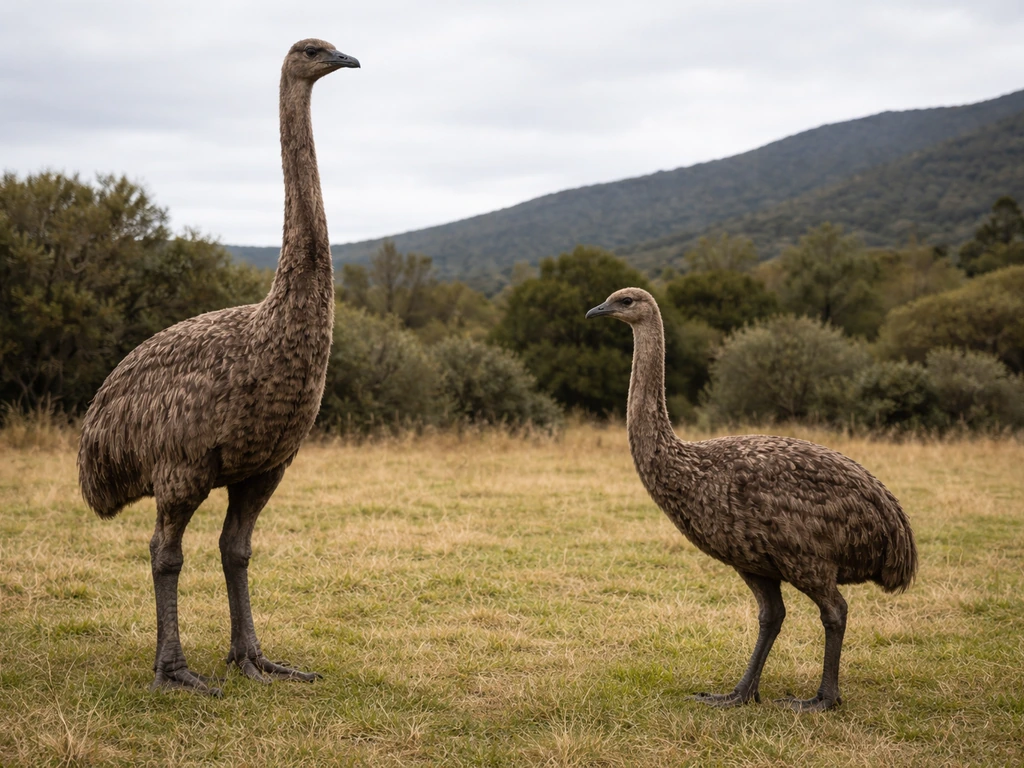
Moa belong to the order Dinornithiformes, a group of flightless ratite birds found only in New Zealand. Scientists currently recognize around 9 species spread across 6 genera, all of which were present during the Late Pleistocene and Holocene epochs. They ranged enormously in size, from the relatively modest little bush moa (Anomalopteryx didiformis) to the towering giants that most people picture when they hear the word 'moa.'
The genera include Dinornis (the giant moas), Emeus (the eastern moa, Emeus crassus), Euryapteryx (broad-footed moa), Anomalopteryx (little bush moa), Pachyornis (stout-legged moa and heavy-footed moa), and Megalapteryx (upland moa). Each occupied a slightly different ecological niche across New Zealand's varied habitats, from coastal forests to mountain shrublands.
When people say 'giant moa,' they almost always mean the genus Dinornis, specifically two species: Dinornis novaezealandiae on the North Island and Dinornis robustus on the South Island. Ancient DNA research has confirmed these are geographically separated allospecies, meaning they evolved in isolation on their respective islands. Dinornis robustus females are estimated to have stood up to 3.6 meters (nearly 12 feet) tall and weighed as much as 230 kilograms, making them the largest birds that ever lived. Ancient DNA work also revealed something surprising: the enormous size difference between males and females in Dinornis was so extreme that scientists originally classified them as separate species entirely.
When did the moa go extinct: the actual date ranges
The most widely accepted timeline, based on radiocarbon dating of moa bones and archaeological sites, places extinction across all moa species within approximately 1300 to 1440 CE. This is a remarkably narrow window in geological terms, and it maps almost exactly onto the period of initial Polynesian (Maori ancestor) settlement in New Zealand, which most researchers place at around 1280 to 1350 CE.
Some species likely disappeared earlier in this window than others. Lowland species living in easily accessible coastal forests were probably hunted to extinction first, while upland or more remote species such as the upland moa (Megalapteryx didinus) may have persisted slightly longer. A 2014 study using high-precision radiocarbon dates suggested that the extinction of all moa species was essentially complete within about 100 years of first human contact, which is an extraordinarily rapid collapse for a large-bodied bird group.
| Moa Species / Group | Estimated Extinction Timeframe | Key Notes |
|---|---|---|
| Giant moa (Dinornis robustus, D. novaezealandiae) | ~1300–1400 CE | South Island females were the largest birds ever; among first targeted by hunters |
| Eastern moa (Emeus crassus) | ~1300–1400 CE | Lowland forest dweller; heavily represented in early hunting sites |
| Heavy-footed moa (Pachyornis elephantopus) | ~1300–1400 CE | Grassland/shrubland species; vulnerable due to habitat overlap with settlements |
| Upland moa (Megalapteryx didinus) | ~1350–1440 CE | Mountain habitat may have offered slight refuge; some of the last dated remains |
| Little bush moa (Anomalopteryx didiformis) | ~1300–1400 CE | Dense forest species; still could not escape hunting pressure |
It is worth being clear about what 'extinct' means in this context. There is no verified record of a living moa after the mid-1400s CE. Occasional anecdotal claims of moa sightings persisted into the 19th century, but none have ever been substantiated by physical evidence, and scientists treat the extinction as complete by approximately 1440 CE at the very latest.
Why did the moa go extinct: the real drivers
The short version is: humans hunted them to death, faster than the birds could reproduce. But the full picture is a little more layered, and understanding how the different factors compounded each other matters if you want to understand why extinction happened so quickly.
Overhunting was the primary cause
Moa had no evolutionary experience with human predators. They had lived in New Zealand for millions of years with no land mammals capable of threatening them, and their only significant predators were the Haast's eagle (Harpagornis moorei) and large raptors. When Polynesian settlers arrived, moa simply did not flee. They were, by all accounts, easy targets. Archaeological sites across New Zealand are filled with moa bones, many showing clear signs of butchering, roasting, and egg extraction. The sheer scale of these midden deposits, some containing the remains of hundreds to thousands of individual birds, tells you everything about how intensively moa were hunted.
Crucially, moa were slow reproducers. Like all large ratites, they likely laid few eggs per year and took years to reach reproductive maturity. This means a population hit hard by hunting cannot bounce back quickly. Computer modeling of moa population dynamics has consistently shown that even moderate hunting pressure sustained over decades would drive moa populations to collapse, which aligns perfectly with the roughly 100-year extinction window the fossil record shows.
Habitat destruction compounded the pressure
Early Maori settlers also burned large areas of lowland forest to clear land for agriculture and to drive game. Pollen and charcoal records show widespread deforestation in New Zealand starting around the time of human arrival. For forest-dependent moa species, this meant their habitat shrank dramatically at exactly the same moment hunting pressure spiked. The combination was devastating: birds that survived the initial hunting waves found themselves pushed into smaller, more fragmented habitats with fewer food resources.
Introduced predators on eggs and chicks
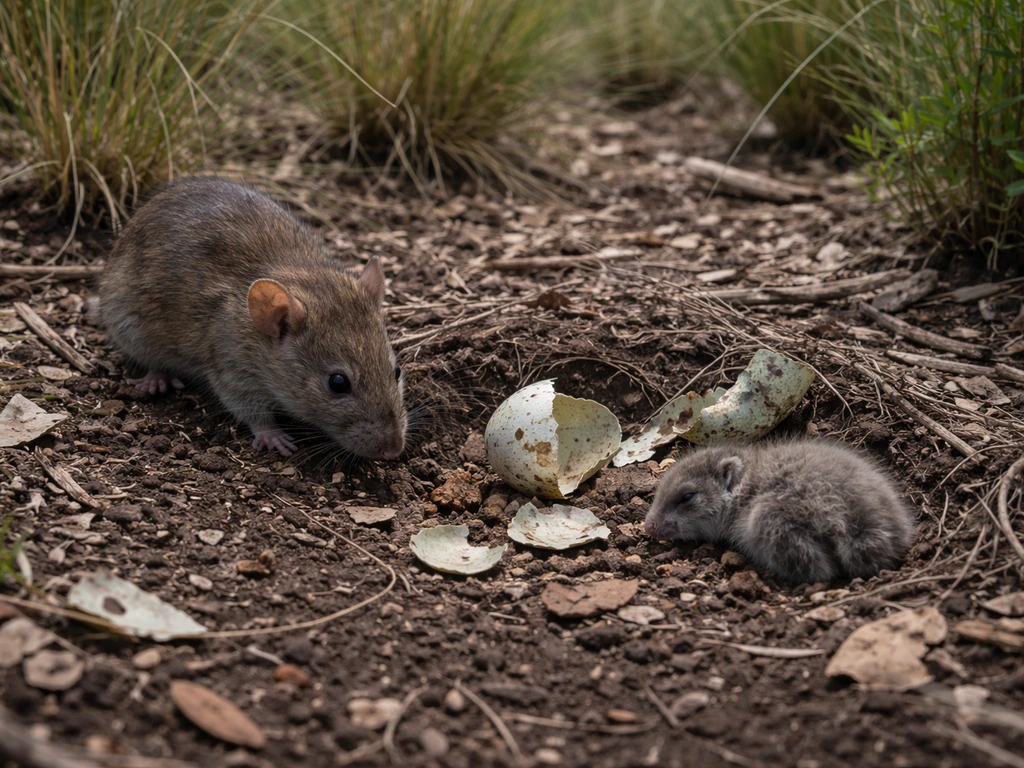
Polynesian settlers brought the kiore (Pacific rat, Rattus exulans) with them to New Zealand. Kiore are highly effective predators of ground-nesting bird eggs and small chicks. For a bird already struggling to maintain population numbers under hunting pressure, even modest additional egg predation could push the reproductive rate below replacement level. Scientists consider this a secondary but real contributing factor, particularly for any remnant moa populations that survived into the later 1300s and early 1400s.
How the human impact unfolded: a rough timeline
- Pre-1280 CE: Moa thrive across New Zealand in all major habitat types, from coastal lowlands to subalpine zones. Populations are large enough to support stable Haast's eagle populations that depend on moa as prey.
- ~1280–1350 CE: Polynesian settlers arrive in New Zealand, bringing dogs and kiore (Pacific rats). Initial settlements concentrate on coastal and lowland areas where moa density is highest.
- ~1300–1350 CE: Large-scale moa hunting begins. Archaeological midden sites from this period show enormous quantities of moa remains. Widespread forest burning begins to clear agricultural land.
- ~1350–1400 CE: Lowland moa populations collapse. Haast's eagle, which depended on moa as its primary prey, also goes extinct around this time, likely because its food source had been eliminated.
- ~1400–1440 CE: Final remnant populations of upland and more remote species disappear. All moa are functionally extinct by this point. No physical evidence of moa survives past this window.
This timeline is not a slow, centuries-long decline. It is a crash. The speed of moa extinction is actually one of the things that makes the New Zealand case so important to conservation science: it is a clear demonstration of how quickly large, naive, slow-reproducing animals can be eliminated by a newly arrived human population. Te Ara’s moa entry (print view) similarly describes Māori hunting of moa during the first century or so after Polynesian arrival and places extinction shortly after that period a clear demonstration of how quickly large, naive, slow-reproducing animals can be eliminated by a newly arrived human population..
How scientists actually figured out when moa went extinct

Pinning an extinction date on any prehistoric animal requires combining multiple lines of evidence. For moa, three types of evidence have been most important: radiocarbon dating, subfossil bone analysis, and archaeological records from human settlement sites.
Radiocarbon dating of bones
Radiocarbon (carbon-14) dating measures the decay of radioactive carbon in organic material to estimate its age. Because moa bones are relatively young in geological terms (the most recent ones are only 600 to 700 years old), they fall well within the reliable range of radiocarbon dating techniques. Scientists have dated hundreds of moa specimens from natural bone deposits, cave sites, and archaeological middens. The youngest reliably dated moa bone clusters around 1400–1440 CE, which gives scientists a firm upper bound on when living moa existed.
Subfossil records and cave deposits
New Zealand's limestone cave systems have preserved extraordinary quantities of moa subfossils, meaning bones that are not yet fully mineralized into stone. These deposits include complete skeletons, feathers, dried skin, egg fragments, and even stomach contents. Caves like those in the Waitomo region and Fiordland have yielded thousands of individual specimens. These collections allow scientists to assess which species were present where and when, and to track the disappearance of different species across different regions. The upland moa (Megalapteryx didinus), for instance, is known from cave deposits in the South Island's high country that date slightly later than lowland species, supporting the idea that remote habitats offered a brief refuge.
Archaeological sites and midden analysis
Archaeological excavations of early Maori settlement sites, particularly the large hunting camps at Wairau Bar, Shag River Mouth (Hawksburn), and Waitaki in the South Island, have produced thousands of moa bones with clear evidence of human processing: cut marks, burned bones, and piles of discarded bone consistent with large-scale butchering operations. These sites can be dated independently through radiocarbon dating of associated charcoal and other organic materials, allowing researchers to link hunting activity to specific time periods. The moa bones in these sites stop appearing in the archaeological record after a certain point, which is consistent with regional extinction.
The limits of the record
It is worth acknowledging that radiocarbon dating has a margin of error, typically plus or minus 20 to 50 years for samples in this age range. This means scientists cannot pinpoint the exact year of moa extinction, only a probable window. The 1300–1440 CE range reflects the overlap of the youngest reliably dated specimens and the uncertainty bands around those dates. It is also theoretically possible that a very small remnant population survived in a remote location without leaving detectable evidence, though most researchers consider this unlikely given the intensity of the search for late-survival evidence.
What the world lost, and what came after
The extinction of moa did not happen in isolation. It triggered a cascade of ecological changes in New Zealand that are still visible today. The Haast's eagle, the largest eagle known to science and a specialist predator of moa, went extinct at almost exactly the same time, almost certainly because its primary prey had disappeared. New Zealand's forests, which had been shaped for millions of years by large browsing birds, began to change without moa to control vegetation. Some plant species that evolved tough leaves and spiny growth forms specifically to deter moa browsing still retain those features today, even though the animals that drove that evolution are long gone. Ecologists call this 'evolutionary anachronism,' and New Zealand is one of the best places on earth to see it.
The moa's closest living relatives are not other ratites like the ostrich or emu, but the kiwi, which shares New Zealand origins and flightlessness. Kiwi are themselves now endangered, facing many of the same pressures (introduced predators, habitat loss) that contributed to the moa's collapse. The story of the moa is, in many ways, a preview of what happens when island-evolved birds meet human pressure without adequate conservation protection. Comparisons with other extinct giants are instructive: the elephant bird of Madagascar, the terror bird of South America, and other large flightless birds all ultimately succumbed to related pressures, though on different timescales. If you are also wondering about the terror bird, its extinction happened much later than the moa, after its South American habitats were disrupted by new human pressures.
Where to verify this and dig deeper
If you want to check these facts or go further, here are the most reliable places to look. Te Ara, the Encyclopedia of New Zealand (teara.govt.nz), has detailed, peer-reviewed entries on moa covering taxonomy, ecology, extinction causes, and Maori cultural relationships with moa. It is free, online, and written by New Zealand's leading natural historians. The Museum of New Zealand Te Papa Tongarewa holds one of the world's largest collections of moa skeletal material, and their online collections database allows you to browse specimens with associated provenance and dating information.
For the primary scientific literature, search Google Scholar or PubMed for author names like Richard Holdaway, Trevor Worthy, and Michael Bunce, who have led much of the foundational work on moa paleontology, ancient DNA, and extinction timing. Holdaway and Jacomb's 2000 paper in Science titled 'Rapid Extinction of the Moas' is particularly important: it modeled moa population dynamics against hunting pressure and remains one of the most cited extinction studies for any bird species. Worthy and Holdaway's book 'The Lost World of the Moa' is the most comprehensive single reference on moa biology and ecology and is available through university libraries.
For physical artifacts, the Canterbury Museum in Christchurch and Te Papa in Wellington have substantial moa exhibits with real subfossil specimens, reconstructed skeletons, and preserved feathers and eggs. If you are in New Zealand, these are worth visiting in person. The specimen quality from New Zealand's cave deposits is genuinely unlike anything you will see for other extinct birds from comparable time periods.
FAQ
Is there a single year when the moa went extinct?
No. The best-supported answer is a window, roughly 1300 to 1440 CE, because the youngest dated bones and the uncertainty of radiocarbon results do not let scientists pick one exact year. Different species and regions likely disappeared at slightly different times within that range.
How do we know moa were gone by the mid-1400s CE?
Researchers look for the youngest moa material that can be reliably dated, especially bone clusters in caves and bones tied to dated archaeological layers. When moa bones stop appearing after around 1400 to 1440 CE and no secure late specimens are found, scientists conclude that living moa were no longer present.
What does radiocarbon uncertainty mean for the moa extinction dates?
It means a stated range, not a pinpoint. In this time span, typical margins are on the order of a few decades (often cited as plus or minus 20 to 50 years), so the 1300 to 1440 CE estimate reflects overlap between measurements and dating error.
Could a tiny remnant population have survived in an isolated place?
It is theoretically possible, but it is considered unlikely. A surviving population so small and remote that it leaves no detectable bones or eggs is hard to reconcile with the widespread archaeological and cave searching done for late-survival evidence.
Did all moa species die out at the same time?
Probably not. Evidence supports a rapid overall collapse, but some species that lived in more accessible habitats (often lowland areas) likely vanished earlier, while upland or more remote species may have persisted for a shorter time after human contact began.
What happened first, hunting or habitat loss from burning forests?
The timing likely overlaps. Hunting pressure rose immediately with settlement, and forest clearing began around the same era. For forest-dependent moa, habitat fragmentation would have amplified the effects of hunting, making recovery even harder.
Did introduced kiore (Pacific rats) actually push moa to extinction?
Kiore are not viewed as the main cause on their own, but they are considered a meaningful secondary contributor. By preying on eggs and chicks, they could reduce reproductive success when moa populations were already under pressure from hunting and shrinking habitat.
How does the moa extinction timeline compare to the arrival of Polynesian settlers?
The extinction window lines up closely with initial settlement estimates (often placed around 1280 to 1350 CE). That close match supports the idea that human activities, rather than a slow natural climate change alone, drove the rapid collapse.
Why is the giant moa (Dinornis) extinction treated as the same general period?
Because the youngest reliably dated Dinornis specimens also fall within the 1300 to 1440 CE range. Even though islands and species can differ in survivorship, the evidence does not support a much later extinction for Dinornis.
Are reports of moa sightings after the 1400s trustworthy?
Anecdotal claims that moa survived into later centuries are not treated as credible unless they come with physical evidence such as dated bones, feathers, or other confirmable remains. The scientific consensus relies on material records that can be dated and verified.
Where should I look if I want to verify the extinction date myself?
Focus on three evidence types: radiocarbon-dated moa bones, late-occurring subfossil deposits in caves, and moa bone abundance patterns in datable archaeological middens. If you see a claim of a “single exact year,” check whether it actually accounts for radiocarbon margins of error.