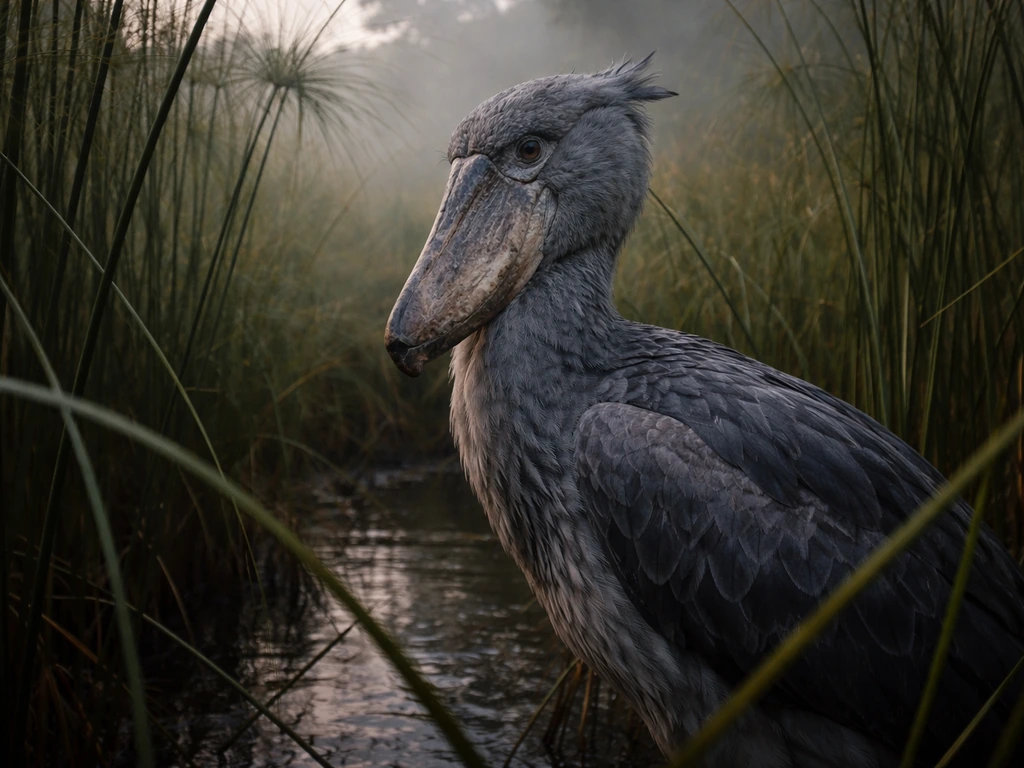
The shoebill bird lives in the freshwater swamps and wetlands of eastern and central Africa. Its core range runs from South Sudan in the north, down through Uganda, western Tanzania, the Democratic Republic of Congo, and into Zambia. That broad arc of papyrus-choked marshland is where almost every verified shoebill sighting comes from, and it's the only place on Earth this species has ever called home.
Where Does the Shoebill Bird Live? Range and Habitat Guide

Maya Hennessy
30 Apr 2026
The shoebill's native range at a glance
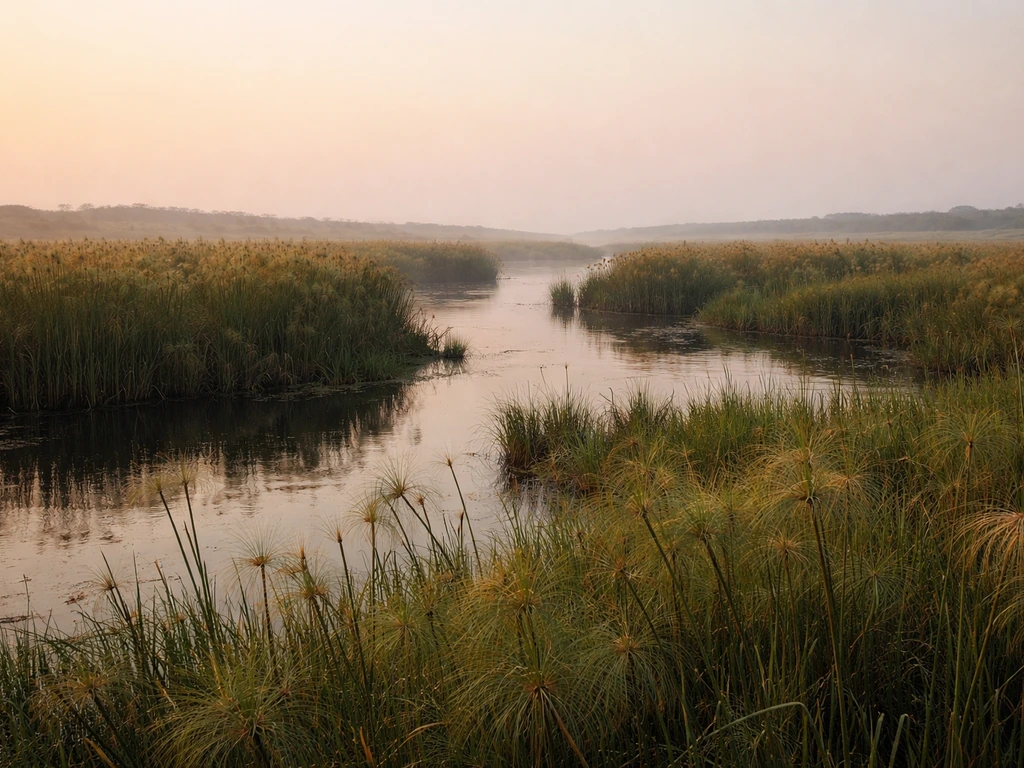
Balaeniceps rex is an African endemic, meaning it exists nowhere outside Africa in the wild. BirdLife International classifies it as one of Africa's rare and localised species, and that 'localised' part really matters. It isn't spread thinly across the continent. Its presence is concentrated in a handful of swamp systems where the right conditions line up.
blank" rel="noopener noreferrer">The CITES species proposal for Balaeniceps rex maps the core distribution running from the swamps of South Sudan southward through Uganda, then branching into DRC and continuing down into Tanzania and Zambia. Those are the countries you'd expect to see a shoebill. The Bangweulu wetlands in Zambia, which carry Ramsar designation as an internationally important wetland, are one of the most well-documented strongholds. Murchison Falls in Uganda is another site birders and researchers regularly associate with the species.
Country-by-country breakdown
| Country | Role in range | Notable site or region |
|---|---|---|
| South Sudan | Northern anchor of core range | Sudd wetlands (one of the largest swamps in the world) |
| Uganda | Reliable stronghold | Murchison Falls, Lake Victoria's Nabajjuzi marsh |
| DRC (Democratic Republic of Congo) | Large but under-surveyed part of range | Congo basin swamp systems |
| Tanzania | Western edge of range | Lake Rukwa and associated wetlands |
| Zambia | Southern stronghold | Bangweulu wetlands (Ramsar designated) |
| Ethiopia, Rwanda, Burundi | Occasional/peripheral records | Isolated wetland pockets |
Ethiopia, Rwanda, and Burundi appear in some occurrence records but are considered peripheral. The CITES documentation explicitly notes occasional records outside the core distribution, so don't be surprised if you see these countries listed on some maps. They reflect rare visits or marginal habitat pockets rather than established populations.
What 'native to Africa' actually means on the map
When people ask where the shoebill is 'from,' they're really asking about origin and evolutionary home. The answer is unambiguously equatorial and sub-equatorial eastern Africa. This isn't a bird that was introduced somewhere or has a secondary population on another continent. Every shoebill outside Africa is in a zoo. The wild population exists only in that crescent of swampland described above, and the species' entire evolutionary history is tied to the great African wetland systems that formed as the rift valley landscape shaped up over millions of years.
A useful way to anchor this geographically: think of the Nile's headwaters region and the western arm of the East African Rift Valley. The shoebill's range basically traces the swampiest parts of that zone. The Sudd in South Sudan, fed by the White Nile, is probably the largest contiguous block of suitable habitat on the planet for this bird.
The exact wetland conditions the shoebill needs
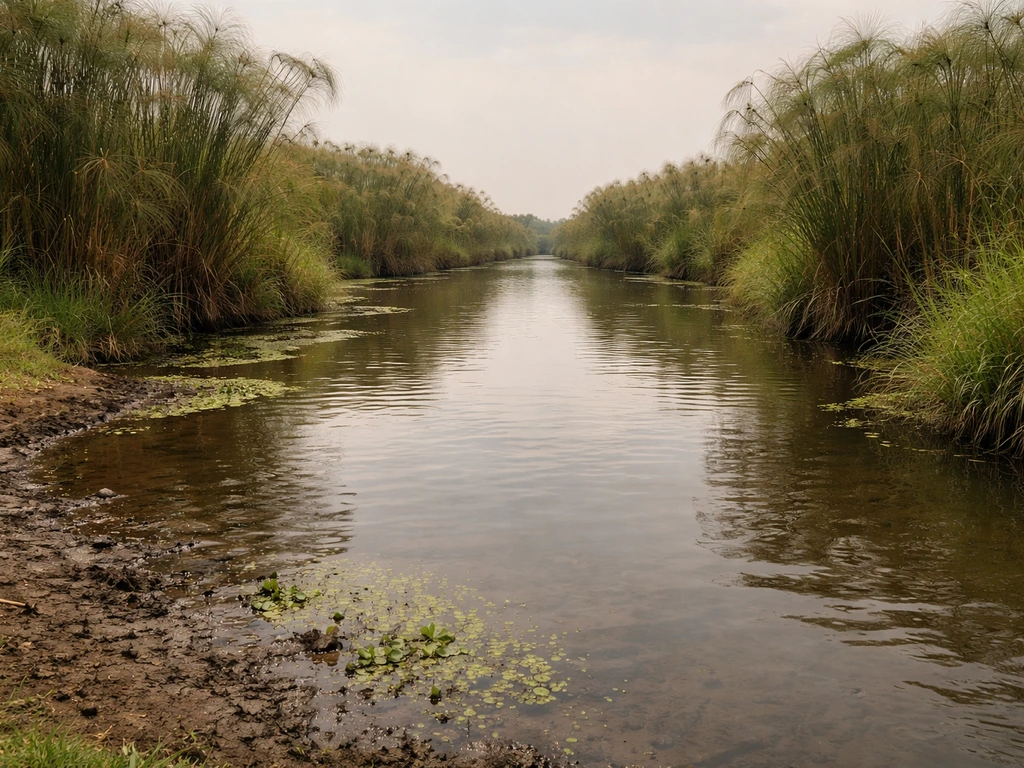
Knowing the country is only half the answer. The shoebill doesn't use just any water. It has very specific habitat requirements, and understanding those helps explain why it's rare even within its range countries.
Papyrus and lungfish: the two non-negotiables
GBIF's species data for Balaeniceps rex notes something ecologically striking: the shoebill's distribution largely coincides with the distributions of papyrus (Cyperus papyrus) and the African lungfish. That's not a coincidence. Papyrus swamps provide the dense, tall vegetation the shoebill uses to stalk prey. Lungfish are a primary food source. Where you lose the papyrus or the lungfish, you lose the shoebill.
Shallow water, tall reeds, and the hunting setup
According to Animal Diversity Web's profile of Balaeniceps rex, the most suitable foraging areas combine shallow water with tall vegetation for camouflage. The shoebill is an ambush predator. It stands motionless for long stretches, waits for a lungfish, catfish, or water snake to surface, then strikes with that enormous bill in a sudden lunge. For this strategy to work, water depth needs to be low enough that prey comes into range, and the reed or papyrus cover needs to be dense enough to hide a bird that stands 1.2 meters tall. That's a specific combination.
- Shallow, slow-moving or standing freshwater (swamps, marshes, floodplains)
- Dense papyrus (Cyperus papyrus) or reed/rush stands for cover
- High abundance of lungfish, catfish, and other large prey species
- Low human disturbance, especially during breeding season
- Seasonal flooding that maintains water levels through the dry season
A 2013 University of Cape Town thesis on shoebill habitat used aerial photography and habitat suitability modeling to quantify these requirements. The research confirmed that shoebills are essentially confined to African swamp systems where papyrus and reeds dominate and where seasonal water availability sustains prey populations year-round.
How surface water drives movement
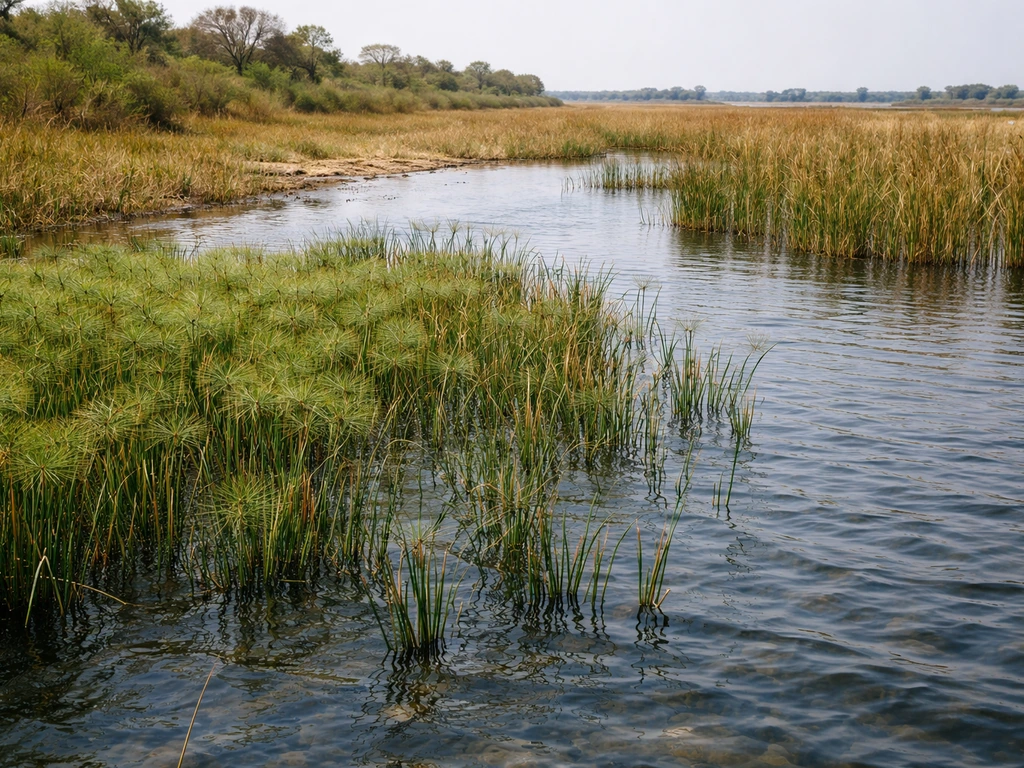
A 2021 paper in Scientific Reports added an important layer to this picture. The researchers found that changes in surface water availability are a key driver of shoebill movements. In practical terms, this means shoebills are not static residents of a fixed patch of swamp. During dry seasons, when water levels drop and suitable hunting spots shrink, birds move. This explains why sightings sometimes pop up in slightly unusual locations within the broader range. The bird is tracking its habitat, not following an arbitrary territory.
Core range vs. occasional sightings: how to read the difference
If you're looking at an occurrence map and see a dot somewhere unexpected, it helps to know how to interpret it. BirdLife's framing of the shoebill as 'rare and localised' means verified sightings cluster tightly around specific wetland strongholds rather than spreading uniformly across the whole region. An isolated dot in southern Ethiopia or the Burundian highlands isn't wrong, but it represents a marginal or dispersal record, not an established breeding population.
GBIF notes that its 'Countries of Occurrence' data are based on mapping standards intended to reflect documented presence, not necessarily breeding residency. So a country appearing in a species list doesn't always mean a stable population exists there. For the shoebill, treat South Sudan, Uganda, DRC, Tanzania, and Zambia as the places with confirmed, recurring presence. Everything else is a footnote worth tracking but not a destination for wildlife viewing.
Zoos also affect the search results here. If you're Googling shoebill sightings and finding reports from Japan or Europe, those are captive birds. If you are also curious about another unusual African bird, a morepork bird is a different species entirely and is not the shoebill. The Memphis Zoo, San Diego Zoo, and several Japanese facilities have kept shoebills. They're fascinating to watch in captivity and have helped raise public awareness, but they tell you nothing about wild range.
How habitat loss is shrinking where they actually live
The shoebill is currently listed as Vulnerable on the IUCN Red List, and BirdLife's DataZone factsheet shows a continuing decline in the number of mature individuals. The global population estimate sits somewhere between 3,300 and 5,300 birds, which is a sobering number for a species spread across a large geographic range. The practical effect of this decline is that even within its native countries, the shoebill is becoming harder to find in places it used to occur.
What's driving the retreat
BirdLife's Conservation Plan for the shoebill identifies several direct threats: disturbance by livestock and people near breeding areas, nest and breeding habitat destruction by fire, and outright habitat conversion as wetlands are drained for agriculture. The IUCN's situation analysis for West and Central Africa adds hunting and deliberate disturbance as factors in parts of the range where the species is less protected.
The result is that the shoebill's functional range is contracting even if maps still show a large area of occurrence. Areas within DRC and South Sudan that technically fall inside the range but have experienced significant wetland degradation or conflict-related disturbance now hold far fewer birds than they once did. The Bangweulu wetlands in Zambia and parts of Murchison Falls National Park in Uganda remain among the best-protected pockets, which is part of why they're considered the most reliable places to see the species today. Ramsar’s Ramsar Sites Information Service annotated summary for Zambia notes that the Bangweulu Swamps support threatened shoebills (Balaeniceps rex) blank" rel="noopener noreferrer">Bangweulu wetlands in Zambia.
This is a pattern familiar from other wetland specialists. Birds with narrow habitat requirements are disproportionately vulnerable because their entire existence depends on the persistence of a specific ecosystem type. The shoebill sits in the same category as other threatened wetland birds worldwide: when the swamp goes, the bird goes with it. It's worth noting that the question of whether the shoebill is currently at risk of extinction is closely tied to these ongoing habitat pressures. You can also check whether the shoebill bird is extinct, since its threatened status does not automatically mean it has disappeared risk of extinction.
How to find reliable, current range information
Range maps go out of date. Populations shift. A map published in 2010 may not reflect where shoebills are concentrated today. If you're comparing venomous birds in the same broad “only one species” style question, see is the hooded pitohui the only poisonous bird as a related comparison. If you're planning wildlife viewing, doing research, or just want the most accurate current picture, here's where to look and what to prioritize.
- BirdLife DataZone (datazone.birdlife.org): The shoebill species factsheet is updated with each IUCN Red List assessment cycle and includes range maps, population estimates, and threat summaries. This is the most authoritative single source for species-level information.
- IUCN Red List spatial data: The IUCN offers downloadable species distribution polygons at nrl.iucnredlist.org. These are the standardized range outlines used by conservation planners and researchers worldwide.
- GBIF occurrence records: The GBIF species page for Balaeniceps rex aggregates georeferenced sighting records from museums, citizen science platforms, and research expeditions. Filtering for recent records (last five years) gives you the most current picture of where birds have actually been observed.
- eBird (Cornell Lab): For birders planning a trip, eBird has field sighting data from Uganda and Zambia in particular, with seasonal filters that help identify peak viewing months and the specific sites producing consistent records.
- Local wildlife authorities: For Uganda, the Uganda Wildlife Authority manages Murchison Falls and keeps current information on shoebill viewing. For Zambia, the Bangweulu Wetlands are managed through a community conservation programme and guides there have up-to-date local knowledge no remote database can match.
What to look for on the ground
If you're heading to one of the core range countries for wildlife viewing, focus your search on large papyrus swamps and flooded reed beds adjacent to permanent water. If you meant macaw birds instead, their native range and preferred habitats depend on the species and are mostly in tropical forests and woodlands macaw bird where do they live. Early morning is when shoebills are most active and most likely to be visible at the water's edge. The bird's stillness is deceptive. It can stand motionless for so long that first-time observers sometimes mistake it for a log or a rock until it turns its head. Look for the silhouette of a very large, heavy-billed bird standing in shallow water at the papyrus margin. When you spot the bird near papyrus, it can be helpful to also know which magnolia species are evergreen and yellow-bird in local landscaping, since these plants are sometimes grown in the same regions is magnolia yellow bird evergreen. That's your best field clue. Some people ask whether the shoebill is the dumbest bird, but its unusual appearance and slow hunting style don't reflect its intelligence is shoebill the dumbest bird.
The seasonal surface water data from the 2021 Scientific Reports study is also practically useful: shoebill concentrations tend to be highest when water levels are stable or slightly receding, because that's when prey fish are more accessible in shallower water. Peak dry season conditions, when water has retreated to its lowest extent, can concentrate both fish and shoebills in smaller areas, making sightings more likely despite lower overall water coverage.
FAQ
Does a shoebill ever live outside eastern and central Africa in the wild?
No. Verified wild presence outside Africa does not exist, and any shoebill reported in other regions is almost always a captive animal in a zoo or private collection.
If an occurrence map shows shoebills in Ethiopia, Rwanda, or Burundi, does that mean there is a breeding population there?
Not necessarily. Those records are often marginal, and mapping data can reflect documented sightings or occasional visits rather than consistent breeding and long-term residency.
Why do some shoebill sightings appear far from major hotspots like Bangweulu or Murchison Falls?
Shoebills track changes in surface water availability. During dry periods they can shift to smaller or slightly different patches of suitable swamp where shallow hunting conditions and prey access remain possible.
What habitat should I look for in the field if I am trying to find a shoebill?
Prioritize flooded reed beds and large papyrus swamps adjacent to more permanent water. The key is shallow water plus dense tall vegetation that provides concealment for an ambush predator.
Can shoebills use any type of wetland, like open lakes or mangroves?
They are not generalist wetland birds. When papyrus or equivalent tall, dense cover is missing, and prey fish access is reduced, shoebills are unlikely to persist even if wetlands appear suitable on a broad map.
How do I interpret “Countries of Occurrence” lists from databases like GBIF?
Treat country listings as documented presence, not proof of stable breeding populations. For the shoebill, focus on areas where sightings recur and habitat conditions remain consistent.
When is the best time of day to see a shoebill in its habitat?
Early morning is typically when they are most active along the water edge. Since they can remain motionless for long stretches, plan to scan slowly at the papyrus margin rather than expecting frequent movement.
What behavior might help me confirm I am looking at a shoebill rather than a similar-looking bird?
Look for the classic heavy, bill-forward silhouette of a very large bird standing low in shallow water, then be ready for a sudden lunge after a long period of stillness.
Are zoo sightings useful for learning where shoebills live naturally?
They are useful for identification and behavior at close range, but they do not indicate wild range. Use zoo locations only as a clue that the species exists in captivity there, not that it lives in the surrounding wild habitat.
Do shoebills remain in one swamp all year?
Often no. Even within the core range, their movements can be driven by seasonal water fluctuations, so a site that holds birds in one month may hold fewer or none later.
What is a common mistake people make when planning a shoebill-watching trip?
Relying on outdated range maps or searching generic “wetland” habitat without checking for papyrus and shallow-water prey access. Sites can change quickly due to water level shifts and wetland degradation.
If the shoebill is Vulnerable, should I expect to find it easily in its native countries?
Usually not. Even inside the confirmed strongholds, sightings can be harder than expected because populations can decline and local habitat degradation can reduce the number of birds using a particular swamp system.
Next Article
Is the Dodo Bird Still Alive? What Evidence Shows Today
Learn if any dodos could exist today, why scientists say they are extinct, and how to judge sightings reliably.