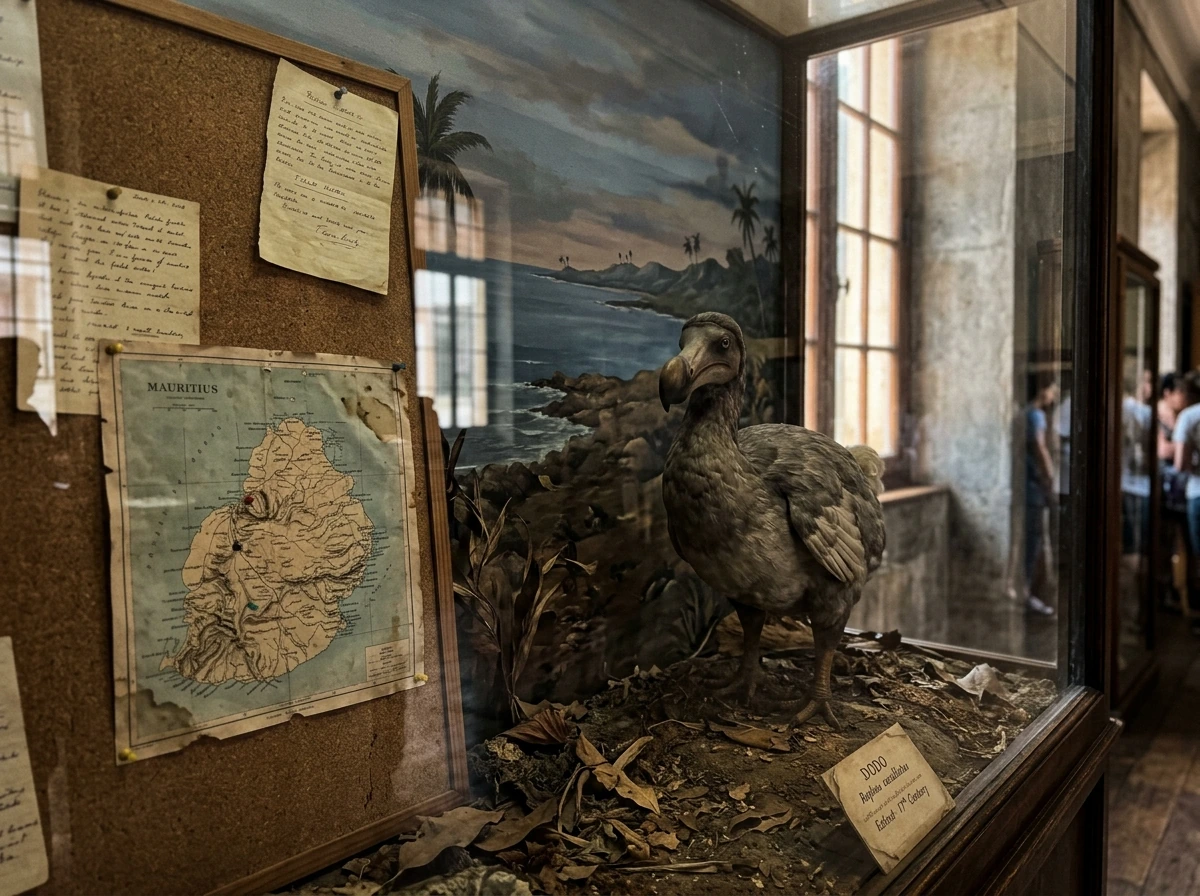
The dodo bird (Raphus cucullatus) went extinct in or around 1662, making that the most widely accepted date for the last credible sighting of a living individual. The broader scientific consensus places the extinction window somewhere between 1662 and roughly 1690, based on statistical modeling of historical records. Either way, the dodo had completely disappeared from Earth by the end of the 17th century, less than a century after Europeans first encountered it.
When Did the Dodo Bird Go Extinct? Dates, Facts, Causes

Maya Hennessy
23 Mar 2026

The exact timing: what 1662 actually means

When people ask when the dodo went extinct, 1662 is the number you'll see most often, and it has solid backing. That year marks the last record considered a credible, confirmed sighting of a live dodo bird. When people ask "what happened to the dodo bird quizlet", the accepted explanation is that the Natural History Museum in London uses 1662 as the anchor date, describing it as the point after which the dodo became the enduring symbol of human-caused extinction. The IUCN Red List also accepts 1662, following ornithologist Anthony Cheke's reasoning that accounts of 'dodos' appearing after that date were actually misidentifications of the red rail, another Mauritian bird. what bird did darwin study
That said, 1662 is a last-sighting date, not necessarily the date the very last dodo died. A landmark study by Roberts and Solow, published in Nature, applied Weibull-distribution statistical modeling to the full historical sightings record and estimated that the species may have persisted until around 1690. A Historical Biology PDF discusses Volkert Evertsz (recorded 1662) and the statistical-estimation perspective that places the dodo's extinction time closer to about 1690 the species may have persisted until around 1690. That's the more conservative scientific estimate, and it matters because it shifts the extinction window slightly but doesn't change the core story: the dodo was gone before the 18th century even began.
| Date / Range | What It Represents | Source / Basis |
|---|---|---|
| 1662 | Last credible confirmed sighting of a live dodo | IUCN Red List, Natural History Museum London, Anthony Cheke's analysis |
| ~1690 | Statistical upper bound for possible persistence | Roberts & Solow modeling (Nature), Weibull-distribution analysis |
| Late 17th century | Broadly accepted extinction window used in scientific literature | General scientific consensus |
Last sightings: who actually saw the final dodos
The most historically significant final sighting comes from 1662, recorded by Volkert Evertsz, a Dutch mariner who was shipwrecked on a small islet off the coast of Mauritius called Amber Island (sometimes referred to as Ile d'Ambre). Evertsz described capturing dodos by hand, noting that the birds showed no fear of humans whatsoever. His account is considered the last reliable firsthand description of living dodo birds in the wild. It's a striking scene: sailors simply walking up to birds that had no instinct to flee, grabbing them off the ground.
There are a handful of reports from slightly later decades, but Cheke and other ornithologists argue convincingly that these references were either misidentifications of the red rail or uncorroborated hearsay. The 1662 Evertsz account remains the gold standard for what we can actually verify. No subsequent credible eyewitness description of a living dodo survives in the historical record.
How the dodo went extinct: a timeline of collapse

The dodo's extinction unfolded over a remarkably short period. Europeans first encountered the bird on the island of Mauritius in the Indian Ocean around 1598, when Dutch sailors landed there on Mauritius. Within roughly 64 years, the species was gone. Here's how that collapse played out:
- 1598: Dutch sailors arrive in Mauritius and encounter dodos for the first time. The birds are described as fearless and easy to catch, and sailors begin killing them for food.
- Early 1600s: Mauritius becomes a regular stopover for Dutch ships. Hunting pressure builds, and sailors begin introducing domestic animals including pigs, rats, cats, and monkeys, which arrive as stowaways or are intentionally brought ashore.
- 1638: Mauritius is formally colonized by the Dutch. Habitat clearance begins in earnest as forests are felled for timber and agriculture.
- Mid-1600s: Dodo sightings become increasingly rare in European accounts. The combination of hunting, introduced predators, and habitat loss is compounding rapidly.
- 1662: Volkert Evertsz records the last credible encounter with living dodos on a small islet off Mauritius.
- Late 1660s to 1690: Possible stragglers persist in remote areas according to Roberts and Solow's statistical model, but no credible sightings are recorded after 1662.
- 1690s onward: The dodo is effectively gone. It takes decades longer for Europeans to fully register the bird as extinct, partly because the concept of species extinction wasn't yet widely accepted.
Why the dodo went extinct: the real drivers
The dodo's extinction wasn't caused by any single thing. It was a collision of pressures that hit simultaneously and compounded each other. Understanding why the dodo died out matters because the same combination of factors has driven many other island bird extinctions, including species we're still losing today.
Human hunting

Sailors killed dodos for food. The birds were large, around one meter tall and weighing roughly 10 to 17 kilograms, which made them a substantial meal. More critically, they were absurdly easy to catch. Having evolved on an island with no natural predators, dodos had no fear response to humans. They didn't flee. Sailors could simply walk up and club them. This made them an obvious target for provisioning ships, though historical accounts suggest dodo meat wasn't actually considered particularly tasty, which means hunting was significant but not the sole killer.
Introduced predators and competitors
This is arguably the most underappreciated driver. When Europeans arrived, they brought animals that had never existed on Mauritius: rats, pigs, cats, dogs, and macaques. These introduced species devastated dodo populations in ways that hunting alone couldn't. Dodos nested on the ground and laid a single egg at a time. Pigs and rats could locate and destroy those nests systematically. Macaques were particularly effective egg predators. A bird that reproduced slowly, with no instinct to protect its nest from novel threats, was completely defenseless against this kind of sustained predation pressure.
Habitat loss
Dutch colonization after 1638 brought land clearing for agriculture and timber harvesting. The forests the dodo depended on for food and shelter were reduced significantly within just a few decades. With its habitat shrinking, the dodo's already-stressed population had fewer resources and fewer refuges from both human hunters and the introduced predators spreading through the island.
Breeding biology
The dodo had a reproductive rate that couldn't absorb these losses. One egg per breeding season, ground-level nesting, and a long developmental period meant that even modest increases in mortality or nest failure translated directly into population decline. There was no capacity to bounce back. Compare this to a species like a pigeon that can produce multiple clutches a year, and you start to see how the math worked against the dodo from the moment humans arrived.
Who killed the last dodo? myths vs. what the evidence shows

There's a persistent idea that some specific group or individual can be blamed for killing the very last dodo. The truth is messier and more instructive. No single person, crew, or nation 'killed the last dodo.' The 1662 Evertsz account describes sailors capturing multiple birds on an islet, but this was a final documented encounter, not a documented killing of the last individual. We simply don't know which specific animal was the last of its kind, or exactly when it died.
The Dutch are sometimes cast as the primary villains because they colonized Mauritius, and there's truth in the historical responsibility, but the extinction was the result of an ecological cascade that no one at the time fully understood or even recognized was happening. The concept of species extinction wasn't scientifically acknowledged until well after the dodo was already gone. Most Europeans who encountered the dodo simply assumed there were more birds somewhere else on the island. The idea that a species could be permanently wiped out wasn't part of 17th-century thinking.
If you're looking for an honest answer to 'who did it,' the accurate framing is: a combination of Dutch sailors, settlers, and the animals they introduced, operating within a colonial system that saw island resources as inexhaustible. That's the evidence-based version. Blaming a single moment or a single actor misses the systemic reality.
Is the dodo extinct today? clearing up the confusion
Yes, the dodo is completely and permanently extinct. It is not endangered, critically endangered, or threatened. Those terms apply to species that still exist but face risk of extinction. The dodo hasn't existed for over 350 years. The IUCN Red List classifies Raphus cucullatus as Extinct, which is the definitive final category in conservation classification.
The confusion sometimes arises because people hear about de-extinction research and wonder whether the dodo could be brought back. Scientists have recovered dodo DNA from museum specimens, which opens theoretical discussions about resurrection biology, but no living dodo exists anywhere, including in captivity. If you've seen headlines about dodo revival projects, those are speculative or early-stage scientific proposals, not evidence that dodos are alive. For more on the DNA angle, the question of whether we have dodo bird DNA is worth exploring separately, as it's a genuinely interesting piece of the scientific story.
How long ago did the dodo go extinct?
Using today's date of March 23, 2026, and the accepted last-sighting date of 1662, the dodo has been extinct for approximately 364 years. If you use the Roberts and Solow upper estimate of 1690, the figure drops to roughly 336 years. Either way, the dodo has been gone for more than three and a half centuries, longer than the United States has existed as a country.
| Reference Date | Years Since Extinction (as of March 2026) | Context |
|---|---|---|
| 1662 (last confirmed sighting) | ~364 years | Most widely cited extinction date |
| 1690 (statistical upper bound) | ~336 years | Roberts & Solow modeling estimate |
| 1598 (first European contact) | ~428 years | Time from discovery to present; shows how fast the collapse happened |
That 64-year window between first contact and last sighting is the number that really puts the dodo's extinction in perspective. It took less than a human lifetime to eliminate a species that had lived on Mauritius for hundreds of thousands of years. That's the part of this story worth sitting with, because the same pattern, fast-moving human pressure meeting slow-reproducing island birds with no defenses, is still playing out with other species today.
How to verify dodo extinction claims yourself
If you want to check any claim about dodo extinction dates, here's a practical approach. Start with the IUCN Red List entry for Raphus cucullatus, which is freely searchable and gives you the official classification and the rationale behind the 1662 date. The Natural History Museum London's online resources and GBIF's species database both provide reliable, well-sourced summaries. For the statistical modeling work, the Roberts and Solow paper published in Nature is the primary reference for the ~1690 upper estimate.
When you encounter a claim about a later dodo sighting (some sources occasionally cite dates in the 1680s or even 1690s), the key question to ask is whether it's a firsthand account or a reference to the red rail. Cheke's analysis, widely accepted by the IUCN and ornithological community, explains why those later references don't hold up as dodo evidence. Sticking to peer-reviewed sources and major natural history museum records will steer you away from the myths and toward the best available science.
The dodo's extinction is one of the most thoroughly documented early cases of human-driven species loss, which is exactly why it became such a powerful symbol. The evidence is clear, the timeline is well-established, and the lessons it carries are still relevant to conservation science today.
FAQ
Why do some sources claim the dodo lasted until the 1680s or 1690, if 1662 is accepted?
It depends on what someone means by “extinct.” The 1662 date is the commonly used anchor for the last credible verified living sighting, but the species could have died out earlier or persisted briefly after. A separate modeling estimate suggests a later extinction window (up to around 1690), so it is safer to say “extinct by the late 17th century” unless a specific, documented last encounter is required.
What is the red rail confusion, and how does it affect extinction dates?
Usually because the later reports are not direct evidence of living dodos. After 1662, some claims were either misidentifications of the red rail or unverified retellings without independent corroboration. Cheke’s reasoning (which is reflected in major conservation references) is that these look like sightings of a different species, not surviving dodos.
Is there any way to know the exact date the last dodo died?
They are describing two different endpoints. “Last sighting” refers to the last credible record of a living individual, while “last death” is unknowable because historical records cannot pinpoint when the final bird died. That is why even strong estimates still talk about an extinction window rather than a specific death day.
Did any dodos survive in captivity or private collections after 1662?
No reliable evidence indicates a captive or surviving breeding population. Museum specimen DNA research is real, but it does not mean dodos survived anywhere, including in zoos or private collections. If you see claims about “surviving dodos” in captivity, treat them as speculation unless they come with contemporaneous, firsthand documentation.
Could a small dodo population have survived unnoticed on Mauritius after the last record?
Not to date, and there is no credible account of living dodos in any location in the wild after the 17th century window. The historical record is also unusually strong for an early extinction case, so if a population had persisted, you would expect at least one additional reliable eyewitness description to survive.
If I want to verify a specific extinction-year claim, what should I check first?
The most defensible approach is to use consensus databases and then check the evidence type behind alternative dates. Start with the IUCN Red List for classification rationale, then consult the Natural History Museum London resources for the 1662 anchoring logic. If a source argues for a later date, look for peer reviewed modeling or clearly dated firsthand accounts rather than secondary retellings.
How do you calculate “how long ago” the dodo went extinct, and why do numbers differ?
You can get a “years since extinction” figure by subtracting from the current year, but the result depends on which extinction endpoint you adopt. Using 1662 gives the longer duration, while using an upper-window estimate like 1690 gives a shorter duration. The important takeaway is that both calculations place the extinction well over 300 years ago.
Next Article
Did a Dodo Bird Hatch Recently? Reality Check and Facts
Yes or no on a recent dodo hatch, plus extinction evidence and a checklist to verify viral claims.