
The dodo cannot fly because evolution stripped away the physical machinery required for powered flight. Living on the island of Mauritius for millions of years with no land predators to escape, the dodo had no survival reason to keep expensive wing muscles and a heavy flight-ready skeleton. Over generations, its keel bone shrank, its pectoral muscles reduced to near nothing, its wings became stubby and functionally useless for lift, and its body grew heavy and compact.
Why Dodo Bird Cannot Fly: Evolution and Anatomy Explained

Maya Hennessy
30 May 2026
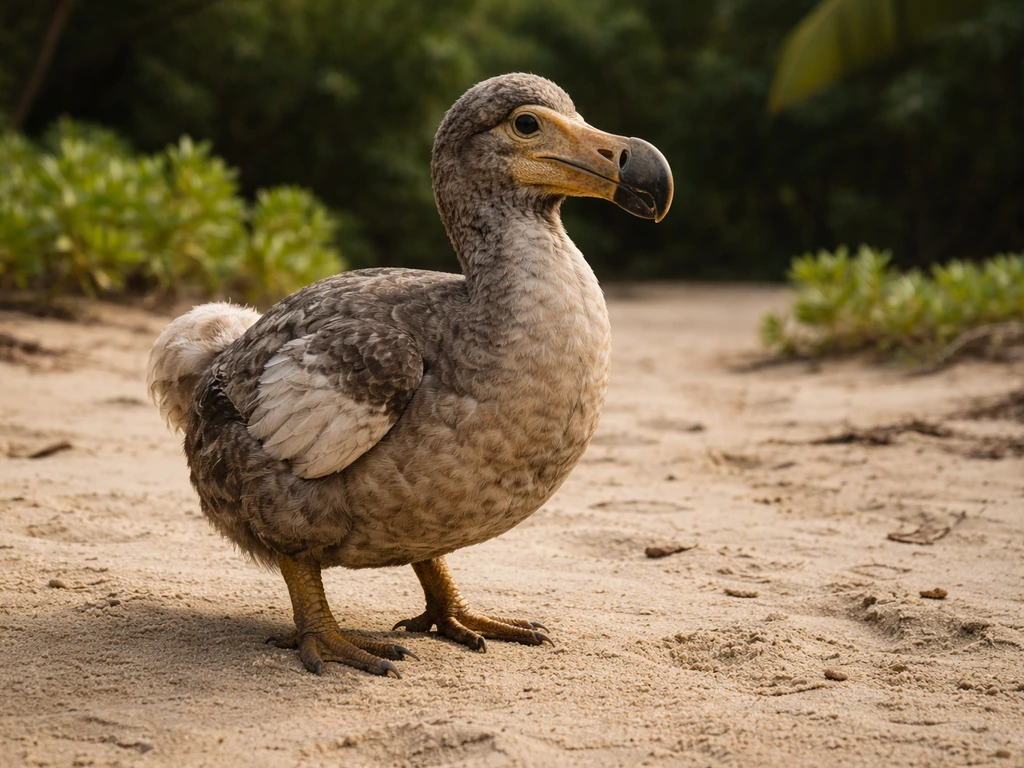
By the time Dutch sailors encountered the bird in 1598, it was as grounded as a boulder. This was not a defect. It was a remarkably efficient adaptation to island life, and understanding exactly how it happened tells us a great deal about how evolution works.
What 'can't fly' actually means for the dodo
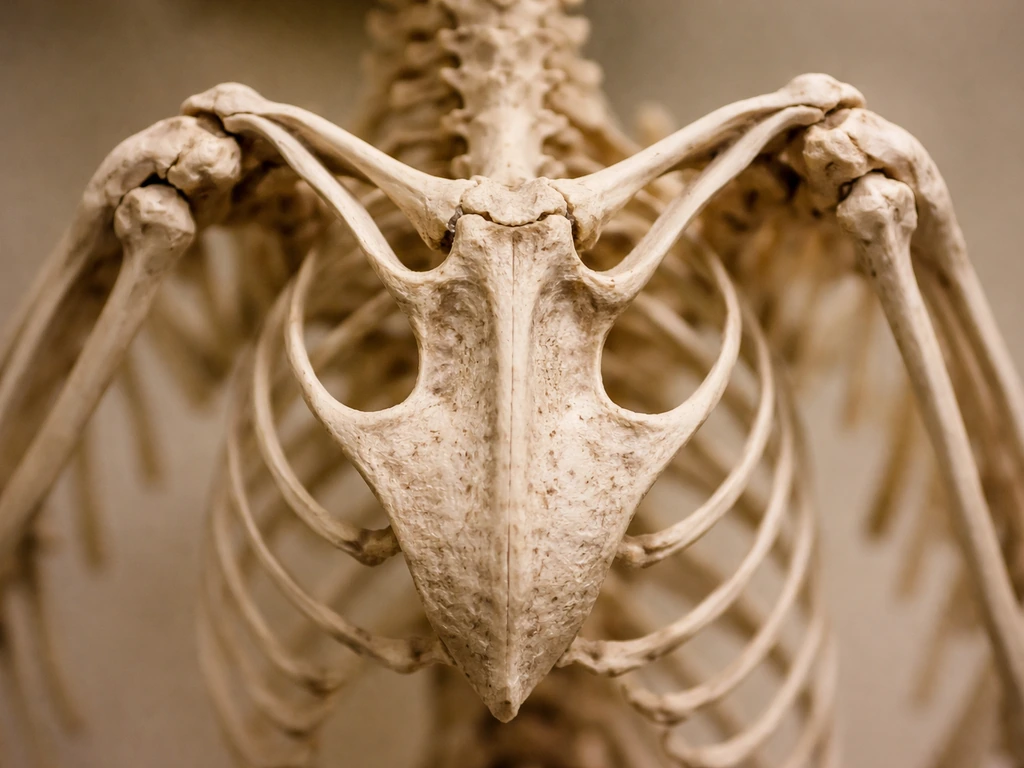
Flightlessness in birds is not always a simple on/off switch. Scientists classify it on a spectrum, using the skeleton (especially the sternum) and the proportion of wing bones to body mass as key indicators. A bird capable of powered flight needs a large, blade-like keel projecting from the breastbone to anchor the enormous pectoral muscles that drive each wingbeat. In the dodo, that keel was truncated and structurally weak, unable to support the muscle mass needed to generate lift.
A recent review of the dodo and solitaire systematics and nomenclature describes the dodo sternum character in comparative “Mascarene columbiforms” anatomy as a truncated or weak keel rather than a normal flight-muscle keel truncated and structurally weak keel. Its pectoral girdle and the bones of the forelimb were also reduced relative to what you see in volant (flying) pigeons, which are the dodo's closest living relatives.
So when scientists say the dodo was 'fully flightless,' they mean it in the most complete functional sense: the bird lacked not just the will or strength to fly, but the anatomical hardware entirely. There was no latent capacity being suppressed. The flight apparatus was simply gone, repurposed, or reduced to vestigial remnants. This is different from, say, a heavily built bird that struggles to get airborne but technically can. The dodo could not have flown under any circumstances. Because the dodo cannot fly and was built for walking, it also had no meaningful running speed recorded dodo running speed.
Bones and muscles built for walking, not wings
The skeleton is where the story gets really concrete. In a flight-capable bird, two muscles do most of the work: the pectoralis major drives the downstroke, and the supracoracoideus pulls the wing back up. A review of the dodo and its ecosystem emphasizes that [biomechanical and functional reconstructions are constrained by which skeletal elements are recovered](https://www. tandfonline.
com/doi/full/10. 1080/02724634. 2015. 1113803) and articulated in fossils, limiting precise inferences when remains are incomplete.
Both originate from the ventral keel of the sternum. The bigger the keel, the more surface area for muscle attachment, and the more powerful the flight. In the dodo, this architecture had largely collapsed. The keel was reduced, the pectoral girdle was lighter and less robust, and the wing bones were short relative to body size.
Meanwhile, the hindlimbs went the other direction. The legs were thick and well-developed, suited for supporting a body that CT-based volumetric reconstructions estimate weighed somewhere between roughly 12. 5 and 16. 1 kilograms for an adult.
That is a serious ground bird. If you are wondering how big a dodo bird was, scientists estimate that an adult weighed roughly 12. 5 to 16. 1 kilograms how big is a dodo bird.
The energy and calcium that would otherwise go into maintaining large wings and flight muscles was redirected into a stockier, ground-adapted body plan. Bone histology studies of dodo remains even show patterns consistent with seasonal calcium reallocation, suggesting the skeleton was actively managed for a ground-dwelling life history rather than an aerial one.
The short, stubby wings the dodo retained were not entirely useless. Some researchers suggest they may have played a role in balance, communication, or display. But powered flight? Completely off the table. The structural math simply did not add up.
How island life drove the dodo to give up flying

Mauritius sits in the Indian Ocean, about 900 kilometers east of Madagascar. When the ancestors of the dodo arrived there (most likely as flying pigeons blown off course or island-hopping at some point in the distant past), they landed in an environment with abundant food and, crucially, no mammalian predators. For the latest dodo bird news and research updates about this extinct flightless species, keep an eye on new paleontology and conservation findings. There were no foxes, no cats, no rats, no mongooses. The island had giant tortoises, some reptiles, and various birds, but nothing that hunted adult dodos on the ground.
In that kind of predator-free environment, maintaining the capacity for flight becomes a costly luxury. Powered flight is metabolically expensive. It requires large muscles, lightweight hollow bones, a specific body proportion, and constant energy investment. If you never need to escape a predator and food is available on the ground, all of that investment is wasted calories. Natural selection ruthlessly trims what it doesn't need. Over many generations, individuals with slightly smaller wings and slightly heavier bodies did just fine, reproduced successfully, and passed those traits on. The result, over a long span of island isolation, was a completely flightless bird.
This process is well-documented across bird evolution. Research tracking island bird lineages shows it happening in a predictable, repeatable pattern: reduce flight muscles, enlarge hindlimbs, increase body size. It has happened at least 35 times independently in birds alive today, and when extinct species are included in the analysis, that number climbs to around 150 separate evolutionary transitions to flightlessness. The dodo is one example of a very well-worn evolutionary path. If you are comparing the dodo bird vs chicken, this broader pattern helps explain why some birds lose flight while others never do dodo is one example of a very well-worn evolutionary path.
What fossils and scientific reconstructions tell us
Most of what we know about dodo anatomy comes from bones, and the most important source of those bones is the Mare aux Songes, a marshy deposit in southeastern Mauritius. Radiocarbon dating places the main bone accumulation there at roughly 4,100 to 4,235 years ago, meaning these are mid-Holocene remains. The site functions as a vertebrate concentration Lagerstätte, a preservation context where bones from many individuals accumulated together, giving researchers a statistically meaningful sample rather than just a few isolated fragments.
Beyond Mare aux Songes, the Thirioux specimens (collected in the early 1900s) include one nearly complete associated skeleton now in Port Louis, Mauritius, and a partial composite skeleton in Durban, South Africa. These are critical because associated skeletons, where bones from one individual are found together, allow much more reliable biomechanical inference than mixed bone beds. The Oxford Dodo, held at the Oxford University Museum of Natural History, is another anchor point: it includes original head and foot material from an early modern specimen, with scanning and research ongoing. The Natural History Museum in London also holds dodo skeletal material as part of its fossil bird collection.
Researchers applying CT-based volumetric mass estimation methods to dodo remains have produced body mass estimates in the range of 12.5 to 16.1 kilograms, which corrected the old image of the dodo as an obese, waddling creature. It was a solid, well-proportioned ground bird, not a grotesque one. These reconstructions also confirmed the reduced flight apparatus: the wing elements are simply not there in the proportions you would need for flight, and the sternum lacks the keel architecture to support it. The anatomical case for full flightlessness is, at this point, airtight.
How the dodo compares with other flightless birds
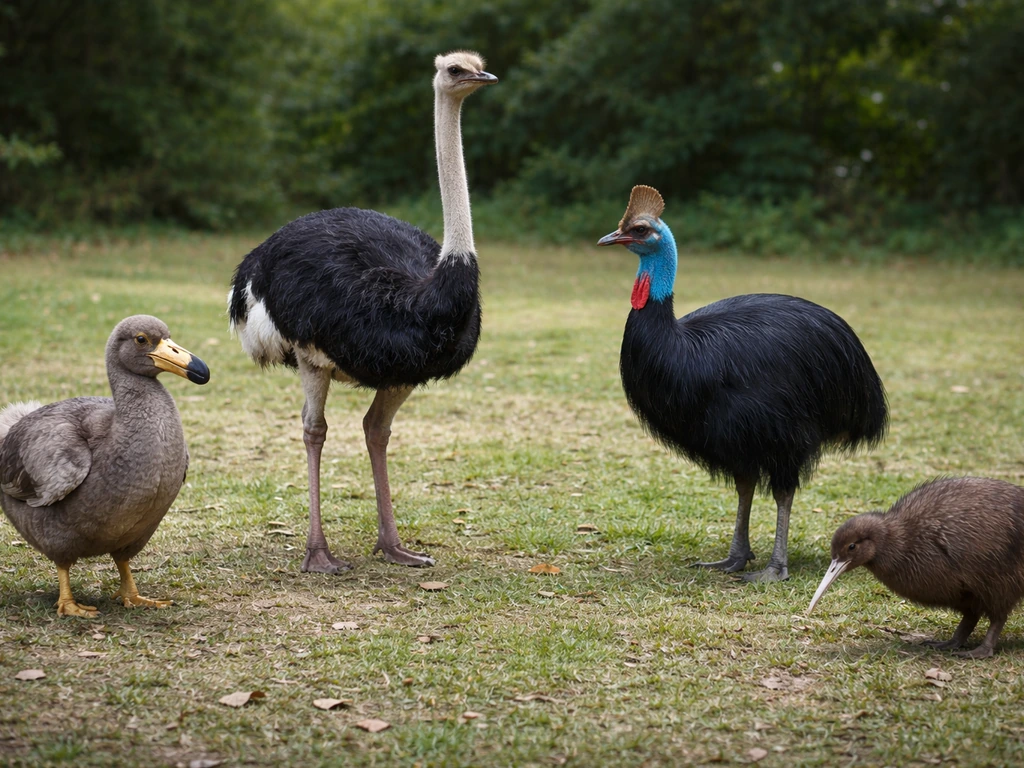
The dodo fits into a broader family of flightless birds, each shaped by its own version of the same basic story. Comparing them helps clarify what is universal about flightlessness and what is specific to the dodo's situation.
| Bird | Where/When | Cause of Flightlessness | Status | Key Anatomical Note |
|---|---|---|---|---|
| Dodo (Raphus cucullatus) | Mauritius; extinct ~1662–1690 | Island isolation, no predators, ground foraging | Extinct | Reduced keel, shortened wings, heavy hindlimbs |
| Moa (Dinornithiformes, 9 species) | New Zealand; extinct ~1400s | Island isolation, no predators for millions of years | Extinct (hunted to extinction by Polynesians) | Virtually no wing bones at all in some species |
| Kiwi (Apteryx spp.) | New Zealand; present day | Island isolation, nocturnal ground foraging | Endangered/vulnerable | Tiny vestigial wings, large olfactory brain region |
| Kakapo (Strigops habroptilus) | New Zealand; present day | Island isolation, ground-adapted foraging | Critically endangered | Reduced keel, large body, nocturnal |
| Ostrich (Struthio camelus) | Africa; present day | Continental grasslands, speed over flight | Least concern | Largest living bird; robust legs, reduced wings |
The moa comparison is particularly striking. New Zealand moa had virtually no wing bones left at all in several species, representing an even more advanced stage of wing reduction than the dodo. The kiwi, still alive today but endangered, retained tiny vestigial wings and shows many of the same skeletal trends as the dodo on a smaller scale.
What's notable is that these birds are not closely related: the moa and kiwi are ratites, while the dodo was a columbiform (pigeon relative). Their flightlessness evolved completely independently, driven by the same environmental logic. If you want a close-up comparison of different flightless megafauna, dodo bird vs ostrich offers a useful adjacent angle. Researchers have confirmed that distinct developmental and genetic pathways underlie these losses, meaning nature found different molecular routes to the same destination.
This convergence is one of the most powerful arguments in evolutionary biology. When unrelated lineages repeatedly arrive at the same body plan under the same conditions, it tells you those conditions are doing the driving, not coincidence.
Why the dodo disappeared, and what that says about flightless birds generally
The same adaptation that made the dodo so well-suited to predator-free Mauritius made it catastrophically vulnerable the moment that equation changed. When humans arrived in force in the late 16th century, they brought everything the dodo's evolution had never prepared it for: hunting, habitat clearance, and most destructively, invasive mammals. Pigs, rats, macaques, and deer arrived with European ships. Current scientific consensus, supported by bone histology and ecological modeling, places invasive mammals as the primary extinction driver, not direct hunting alone. The mammals raided dodo nests, ate eggs, and competed for food resources. The dodo, having evolved without any ground-level predator pressure, had no behavioral or physical defenses against any of it.
The last confirmed dodo sighting is attributed to Volkert Evertsz in 1662, though some statistical modeling suggests small populations may have persisted until around 1690. Either way, within roughly a century of sustained human contact, the species was gone. That speed is a direct consequence of flightlessness. A bird that can fly can escape, disperse, find refuge. A bird that cannot fly is trapped wherever it stands.
This is why the dodo's story resonates so powerfully in conservation science today. The kiwi, the kakapo, and many island rails face versions of the same vulnerability. Flightlessness is not a flaw in these birds; it is a perfectly reasonable evolutionary response to their original environment. The problem is that environments change, usually now because of us, and flightless birds cannot adapt fast enough. Understanding the dodo's biology makes the urgency around protecting living flightless birds much easier to grasp.
Where to go if you want to dig deeper
If you want to go beyond the basics, the peer-reviewed literature on dodo anatomy and ecology is more accessible than you might expect. The 2015 review of the dodo and its ecosystem (published in the Journal of Vertebrate Paleontology as a supplement) is a comprehensive entry point that covers the Mare aux Songes deposit, locomotion, diet, and the broader ecological picture. The 2017 bone histology paper published in Scientific Reports (Wiemann et al.) gives a surprisingly readable account of what the dodo's bones reveal about its seasonal biology and energy use.
For anatomy specifically, look for papers that use geometric morphometrics or CT-based reconstruction to discuss dodo skeletal proportions. The mass estimation studies (especially those using convex-hull CT methods) are useful for understanding how we know what we know about the dodo's body size and build, and why early artistic depictions were so misleading.
Museum collections are also worth exploring directly. The Oxford University Museum of Natural History has online resources about the Oxford Dodo specimen, including its scanning history and specimen significance. The Natural History Museum in London maintains a fossil bird collection that includes dodo material and provides institutional context for anyone researching the species. Both are legitimate starting points if you want named, physical specimens to anchor your reading.
For the broader evolutionary picture, the paper 'Predictable evolution toward flightlessness in volant island birds' (published in PNAS) is the clearest overview of why island birds lose flight so consistently. If you want the extinction angle, 'Anthropogenic extinctions conceal widespread evolution of flightlessness in birds' (also in PNAS) puts the dodo into the context of the roughly 150 estimated independent losses of flight in birds when extinct species are included. Reading those two papers alongside the dodo-specific literature gives you a genuinely complete picture of why the dodo is flightless, and why that matters well beyond one extinct bird on one island. This is the dodo bird verdict: island pressures and later human-driven change turned what began as an efficient adaptation into an irreversible loss of flight dodo verdict.
FAQ
Could a dodo technically flap enough to lift off, even if it was called “fully flightless”?
Not in a powered-flight sense. Its sternum did not retain the keel structure needed to anchor the large downstroke muscles, and the wing skeleton and muscle system were reduced relative to flying birds. That combination prevents sustained lift rather than just making takeoff harder.
Why do some people think dodos were “too lazy” to fly?
That idea conflicts with how the anatomy changed. Flightlessness came from lost or repurposed flight hardware, plus a body plan that favored walking and heavy-ground support. A behavior explanation would not account for the missing keel architecture and reduced wing proportions.
If the dodo couldn’t fly, why did it keep stubby wings at all?
Vestigial wings can still serve other functions. Researchers suggest they may have helped with balance, signaling, or display even after the flight apparatus stopped working. The key point is that those wings were not built to generate aerodynamic lift.
Were dodos slow because they could not fly, or was there a separate reason for their movement limits?
Flightlessness and ground adaptation are connected, but movement speed depends on hindlimb mechanics and body mass. Even though the dodo was designed for walking, it was also heavy (estimated around 12.5 to 16.1 kg). The resulting locomotion pattern is a whole-body tradeoff, not just the absence of flight.
Did dodos have any ability to glide or jump to get air time?
The evidence in the article points to no functional powered flight, but it does not establish a robust gliding capability. With reduced flight-wing proportions and missing sternum keel support, any brief air movement would not be expected to function like gliding in typical winged animals.
Are “flightless” and “not able to take off from the ground” exactly the same thing?
No. Some birds are weak flyers that can sometimes get airborne. In contrast, the dodo is described as functionally flightless because the anatomical machinery for flight was absent or too reduced to support the muscle and skeleton architecture required for lift.
Did the dodo evolve flightlessness because there were no predators at all on Mauritius?
Predator-free conditions were a major driver because the cost of maintaining flight would be wasted when escape advantages are unnecessary. The article also emphasizes a later shift, where invasive mammals created egg raiding and competition that the dodo’s ground-adapted defenses did not counter.
Which is more responsible for the dodo’s extinction, hunting or invasive mammals?
The article describes scientific consensus that invasive mammals were the primary driver. They raided nests, ate eggs, and competed for food, which is especially damaging to flightless birds because adults cannot easily escape or disperse to safer habitat.
How fast could flightlessness-related vulnerability cause extinction once humans arrived?
Within about a century of sustained human contact, the dodo disappeared, with a last confirmed sighting in 1662. The article links that rapid collapse to how flightlessness traps a species geographically when new threats intensify.
Were dodos uniquely flightless, or is it something that happened repeatedly in other island birds?
It happened repeatedly. The article notes multiple independent evolutionary transitions to flightlessness in island bird lineages, showing that similar environmental pressures can produce similar outcomes even in unrelated groups.
Why do comparisons to kiwi or ostrich help, if those birds are not closely related to the dodo?
Because they show convergence. Different evolutionary lineages can reach flightlessness through different developmental and genetic routes, but under similar ecological pressures like reduced need for escape and ground-focused living.
How confident are scientists about dodo body mass and what that implies for flight capability?
The article describes CT-based volumetric mass estimation placing adult mass roughly between 12.5 and 16.1 kg, correcting older depictions. Higher confidence in mass and skeletal proportions strengthens the conclusion that the flight apparatus could not generate the required lift and muscle power.
Next Articles
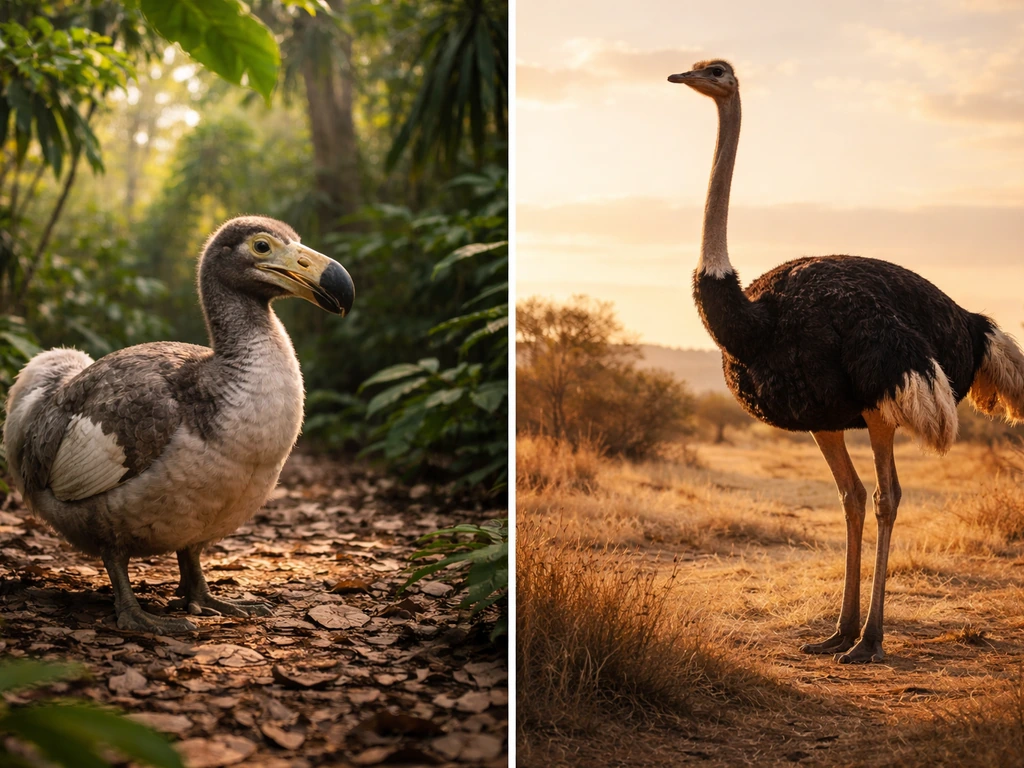
Dodo Bird vs Ostrich: Key Differences, Ecology, History
Compare dodo vs ostrich by range, traits, diet, behavior, reproduction, and human impact, linking ecology and flightless
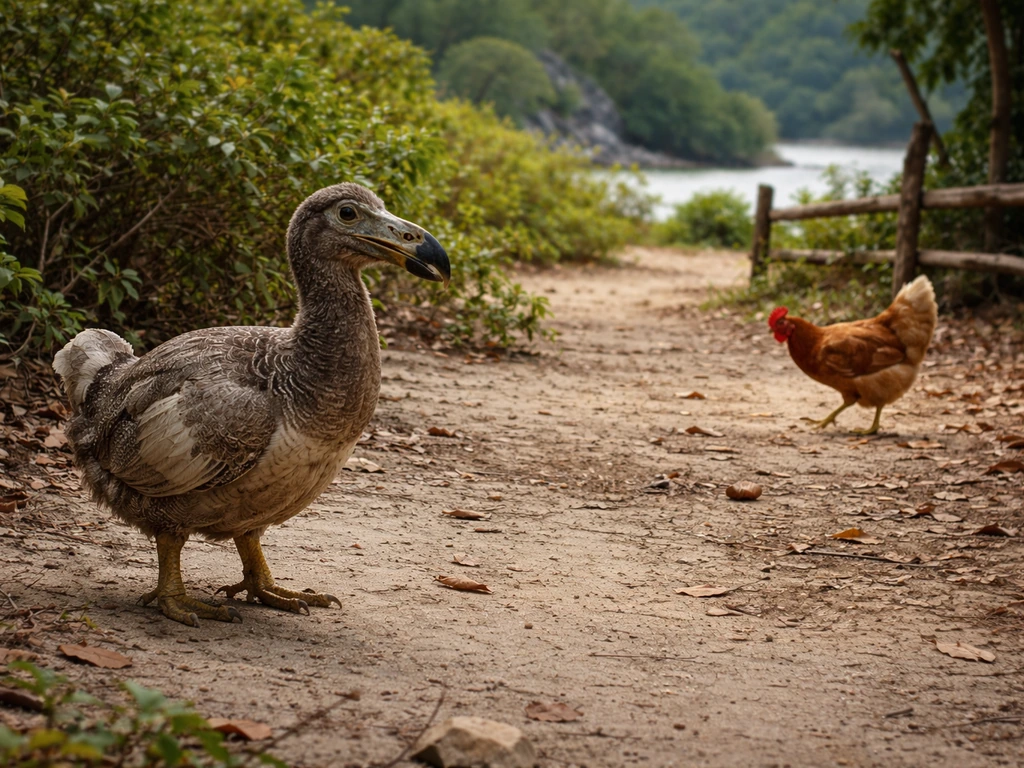
Dodo Bird vs Chicken: Key Differences and Why One Survived
Compare dodo vs chicken traits, flight and anatomy, diet and behavior, and explain why humans led dodo to extinction.
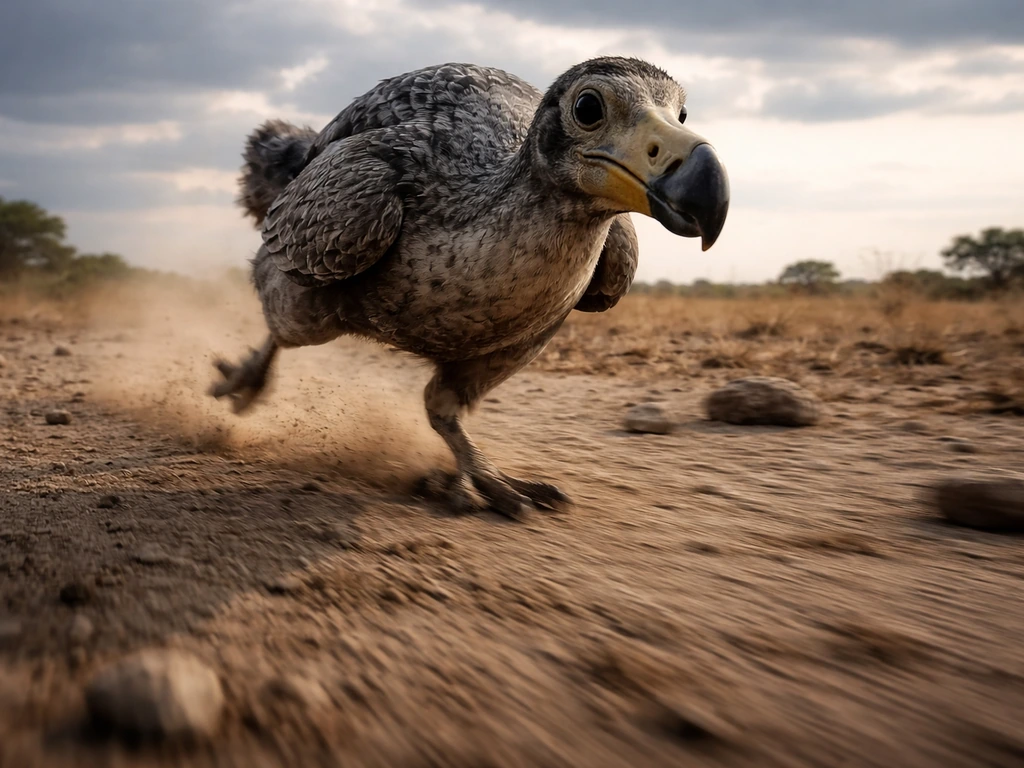
How Fast Can a Dodo Bird Run? Speed Estimates Explained
Estimates for how fast a dodo could run, what limits speed, evidence types, and context vs moa kiwi and cassowary.