Yes, the Andean condor (Vultur gryphus) is a bird of prey. It sits in Order Accipitriformes, the same taxonomic order that contains eagles, hawks, and Old World vultures, and it carries every anatomical hallmark of a raptor: a hooked beak built for tearing flesh, sharp talons, and exceptionally keen eyesight. The only thing that makes people hesitate is that it mainly eats carrion rather than hunting live animals. But that hesitation is based on a misconception about what "bird of prey" actually means.
Is the Andean Condor a Bird of Prey? Raptor Facts

Maya Hennessy
20 May 2026

What "bird of prey" actually means
The phrase "bird of prey" (or raptor) does not mean a bird that exclusively chases and kills live animals. According to the University of Minnesota's Raptor Center, a raptor is simply a carnivorous bird distinguished by three physical traits: a hooked beak, sharp talons, and keen eyesight. PBS Nature's definition is even more inclusive, describing raptors as birds adapted for "hunting and/or scavenging," making it explicit that carrion feeders qualify. The U.S. National Park Service's bird-of-prey resources list the same core traits: hooked beaks, sharp talons, excellent vision, and a carnivorous diet. Notice that none of those definitions require a bird to actively hunt. The classification is grounded in anatomy and diet type (meat), not in whether the meat was alive five minutes ago.
It is worth noting that ornithologists have debated the exact boundaries of "raptor" for decades, and some taxonomic papers flag that relying solely on beak shape or talons can create edge cases. But in everyday conservation and wildlife science contexts, the definition is consistent: carnivorous birds with hooked beaks, talons, and sharp vision are raptors. The Andean condor clears every one of those bars.
Yes, the Andean condor fits
Taxonomically, the answer is unambiguous. Both ITIS (the Integrated Taxonomic Information System) and the U.S. Fish and Wildlife Service's taxonomic tree place Vultur gryphus in Order Accipitriformes, Family Cathartidae (New World vultures). Britannica confirms the same placement, grouping New World vultures including the Andean condor under Accipitriformes alongside the Accipitridae family that contains eagles and hawks. eBird, one of the most widely used bird taxonomy tools, lists it under Cathartidae within the same broader raptor grouping. If you look the bird up in any of those references today, you will see it sitting right there alongside other recognized birds of prey. The classification is not a matter of debate.
Scavenger vs. hunter: why it still counts as a raptor
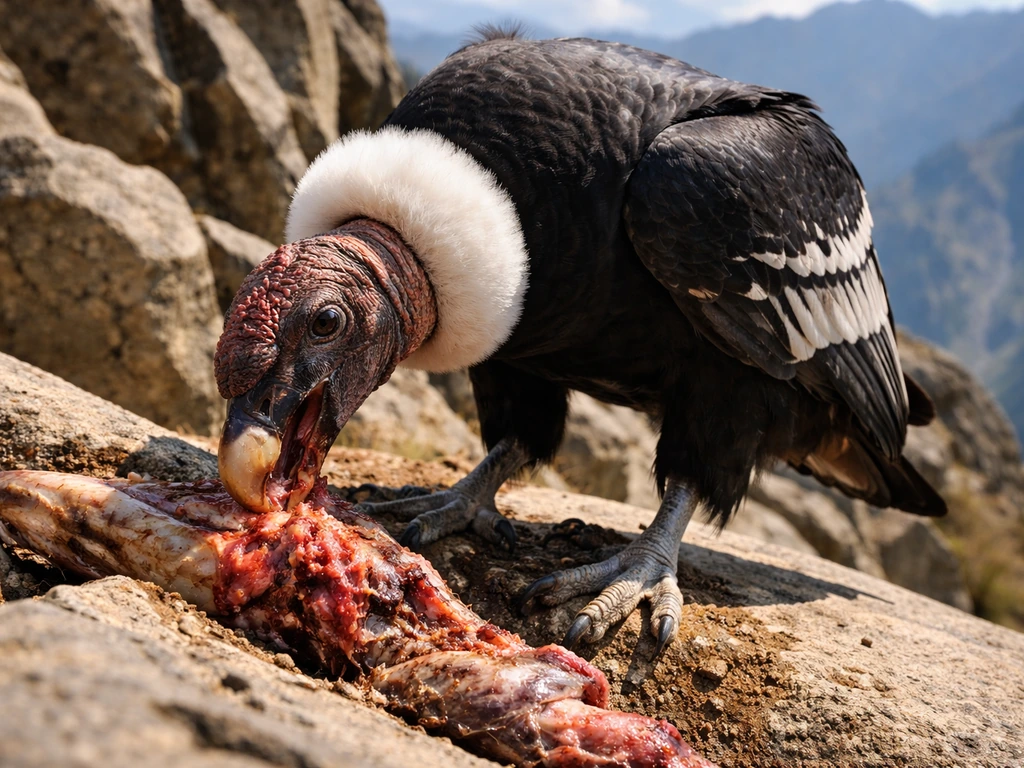
Here is the part people find confusing. The Andean condor is primarily a scavenger. It feeds on large carrion: deer carcasses, dead cattle, sheep, and similar remains. The Peregrine Fund describes condors pushing their heads deep into carcasses to reach soft tissue and viscera. Animal Diversity Web is blunt about it: condors "lack well developed hunting techniques." They may occasionally chase weakened live prey and begin feeding before it has died, but that is opportunistic, not a primary hunting strategy. Wikipedia summarizes the diet as "mainly carrion," located by soaring at altitude and spotting it visually or following other scavengers downward.
So why does that still count? Because the PBS definition already answered this: raptors are adapted for hunting and/or scavenging. Scavenging is not a loophole or a lesser status. It is a legitimate ecological role, and the anatomical tools needed to process a carcass (a hooked beak to tear through hide and flesh, strong feet to brace against a large body, excellent vision to spot a dead animal from altitude) are the same suite of traits that define the raptor group. The condor's bare, featherless head and neck is actually a hygiene adaptation for feeding inside carcasses without fouling feathers, which, far from excluding it from raptor status, is a specialized evolutionary refinement of the scavenging raptor lifestyle.
One more detail worth knowing: the Andean condor forages by sight rather than smell, which sets it apart from some smaller New World vultures like turkey vultures that rely heavily on olfaction. That acute visual scanning ability, used to spot carcasses from high altitude, is very much in line with the "keen eyesight" trait that the Raptor Center and NPS both use to define raptors.
The physical traits that put it in the raptor category
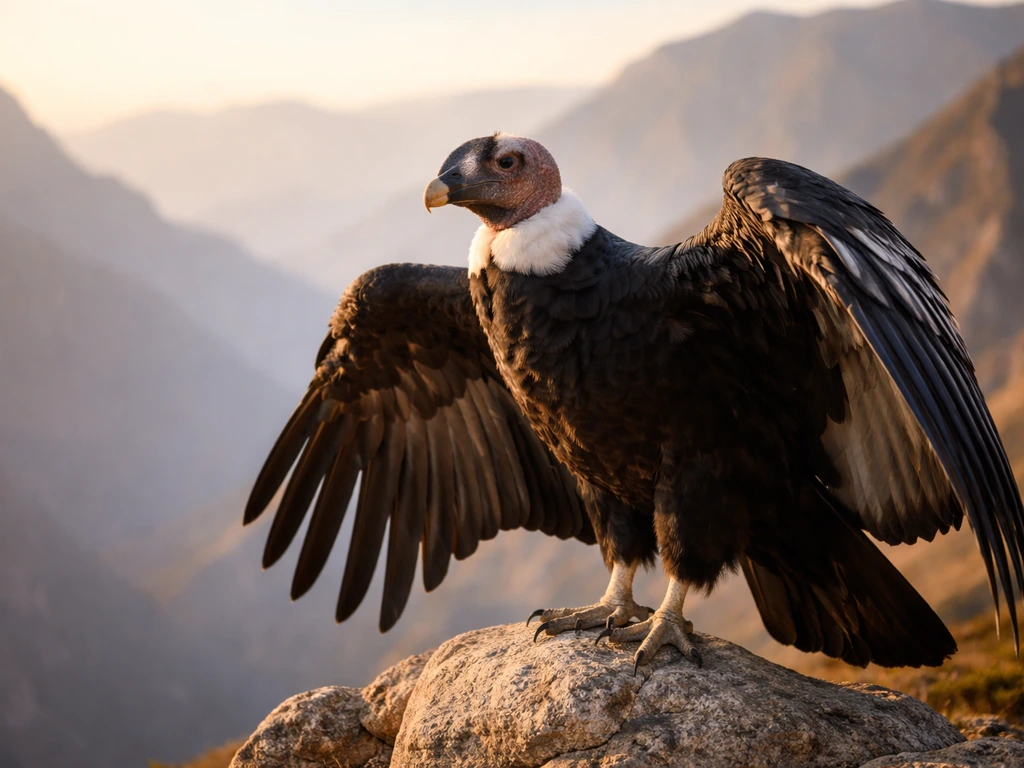
Set aside taxonomy for a moment and just look at the bird. The Andean condor has a wingspan of roughly 3.2 meters (about 10. The Andean condor is the largest bird of its kind, and its massive wingspan reflects that status is the andean condor the largest bird. 5 feet), the longest of any land bird. That enormous wingspan is built for thermal soaring over the Andes, allowing the bird to cover enormous distances scanning for food with minimal energy expenditure. It has a strongly hooked beak purpose-built for tearing into tough hide and flesh. It has eight sharp talons, though condor talons are less curved and raking than those of an eagle (because they grip a stationary carcass rather than catching fast-moving prey). Its eyes provide the kind of acute long-range vision needed to spot a carcass from hundreds of meters in the air. Every major source that defines raptors by physical traits, including the Raptor Center, PBS, and NPS, describes exactly this combination of features.
How it compares to eagles, hawks, and falcons
It helps to line the Andean condor up against the raptors most people think of first.
| Trait | Andean Condor | Eagle (e.g., Bald Eagle) | Hawk (e.g., Red-tailed) | Falcon (e.g., Peregrine) |
|---|---|---|---|---|
| Taxonomic order | Accipitriformes | Accipitriformes | Accipitriformes | Falconiformes |
| Primary diet | Carrion (scavenging) | Fish, mammals, carrion | Small mammals, birds | Birds, small mammals |
| Hunting style | Scavenging; rare live-prey opportunism | Active predation + opportunistic scavenging | Active predation | High-speed active predation |
| Hooked beak | Yes | Yes | Yes | Yes |
| Sharp talons | Yes (less curved) | Yes (very curved) | Yes | Yes |
| Keen eyesight | Yes (locates carrion by sight) | Yes | Yes | Yes |
| Wingspan | Up to 3.2 m (10.5 ft) | Up to 2.3 m (7.5 ft) | Up to 1.4 m (4.5 ft) | Up to 1.2 m (4 ft) |
The key takeaway from that comparison: eagles already blur the predator/scavenger line (bald eagles regularly eat carrion), and no one questions whether eagles are raptors. The Andean condor is further along the scavenging end of that spectrum, but it is on the same spectrum. Falcons are actually in a different order altogether (Falconiformes) and are considered birds of prey through convergent evolution, not because they share a common ancestor with hawks and eagles. The condor shares its order directly with eagles and hawks. In terms of formal taxonomy, the condor has a stronger structural claim to the raptor category than a peregrine falcon does.
Where the Andean condor lives and why that matters for conservation
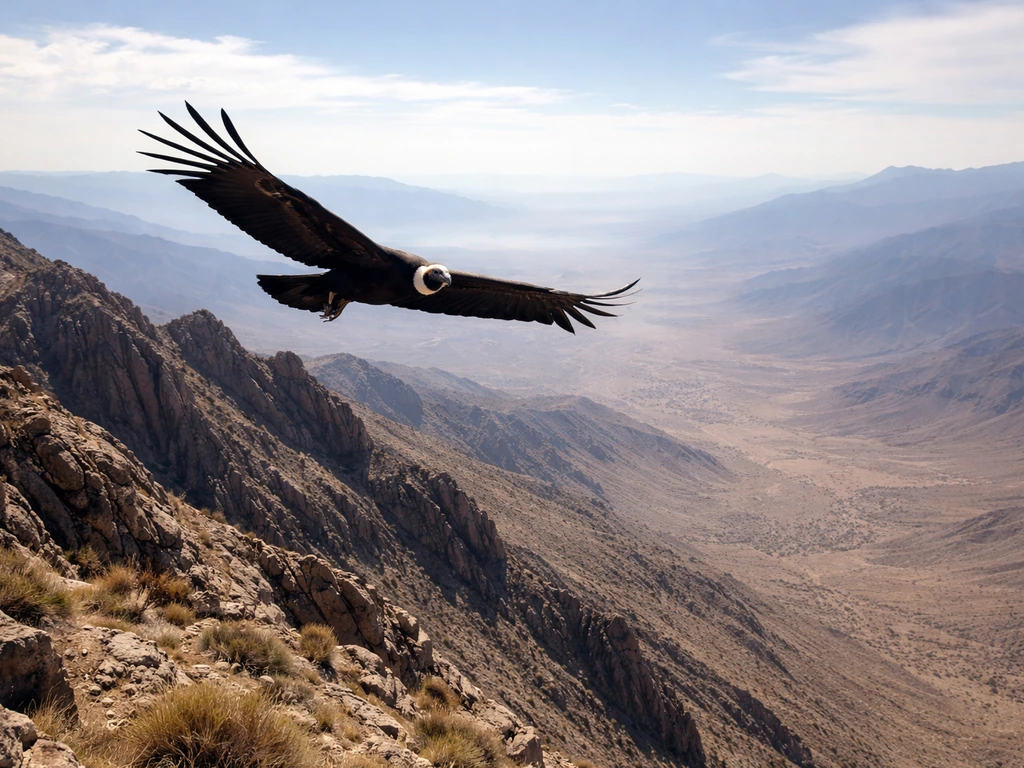
The Andean condor ranges across western South America, from the mountains and deserts of western Venezuela south all the way to Tierra del Fuego. Its core habitat is the high Andes, where it soars on mountain thermals and nests on inaccessible cliff ledges. In Bolivia, for example, it occurs in high Andean puna grassland and along the Yungas treeline. Animal Diversity Web describes the full distribution as spanning most western mountain and desert environments in the region. Animal Diversity Web describes the Andean condor’s distribution as western South America’s mountains and deserts, from Venezuela south to Tierra del Fuego spanning most western mountain and desert environments in the region.
Conservation-wise, the Andean condor is classified as Vulnerable. The threats facing it are almost uncomfortably familiar if you follow endangered bird species: habitat loss, direct persecution (shooting and poisoning by people who blame condors for livestock deaths), and secondary poisoning from lead in carcasses left by hunters. The Peregrine Fund notes that changing landscapes and reduced food availability compound these pressures. For a species that reproduces slowly (one chick every two years at best), those mortality sources hit hard. Understanding that the Andean condor is a raptor and a top-level scavenger makes its ecological role clearer: it is a cleanup species that removes disease-carrying carcasses from the environment, and losing it has real downstream consequences for the Andean ecosystem.
If you are already interested in condor conservation, related questions worth exploring include how the Andean condor compares in size to other large birds, how the California condor's story differs, and whether condors as a group are at risk of extinction. If you are already interested in condor conservation, related questions worth exploring include how the Andean condor compares in size to other large birds, how the California condor compares in size, and whether condors as a group are at risk of extinction. The Andean condor is not extinct; it is currently classified as Vulnerable at risk of extinction. Those topics give useful context for understanding why protecting this raptor matters beyond the classification question.
How to verify this yourself and dig deeper
If you want to confirm the Andean condor's raptor status with your own eyes, here is exactly where to look and what to check for.
- ITIS (itis.gov): Search "Vultur gryphus." You will see Order Accipitriformes and Family Cathartidae listed directly in the taxonomic hierarchy. That order placement is the formal confirmation.
- U.S. Fish and Wildlife Service taxonomic tree (fws.gov): The same search returns the same Order and Family, giving you a second government-grade verification.
- Animal Diversity Web (ADW, animaldiversity.org): Look up Vultur gryphus for detailed diet, foraging behavior, and distribution. This is where you will find the explicit "scavenger" label and the notes about lacking developed hunting techniques, which help you understand the scavenging context.
- The Peregrine Fund (peregrinefund.org): Their Andean condor species page covers diet, range, and conservation threats in plain language, written by raptor researchers.
- eBird (ebird.org): Search Andean condor to see its species page, taxonomic placement, and range maps built from real observation data. The range map is especially useful for understanding where across the Andes the bird is currently being recorded.
- University of Minnesota Raptor Center (theraptorcenter.umn.edu): Check their raptor definition page. Comparing their three-trait definition (hooked beak, sharp talons, keen eyesight) against what you now know about condor anatomy makes the classification click.
The bottom line is that the Andean condor is unambiguously a bird of prey by every credible scientific and conservation standard. It is a raptor by taxonomy, by anatomy, and by diet. The only wrinkle is that it scavenges rather than hunts, and once you understand that scavenging is explicitly included in the raptor definition, that wrinkle disappears entirely.
FAQ
If the Andean condor mainly eats carrion, can it still be considered a bird of prey?
No. A “bird of prey” does not require live-kill hunting. The condor’s hooked beak, strong feet for handling flesh on a carcass, and keen vision qualify it, even though most of its meals come from carrion.
Does the Andean condor ever hunt live animals, or is it strictly a scavenger?
It can occasionally take live prey, but that behavior is opportunistic rather than its main feeding strategy. In practice, the condor’s energy-efficient approach is to locate carcasses from the air and feed once available, which is why scavenging defines its day-to-day ecology.
Why are falcons also called birds of prey, but the condor is talked about differently?
Falcons are typically treated as birds of prey due to convergent traits like speed and predatory hunting, but they are not in the same evolutionary and taxonomic grouping as eagles and hawks. The condor’s placement in the same broad raptor line as eagles and hawks is why the “raptor” label applies without relying on “similar-looking predator” logic.
What behaviors should I watch for to confirm it is a scavenging raptor in the field?
Yes, you can often spot its scavenger specialization in behavior. The condor commonly searches from altitude, then moves in once carcasses are located (by visual scanning and sometimes by following other scavengers), rather than repeatedly pursuing prey like many active hunters.
What physical traits or field marks are the quickest way to identify the Andean condor as a raptor?
Look for a bare head and neck, a massive hooked beak, and very broad wings suited to thermal soaring. Its feeding posture matters too, it typically braces while pulling and tearing from carcasses, which matches the raptor anatomy described in conservation guides.
How does the Andean condor find food compared with other vultures like turkey vultures?
Its reliance on sight is a key practical distinction. In many regions, smaller New World vultures depend more on smell for finding food, but the condor’s primary advantage is spotting carcasses from great distances while soaring.
Does being a scavenger make the Andean condor more exposed to human-caused toxins?
Yes. Because it often feeds at carcasses and can be exposed to toxic substances, it is vulnerable to human-caused risks such as poisoning when carcasses contain lead from hunting ammunition. This makes its raptor role important for ecosystems, but also increases the stakes of conservation.
How does the condor’s conservation status affect why people should care, even if it is a raptor?
Conservation status does not change its classification. The condor can be “Vulnerable” and still be clearly a raptor, since taxonomy and anatomical traits are separate from population risk. However, slow reproduction means mortality from persecution or poisoning can quickly reduce recovery prospects.
Next Article
Is the California Condor the Largest Bird in the World?
Find out if the California condor is the world’s largest bird, comparing size metrics and key global contenders.