The Andean condor holds the title of largest living bird of prey and has the longest wingspan of any land bird alive today, reaching up to about 3.3 meters (10.8 feet). By pure wingspan, though, the wandering albatross edges it out with a confirmed record of 3.63 meters (11 ft 11 in). So the honest answer is: it depends on how you define "largest." If you mean the biggest bird overall on Earth, the ostrich wins by weight and height. If you mean the largest flying bird by wingspan, the wandering albatross takes it. If you mean the largest land bird capable of flight, or the largest bird of prey by any measure, the Andean condor is your answer.
Is the Andean Condor the Largest Bird in the World?

Maya Hennessy
11 May 2026

What "largest bird" actually means

This is where almost every debate about bird size falls apart. "Largest" can mean three very different things, and sources routinely mix them up without warning.
- Wingspan: the tip-to-tip measurement of fully extended wings. This is the most commonly cited metric for flying birds and the one most people think of when they imagine a big, soaring bird.
- Body mass (weight): how heavy the bird actually is. A bird can have an enormous wingspan but relatively light bones and muscles. Bustards and pelicans can outweigh condors despite having shorter wingspans.
- Total length (body length): measured from bill tip to tail tip, usually on a flattened specimen. This metric is less commonly used in popular rankings but shows up in field guides and scientific papers.
Wingspan is measured by pressing a bird flat and stretching each wing to its natural maximum, but technique differences between labs, field workers, and museum curators can shift a reported wingspan by several centimeters. Body length is even trickier on a live bird because neck posture alone can change the reading significantly. None of this is sloppy science; it just means you have to know which metric a source is using before you accept its ranking.
Andean condor size: the actual numbers
The Andean condor (Vultur gryphus) is genuinely enormous by any flying-bird standard. Here are the core measurements drawn from multiple sources, including Animal Diversity Web, Dimensions.com, and field-survey data.
| Measurement | Typical Range | Maximum Recorded |
|---|---|---|
| Wingspan | 270–330 cm (8.9–10.8 ft) | ~350 cm (11.5 ft, claimed) |
| Body length | 100–132 cm (3.3–4.3 ft) | ~132 cm |
| Body mass (male) | 11–15 kg (24–33 lb) | ~15 kg |
| Body mass (female) | 6–14 kg (13–31 lb) | ~14 kg |
Male Andean condors are considerably larger than females, which matters a lot when sources compare averages. A dataset that pools both sexes will produce a lower average weight than one that focuses on adult males. Guinness World Records, for instance, gives males an average of 9–12 kg with a maximum wingspan around 3 meters. National Geographic rounds the wingspan up to "10.5 feet" (about 3.2 m) and weight to "up to 33 pounds" (about 15 kg). These figures are consistent when you account for sex and whether the source is reporting averages or individual maxima.
How the Andean condor ranks against other contenders

Putting the Andean condor side by side with the other birds most often named in "largest bird" conversations makes the picture much clearer.
| Species | Max Wingspan | Max Weight | Category |
|---|---|---|---|
| Wandering albatross | 3.63 m (11 ft 11 in) | ~12 kg | Largest wingspan, any living bird |
| Andean condor | ~3.3–3.5 m (10.8–11.5 ft) | ~15 kg | Largest land bird wingspan; largest bird of prey |
| California condor | ~2.9 m (9.5 ft) | ~10 kg | Second-largest New World vulture |
| Great bustard | ~2.4 m (7.9 ft) | ~14 kg | Contender for heaviest flying bird |
| Kori bustard | 2.1–2.7 m (6.9–8.9 ft) | ~18 kg | Possibly heaviest flying bird by mass |
| Harpy eagle | ~2.0 m (6.6 ft) | ~9 kg | Large raptor benchmark |
| Ostrich (flightless) | N/A | ~156 kg | Largest and heaviest bird overall |
The ranking that tends to confuse people most is the Andean condor vs. wandering albatross comparison. The albatross wins on verified maximum wingspan: Guinness records 3.63 meters for a single male wandering albatross, while the condor's widely accepted typical maximum sits around 3.3 meters, with a claimed outlier record of around 3.5 meters. The condor, however, is heavier and has a much broader, more robust wing shape suited for soaring over mountains rather than ocean. Animal Diversity Web explicitly calls the Andean condor's wingspan the longest of any land bird, which is the framing most field ornithologists use.
On weight, the kori bustard (up to about 18 kg) and great bustard (up to about 14 kg) can rival or exceed the condor, which makes them serious contenders for the title of "heaviest flying bird." But neither approaches the condor in wingspan, and neither is a bird of prey. So if someone asks which flying bird has both the greatest wingspan and the greatest weight among raptors, the Andean condor wins without much competition. The California condor, which is closely related, is noticeably smaller in both wingspan and weight and is not a rival for the top spot.
Why different sources give different rankings
It is genuinely frustrating that you can find three reputable sources that rank the "largest flying bird" differently. Here is why that happens, and it has nothing to do with anyone being wrong.
- Max vs. average: A source reporting one record individual's wingspan (a 3.63 m albatross) and a source reporting a species' average wingspan (the condor's average is closer to 2.9–3.1 m in many datasets) are not measuring the same thing. Both numbers are real; they answer different questions.
- Sex-specific vs. pooled data: Because male Andean condors are substantially larger than females, a study using only adult males will produce higher weight and wingspan averages than one using all captured birds. Always check which sexes a dataset includes.
- Scope of comparison: "Largest bird of prey," "largest land bird capable of flight," "largest flying bird by wingspan," and "largest bird in the world" are four different titles. The Andean condor holds some but not all of them.
- Measurement technique: Wing posture during measurement, whether the specimen is fresh or museum-preserved, and whether the researcher stretched the wing to anatomical maximum or natural resting extension all affect the number. Wikipedia's wingspan table explicitly notes it lists maximum values from verified records, not field averages.
- Outdated rankings: Some older sources still list the Andean condor as the world's largest bird without qualification. That framing made sense when the comparison set was smaller or when the article was written for a general audience that wanted a simpler answer.
Where the Andean condor actually lives
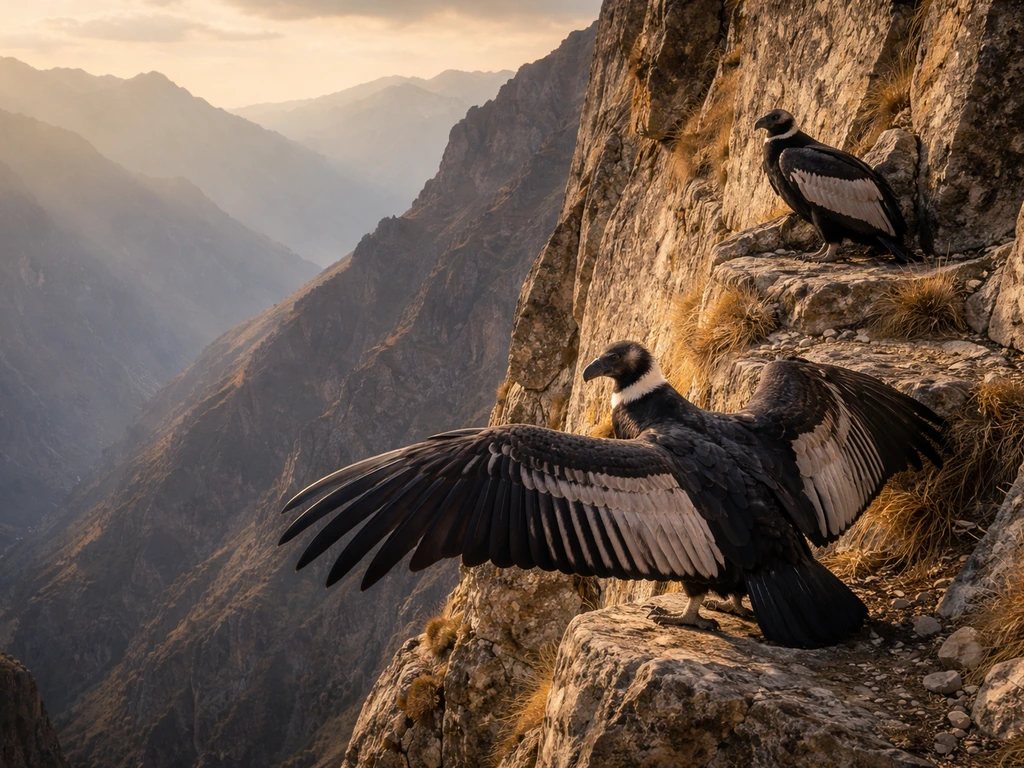
The Andean condor is tied to the Andes mountain range, which runs the entire length of South America from Venezuela and Colombia in the north down through Ecuador, Peru, Bolivia, Chile, and Argentina. It favors open grasslands, alpine zones, and shrublands at elevations up to 5,000 meters (about 16,400 feet). The bird relies on thermals and updrafts produced by mountain topography to stay aloft, which is part of why its enormous wingspan is so ecologically important: it needs very little flapping energy to soar for hundreds of kilometers in search of carcasses.
Roosting and nesting happen on cliff faces, usually on bare rocky ledges or in shallow caves. Condors do not build nests in the traditional sense: a breeding pair simply lays a single egg directly on a cliff ledge. Communal cliff roosts are well-documented and serve a dual purpose, protecting birds from weather extremes and from disturbance by predators or humans. The northern part of the range (Ecuador, Colombia, Venezuela) holds the smallest populations and has seen the sharpest declines.
Conservation status and why the condor's size matters
The Andean condor was listed as Near Threatened on the IUCN Red List for years, but that changed in 2020 when it was upgraded to Vulnerable, reflecting continued population declines across its range. The American Bird Conservancy still lists it as Near Threatened in older content, which is a good example of how conservation status can lag in secondary sources. If you want the current official status, always check the IUCN Red List directly for Vultur gryphus.
The biggest threats are poisoning and lead contamination. At least 125 Andean condors were documented as poisoned in Ecuador, Colombia, and Venezuela alone in a single study period, largely from ingesting carcasses laced with poison set out by ranchers targeting predators, or from lead shot in gut piles left by hunters. The species is listed on CITES Appendix I, meaning international commercial trade is prohibited.
Its enormous size is directly relevant to conservation in two ways. First, the condor's size means it has an exceptionally low reproductive rate: one egg per pair roughly every two years, a chick that takes six months to fledge, and a bird that does not reach sexual maturity until about five to six years of age. Losing one adult has a disproportionate impact on population recovery compared to a smaller, faster-breeding species. Second, the condor's role as a scavenger at the top of the food chain means it bioaccumulates toxins more efficiently than species lower in the chain. Its size is both its ecological asset and its conservation liability.
Questions about whether condors are endangered, whether they are dangerous to people, and where specific populations are found in countries like Brazil connect to broader debates about vulture conservation in the Americas. If you’re worried about whether condors are dangerous in real-world encounters, it helps to look at the specific behavior and risk factors discussed in are condor bird dangerous. In Brazil, the Andean condor is found mainly in the western Andes, including areas in the states along the border such as Acre where specific populations are found in countries like Brazil. The Andean condor is not considered dangerous to live humans, but its status as a massive obligate scavenger makes it one of the most ecologically sensitive indicators of Andean ecosystem health.
The bottom line and how to check it yourself
Here is the confident summary: the Andean condor is the largest bird of prey on Earth by both wingspan and weight, and it has the longest wingspan of any land bird alive today. This can be confusing, but the Andean condor is not extinct; it is still living and classified as Vulnerable on the IUCN Red List. It is not the largest flying bird by maximum recorded wingspan (that goes to the wandering albatross at 3.63 m), and it is not the heaviest flying bird by mass if you count bustards. It is also not the largest bird overall, since flightless birds like the ostrich dwarf it in weight.
If you want to verify any specific claim, here is how to compare like-for-like: look for whether a source reports maximum individual records or species-wide averages, check whether the data is sex-specific or pooled, and confirm which comparison scope is being used (land birds only, raptors only, all flying birds, all birds). Guinness World Records is a reasonable benchmark for verified record specimens. Animal Diversity Web and BirdLife International are solid references for range data. For conservation status, go straight to the IUCN Red List (iucnredlist.org) and search Vultur gryphus to get the current category and the year of the last assessment.
If you came here wondering specifically about a different angle, a few quick clarifications: the California condor is a separate, smaller species and is not the largest bird in the world either. The question of whether condors are birds of prey is genuinely interesting given their vulture classification and scavenging lifestyle. And if you are thinking about "largest bird ever" rather than largest alive today, you would need to look at extinct species like the giant teratorn Argentavis magnificens, which likely had a wingspan exceeding 6 meters, making even the Andean condor look modest by comparison.
FAQ
What’s the most fair way to compare “largest” when different lists disagree?
If you care about “largest” in a way that is comparable across species, focus on a single metric and scope. For example, “largest land bird alive today by wingspan” is where the Andean condor is commonly cited, but “largest flying bird by verified maximum wingspan” points to the wandering albatross. “Largest bird of prey” is another scope where the condor is usually favored, even though some other birds can exceed it in weight.
Why do some sources make the Andean condor look smaller than other “largest bird” candidates?
Yes, sex can flip rankings in practice because male condors are much larger than females. When a source reports a single number without clarifying whether it is an adult male average, a pooled average, or a maximum individual record, you can get misleading comparisons. A quick check is whether the source explicitly says “males,” “adults,” “average,” or “maximum specimen.”
How much can measurement method change the stated wingspan for the condor?
For wingspan specifically, technique matters. Some measurements come from a bird laid out and wings stretched to their natural maximum, while others come from museum specimens or field estimates, which can differ by several centimeters. If you want the cleanest comparison, use verified record measurements from standardized protocols, then treat “typical” ranges as approximate rather than exact.
Is the Andean condor always the heaviest flying bird?
The condor is often described as “largest” because it combines a very long wingspan with substantial mass and a broad wing shape for soaring. But if you only rank by “weight of any flying bird,” bustards like the kori bustard and great bustard can challenge the condor. So the best answer depends on whether your definition allows non-raptor flyers and whether you are using typical mass versus maximum mass.
If ostriches are bigger, why do people still call the condor the largest?
It depends what you mean by “largest bird,” even among living birds. The ostrich can be larger than the condor by height and body mass, but it cannot fly, which removes it from many “largest flying bird” comparisons. The condor’s strength is that it is the top-ranked living bird of prey by wingspan and also among the leading candidates by weight among raptors.
Does the California condor ever outrank the Andean condor for “largest bird” claims?
The “Vultur gryphus” is the species name for the Andean condor. The California condor is a different species, Gymnogyps californianus, and it is smaller in wingspan and mass, so it does not compete for the top spot in any of the common “largest condor” style comparisons.
If the albatross has the record wingspan, why does the condor still get “largest” labels?
Not by verified maximum wingspan. The wandering albatross has the best-documented record maximum, but it is not a land bird and it is not a raptor. The condor’s commonly used “largest land bird” framing also matches its niche and how field ornithologists compare wingspan among land birds.
How do averages versus maximum records change the “largest bird” answer?
Yes. If you average across the whole species and do not separate sexes, the reported “typical” weight and wingspan can look smaller than what record-focused sources list for individual males. A good sanity check is to identify whether the number comes from an average (often lower) or a maximum record (often higher) and whether it is sex-specific.
Why is the condor’s size and biology important for conservation outcomes?
The condor’s low reproductive rate means population changes can be slower to reverse. With one egg per breeding attempt and maturation that takes years, losses from threats like poisoning and lead contamination can have a long tail effect, even if the total number of incidents seems small.
What quick checklist can I use to verify a “largest bird” statement without getting misled?
To verify an exact ranking claim, do three quick checks: (1) identify the metric (wingspan, mass, or length), (2) confirm scope (land birds only, raptors only, all birds, or all flying birds), and (3) check whether the source uses maximum records or pooled averages and whether sex is included. Guinness-style record references are most useful for maxima, while other bird references are more reliable for range and typical biology.