Cassowaries live in the tropical rainforests of New Guinea and its surrounding islands, with one species also found in northeastern Australia. Their core territory covers the island of New Guinea (split between Indonesia's Papua provinces and Papua New Guinea), plus scattered islands like Yapen, Seram, and parts of the Bismarck Archipelago. If you're trying to picture exactly where, think dense lowland jungle, montane cloud forest, and swampy coastal woodland, depending on which of the three species you're looking at.
Where Does the Cassowary Bird Live? Habitat and Range Guide

Maya Hennessy
12 May 2026
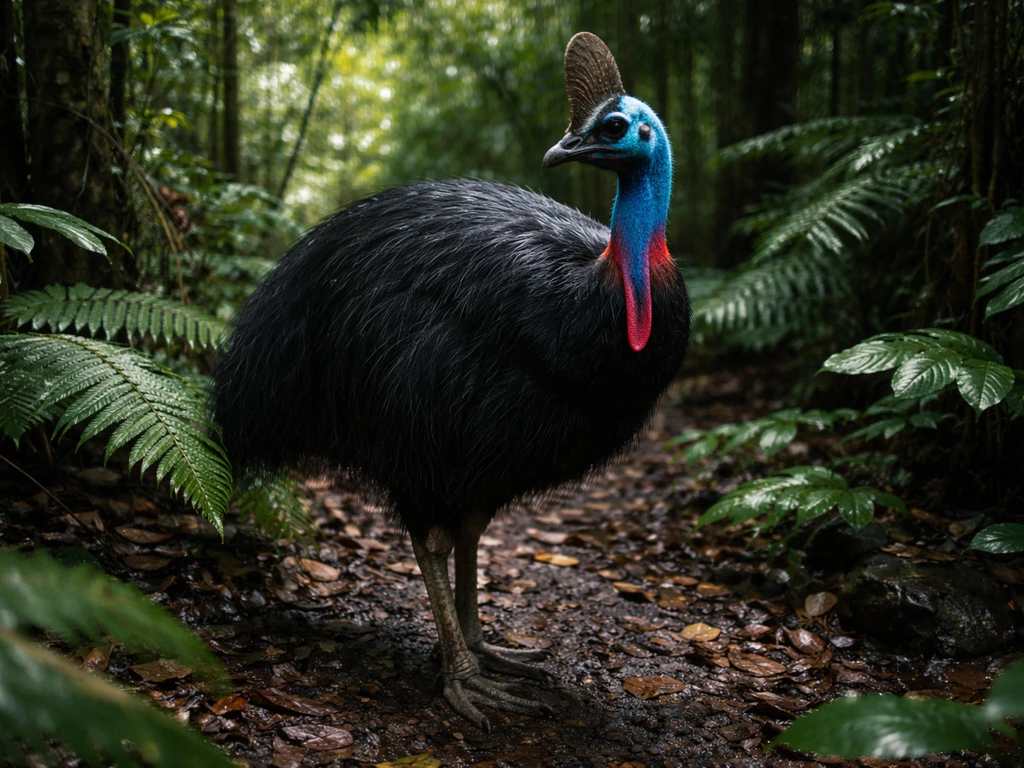
Three species, not one: which cassowary are you thinking of?
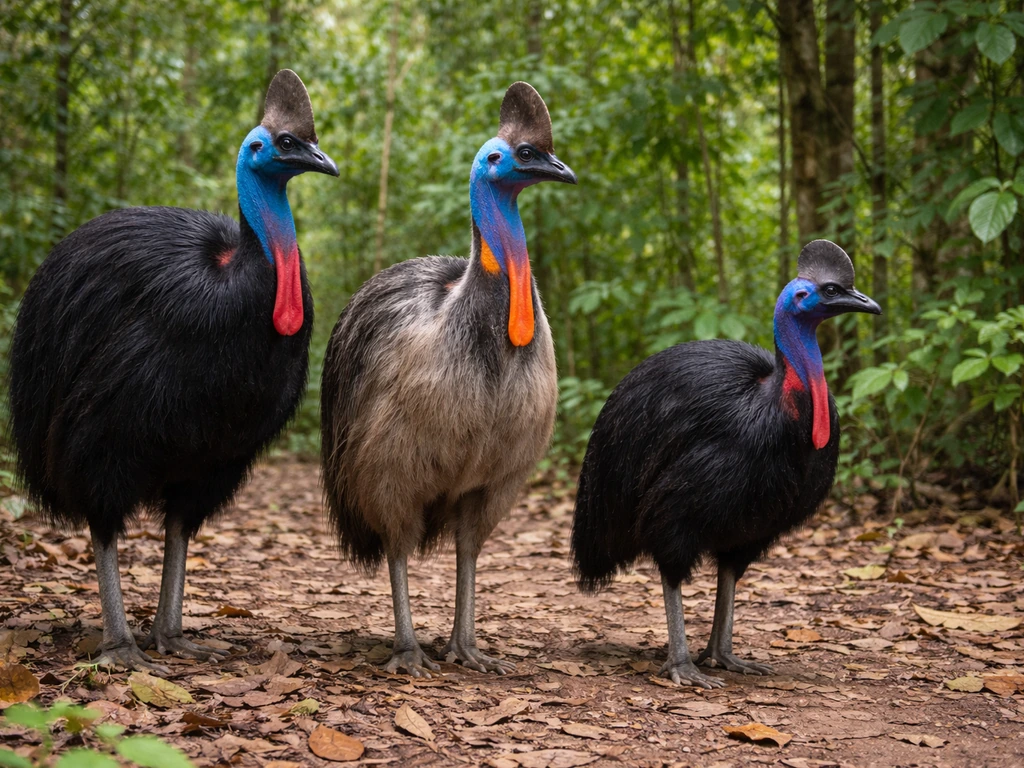
Most people say "cassowary" and picture one bird, but there are actually three living species, and they don't all share the same range or habitat. If you mean the biggest extinct bird overall, that answer depends on which fossils and time period you consider. Getting them straight matters a lot if you're trying to verify a sighting or understand a distribution map.
- Southern cassowary (Casuarius casuarius), also called the double-wattled cassowary. The most widespread and best-known species. Found across New Guinea, eastern Indonesia, and northeastern Australia.
- Northern cassowary (Casuarius unappendiculatus), also called the single-wattled or one-wattled cassowary. Restricted to the northern coastal lowlands of New Guinea and a handful of offshore islands.
- Dwarf cassowary (Casuarius bennetti), also known as Bennett's cassowary. The smallest of the three. Lives in montane forest, primarily in Papua New Guinea but also in parts of Indonesian Papua and the Bismarck Archipelago.
All three belong to the genus Casuarius and are flightless birds, placing them in the same broader group as emus and kiwis. If you've been reading about extinct or endangered flightless birds more broadly, the cassowary is very much a living representative of that lineage, and understanding where it lives today is directly tied to why its survival is so precarious.
The core regions: countries and islands where cassowaries live
New Guinea is the heartland. The island is the largest tropical island in the world, and it's shared politically between Indonesia (the western half, comprising Papua and West Papua provinces) and Papua New Guinea (the eastern half). All three species are found here, though in different parts and at different elevations. Outside New Guinea, the range extends in a few specific directions.
| Species | Countries/Territories | Key Islands |
|---|---|---|
| Southern cassowary (C. casuarius) | Indonesia, Papua New Guinea, Australia | New Guinea mainland, Seram, Aru Islands, Ceram; northeastern Queensland (Australia) |
| Northern cassowary (C. unappendiculatus) | Indonesia, Papua New Guinea | Northern New Guinea mainland, Yapen, Batanta, Salawati, Raja Ampat area |
| Dwarf cassowary (C. bennetti) | Indonesia, Papua New Guinea | New Guinea mainland (mainly eastern side), Yapen, New Britain, New Ireland (Bismarck Archipelago) |
Australia is the most surprising entry on that list for a lot of people. The southern cassowary does occur in Far North Queensland, specifically in the Wet Tropics region around the Daintree, Mission Beach, and Atherton Tablefoots area. But only one subspecies is present there: Casuarius casuarius johnsonii. The broader species is primarily a New Guinea bird; Australia is at the edge of its range, not the center of it.
Day-to-day habitat: the environments cassowaries actually use
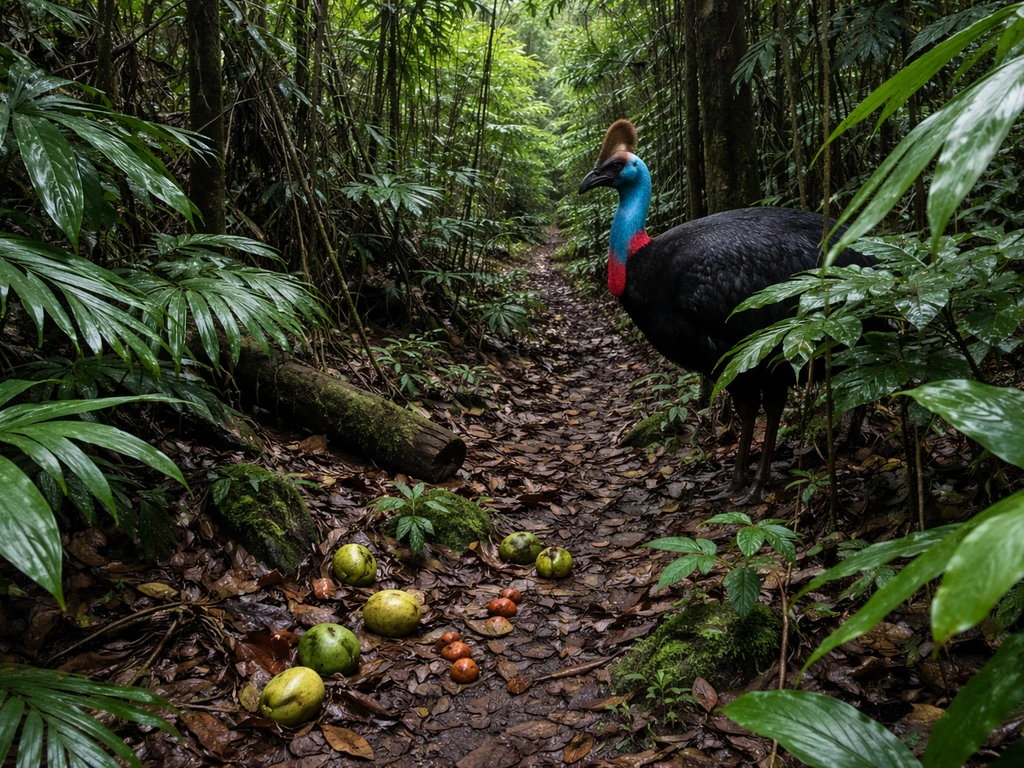
Cassowaries are rainforest birds at their core. They depend on dense tropical forest where fallen fruit is abundant, cover is thick, and human disturbance is minimal. But the specific habitat varies meaningfully by species and by what's available in a given region.
In New Guinea, cassowaries use a wider range of forest types than most people expect. Documented habitats include lowland tropical rainforest, gallery forest along rivers, swamp-forest and melaleuca swamps, forest edges, savanna woodland margins, mangrove borders, and even fruit plantations near forest. They show up where food concentrates, which often means riverbanks and forest edges at certain times of year rather than deep interior forest exclusively.
In Australia's Wet Tropics, the southern cassowary is strongly associated with closed-canopy tropical rainforest, but it also uses melaleuca swamps and mangrove forest. Queensland's Wet Tropics rainforest is naturally limited in extent, which is a big reason the Australian subpopulation is considered so vulnerable. There isn't a lot of suitable habitat to begin with, and what exists has been significantly fragmented.
Elevation matters more than most guides let on
Southern and northern cassowaries are lowland birds. They prefer coastal and near-coastal forest, swamp edges, and river flats, generally below 1,000 meters. The dwarf cassowary is the outlier here: it lives in montane cloud forest and can be found at elevations up to around 3,300 meters. That's a genuinely different ecosystem, cooler and often misty, and it's why you won't find dwarf cassowaries in the same places as the other two species even when their ranges overlap on the same island.
How the range breaks down by species
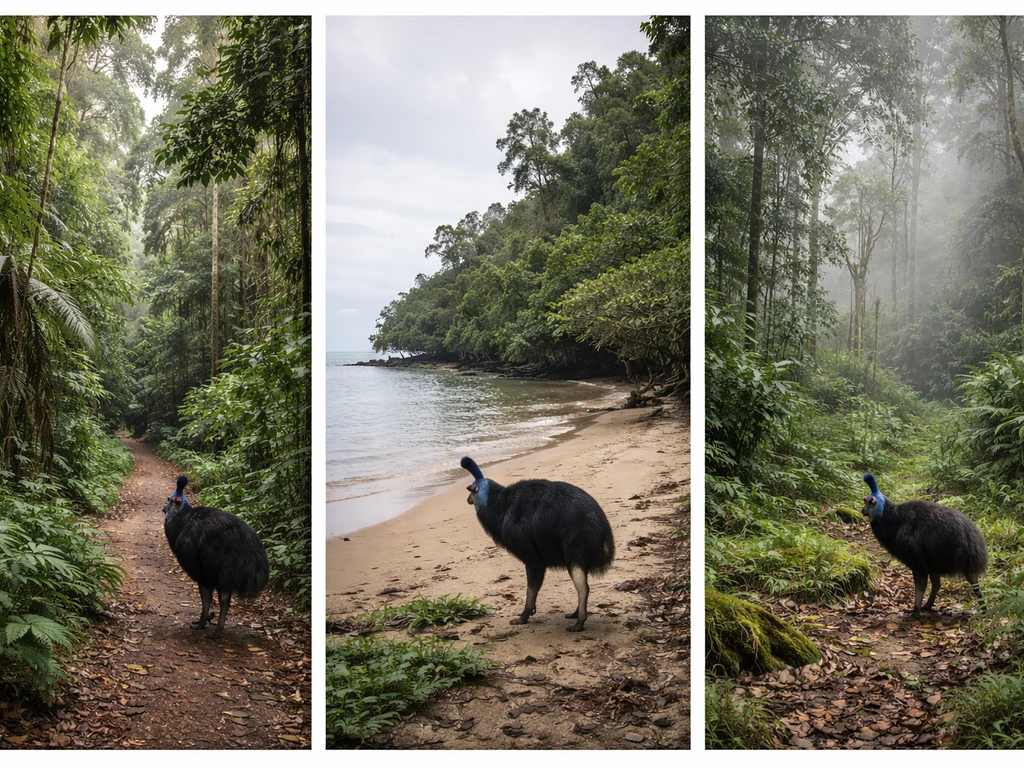
Southern cassowary: the widespread one
The southern cassowary has the broadest distribution. Across New Guinea, it occupies lowland rainforest on both the Indonesian and Papua New Guinean sides of the border. It's also present on some Indonesian islands to the west, including Seram and the Aru Islands. Then there's the Australian population, which is genuinely isolated from the New Guinea population geographically and is treated as its own subspecies for conservation purposes. If someone outside the bird-watching world mentions a cassowary encounter in Australia, this is almost certainly the bird they saw.
Northern cassowary: the coastal specialist
The northern cassowary is more tightly range-restricted than its southern counterpart. It lives in the coastal swamps and lowland rainforests north of New Guinea's Central Cordillera mountain range, and in some areas west of Cendrawasih Bay, reaching as far as the Raja Ampat islands. It's also found on the islands of Yapen, Batanta, and Salawati. Its populations are considered declining, driven by habitat loss, fragmentation, and increasingly sophisticated hunting pressure. Diseases like aspergillosis and avian tuberculosis have also been documented as threats, along with cyclone damage to habitat.
Dwarf cassowary: the mountain bird
The dwarf cassowary is the least-studied of the three. The majority of the population is concentrated on the eastern side of New Guinea in Papua New Guinea, though it's also present in the Indonesian provinces to the west. Its island range extends into the Bismarck Archipelago, with records from both New Britain and New Ireland. It's assessed as Near Threatened by the IUCN, with habitat destruction and hunting cited as the primary concerns. Because it lives at altitude, it occupies different habitat from the other two species, but it's not immune to the same pressures.
Behavior and why it ties directly to where you find them
Cassowaries are solitary and strongly territorial. Each individual maintains a home range and will actively defend it, including approaching or chasing intruders, which is part of why they have a reputation for being dangerous. That territoriality has a practical consequence for anyone trying to locate them: you're unlikely to find multiple cassowaries together except during brief mating interactions or a mother with young chicks. You're looking for individual animals in specific habitat patches.
Their diet is almost entirely fruit, which makes them highly mobile within their range as they track fruiting trees. This also makes them ecologically critical as seed dispersers, moving large seeds through the forest in ways that few other animals can. Where fruiting trees are dense and diverse, cassowary presence tends to follow. That's why riverbanks and forest edges can be productive places to look, not because cassowaries prefer open ground, but because fruit often concentrates near light gaps and water.
Cassowaries are also cautious about open ground. They use thick vegetation for cover and tend to retreat from human presence when given the option. In fragmented landscapes, where a cassowary's home range might require crossing roads or open agricultural land, encounters become both rarer and more dangerous for the bird, since vehicle strikes are a leading cause of death for the Australian population.
How land use and conservation are reshaping where cassowaries live
The honest picture is that cassowary range is shrinking and breaking apart. In Australia, the southern cassowary's Wet Tropics habitat was already naturally limited in extent and was further reduced and fragmented well before modern conservation efforts began, with significant changes documented prior to 1990. Today, remaining cassowary subpopulations in Queensland are isolated from each other, which limits gene flow and makes local extinctions harder to recover from.
In New Guinea, the situation is complicated by the fact that both Indonesian Papua and Papua New Guinea are experiencing rapid land-use change: logging, agricultural expansion, and infrastructure development are eating into lowland rainforest at pace. For the northern cassowary in particular, this loss is happening in exactly the coastal lowland habitat the species depends on. Hunting pressure compounds the problem, especially as more sophisticated methods become available in remote areas.
The silver lining, if there is one, is that cassowaries appear better able to cross fragmented landscapes than many forest specialists. A draft national recovery plan for the Australian southern cassowary subpopulation notes that individuals may be capable of moving through intervening habitat between fragments. That doesn't make fragmentation harmless, but it does mean that maintaining even thin wildlife corridors between forest patches can meaningfully support the species. This is an active focus in both Queensland conservation planning and some PNG-based programs.
Cassowaries are genuinely keystone species in their ecosystems. As the primary dispersers of large-seeded tropical fruits, their disappearance from an area doesn't just mean one fewer bird; it can affect the long-term composition of the forest itself. That broader ecological role is why conservation organizations treat cassowary habitat as a proxy for overall rainforest health.
How to verify the range for your specific area
If you want to know whether a specific location falls within cassowary range, skip general sources and go straight to the dedicated databases. They give you actual spatial data, not just text descriptions. IUCN Red List assessments support this with an interactive online map and downloadable spatial data such as ArcGIS shapefiles or point-data CSV files blank" rel="noopener noreferrer">They give you actual spatial data, not just text descriptions.. BirdLife DataZone notes that its blank" rel="noopener noreferrer">species maps, including elevational limits, are created by combining each species' range map with habitat-requirement coding and elevational limits from Red List assessment data.
- IUCN Red List (iucnredlist.org): Each of the three cassowary species has its own assessment page with an interactive distribution map and downloadable spatial data. Search by species name (Casuarius casuarius, C. unappendiculatus, or C. bennetti) and go to the Maps tab. This is the most authoritative range data available.
- BirdLife DataZone (datazone.birdlife.org): BirdLife maintains species factsheets with range maps and conservation context for each cassowary species, including the northern cassowary. It's especially useful for understanding range in the context of threats and population trends.
- eBird (ebird.org): For the Australian population especially, eBird has substantial sighting records from the Wet Tropics region. It won't cover New Guinea as comprehensively, but for Queensland it gives you real-time verified occurrence data.
- Oiseaux.net: Provides distribution map pages for cassowary species and links through to IUCN data for precise spatial coverage. Useful as a quick visual reference before diving into the full IUCN dataset.
- Queensland Department of Environment and Science: For the Australian subspecies specifically, Queensland government resources including species profile pages and recovery plan documents provide detailed local habitat and distribution guidance that national databases don't always capture at fine resolution.
When you're looking at any of these maps, pay attention to whether you're viewing the full species range or a subspecies range. The IUCN and BirdLife maps typically show the full species, which can make the Australian cassowary look more continuous with the New Guinea population than it really is on the ground. The Australian birds are genuinely isolated, and conservation planners treat them that way.
For anyone interested in the broader story of flightless birds and where they ended up geographically, the cassowary's distribution across New Guinea and its nearby islands reflects both ancient biogeography and the pressures of the modern world. That pattern helps explain whether goliath birds like the cassowary are considered old world or new world species flightless birds and where they ended up geographically.
One way to think about the size of living birds is to ask what was the largest bird to ever live, since the biggest species belonged to different lineages than the cassowary flightless birds. Unlike some of the extinct giants that once defined the flightless bird story, cassowaries are still here and still occupying much of their original range.
But that range is under pressure in ways that make understanding exactly where they live, and why, more important than ever. The Goliath bird-eating spider is endangered too, and its status similarly depends on how quickly its habitat is being affected is the goliath bird-eating spider endangered.
FAQ
How can I tell which cassowary species I’m looking at if I’m near the overlap zones?
Use both elevation and locality. Southern and northern cassowaries are generally lowland and below about 1,000 meters, while the dwarf cassowary is tied to higher-elevation cloud forest (up to around 3,300 meters). If you are at altitude in misty, cooler forest, a dwarf cassowary is the main candidate.
If I hear reports of cassowaries in “the same place,” is it possible for multiple cassowary types to be in the area at the same time?
It can happen on some islands where ranges intersect, but you are unlikely to find multiple individuals together because they are strongly territorial. Also, even where different species occur regionally, they often partition habitat by elevation and forest type, so “same area” may still mean different microhabitats.
Do cassowaries live in deep untouched rainforest only, or are they found near disturbed areas too?
They do better where cover is thick and fruiting is reliable, but they can use forest edges, riverbanks, and even fruit plantations when those areas are adjacent to forest. In fragmented places, they may still be present, but crossings over open land increase the risk of encounters and vehicle strikes.
What time of day or season should I focus on for the best chance of seeing them?
Because their diet is mostly fruit, your best odds are often during periods when fruiting trees are producing heavily, especially along riverbanks and forest edges where fruit concentrates. They also rely on thick cover, so look for signs near vegetation corridors rather than open ground.
Are cassowaries more likely to be seen in swampy areas, river corridors, or on dry forest slopes?
It depends on the species, but in general cassowaries commonly use swamp-forest, mangrove borders, and gallery forest along rivers, particularly because those areas can funnel food and provide cover. For the Australian southern cassowary, mangroves and melaleuca swamps are specifically part of the habitat picture, not just rare exceptions.
If a cassowary is in my area, how likely is it to be near roads?
In fragmented landscapes, cassowaries may be forced to cross roads or open agricultural land to move between forest patches, so road proximity can increase encounter probability for people but also raises the bird’s risk. If you are on the lookout, treat roadsides as high-risk zones and keep distance, since vehicle strikes are a major cause of mortality in Australia.
I found a map online. Why does it look like the Australian cassowary range connects to New Guinea, but people say it’s isolated?
Some maps show the full species range rather than the Australian subspecies range, which can make Australia appear more continuous than it is. In practice, the Australian birds are geographically isolated and handled as a separate conservation unit, so you should check whether the map is showing species versus subspecies.
Where should I start if I want to confirm whether a specific location is inside cassowary range?
Use dedicated species distribution databases rather than general articles or generic habitat descriptions. Also, verify whether the dataset is showing species-level range or subspecies-level range, since the same country can include multiple subspecies with very different distributions.
Are cassowaries ever found in agricultural fields or gardens away from forest?
They can appear near fruiting crops like plantations when those areas are close to forest and still provide cover corridors. However, they generally avoid prolonged time in open ground, so isolated farms far from forest are less likely to support repeat sightings.
What are common mistakes people make when trying to identify or verify a cassowary sighting?
The most frequent issue is assuming “cassowary” means a single species. Location plus elevation matters, and they are also solitary, so expecting a group of cassowaries is a red flag. Another common mistake is over-trusting a species map without checking whether subspecies boundaries are being shown.