
LiMu Emu is not a real bird species. It is a CGI advertising mascot created for Liberty Mutual Insurance, where the name 'LiMu' is simply a shorthand for 'Liberty Mutual,' not a scientific or common name for any bird. There is no taxon, subspecies, or documented species called 'Limu emu' in any taxonomy database, fossil record, or museum catalog. If you came here wondering whether this is some obscure extinct or flightless bird you had not heard of before, the answer is a confident no.
Is Limu Emu a Real Bird? How to Verify the Claim

Maya Hennessy
23 Apr 2026
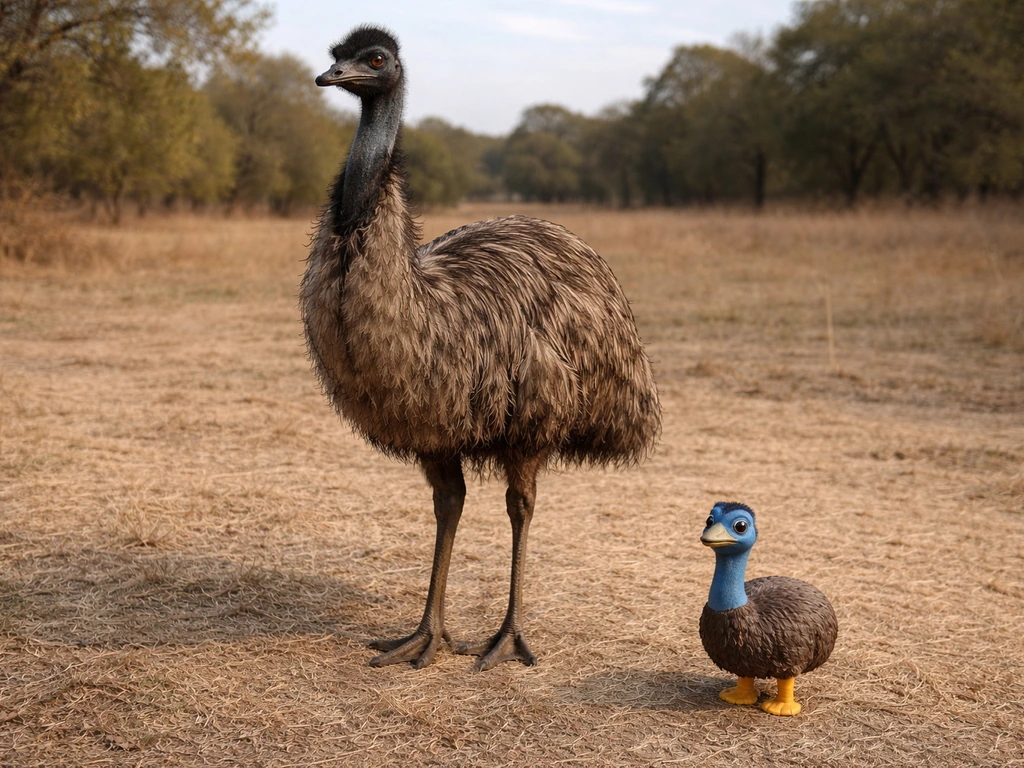
What 'LiMu Emu' actually refers to

LiMu Emu is the mascot of a long-running Liberty Mutual Insurance advertising campaign called 'LiMu Emu and Doug.' Liberty Mutual's own campaign materials describe the character as a 'fictional dynamic duo' brought to life using 'cutting-edge CGI technology.' The wings are described on their own pages as 'purely decorative,' and the character wears sunglasses, which is a costume detail, not a behavioral or physical trait of any real bird.
The capitalization is a clue here. Liberty Mutual writes it 'LiMu Emu,' with a capital M in the middle, because LiMu is a contraction of 'Liberty Mutual.' It is branding, not biology. The name is not written as a binomial (like Dromaius novaehollandiae) or as any kind of scientific epithet. In crossword puzzles and pop-culture trivia, the answer to 'CGI emu who wears sunglasses in insurance ads' is simply 'LIMU,' which tells you everything about how the name functions: as a brand character, not a species designation.
How to tell a real species from a nickname or misidentification
A real bird species will always have a formal scientific (binomial) name in the format Genus species, assigned by a taxonomist and recognized by authoritative databases. A real species also leaves a paper trail: peer-reviewed descriptions, type specimens in museum collections, and entries in databases like GBIF, the Integrated Taxonomic Information System (ITIS), or the IOC World Bird List. If you search for a bird name and none of those resources return a matching taxon page, that is a strong signal the name is not a valid species.
For extinct birds, the bar is the same: even species known only from fossil records, like the moa or the Madagascan elephant bird, have published scientific names and specimen references you can trace to a museum drawer. Nicknames, mascots, advertising characters, and colloquial regional names do not appear in those databases unless they happen to coincide with a real species' common name. LiMu Emu fails every one of these tests.
Checking the evidence: taxonomy databases, fossils, and museum records

A search of GBIF (the Global Biodiversity Information Facility) for 'Limu emu' returns no taxon. The only emu-related entry that surfaces is the real emu, blank" rel="noopener noreferrer">Dromaius novaehollandiae, formally described by ornithologist John Latham in 1790. The emu is scientifically named blank" rel="noopener noreferrer">Dromaius novaehollandiae. That species has a robust record: specimen data from Australia, museum holdings across multiple continents, and a full taxonomic hierarchy placing it in the order Casuariiformes alongside cassowaries. There is no synonym, no subspecies, and no historical record of any bird called 'Limu emu' anywhere in that database or in comparable resources.
Museum collections tell the same story. Natural history institutions like the Smithsonian, the Natural History Museum in London, and the Australian Museum hold emu specimens under Dromaius novaehollandiae. None of them catalog a 'Limu emu.' Fossil records for the genus Dromaius include extinct relatives like Dromaius baudinianus (Kangaroo Island emu) and Dromaius ater (King Island emu), both documented from bones and historical accounts before their extinction in the early 19th century. LiMu Emu appears in none of this literature.
What we actually know about the real emu
Since LiMu Emu is visually based on a real emu, it is worth knowing what the actual bird looks like. Dromaius novaehollandiae is the second-tallest living bird on Earth, standing up to 1.9 meters (about 6.2 feet) tall and weighing up to 60 kilograms (132 pounds). It is a ratite, meaning it belongs to a group of flightless birds that also includes ostriches, rheas, cassowaries, and kiwis. Its wings are vestigial, measuring only about 20 centimeters, and are genuinely non-functional for flight, not 'purely decorative' in the advertising sense.
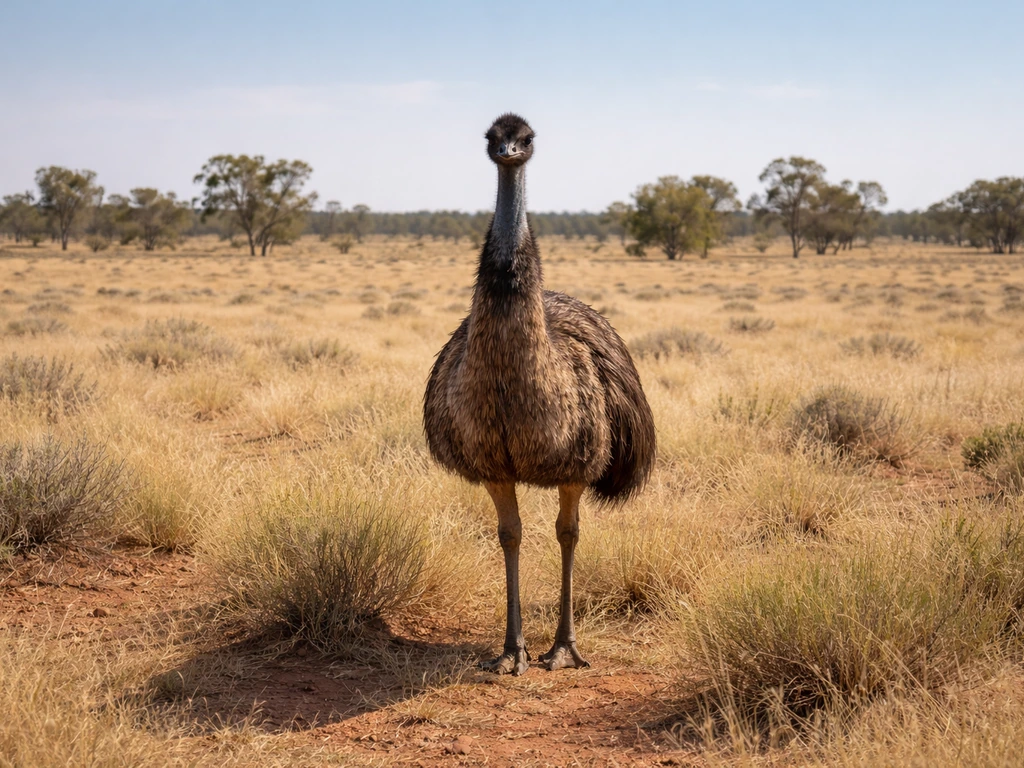
The real emu is native to Australia and is found across most of the continent's mainland, from coastal regions to the arid interior. Emus are found across most of Australia’s mainland, from coastal areas to the arid interior where emu bird is found. So if you’re really asking where an emu lives, it’s native to Australia and ranges across much of the mainland. If you are looking for where this bird lives, you can think of its range across Australia’s mainland native to Australia. If you meant the real osprey instead, it lives near coasts and freshwater lakes, where it can hunt for fish native to Australia. It is not endangered; the IUCN lists it as Least Concern. Emus are fast runners (up to 48 km/h), strong swimmers, and are known for their curious, assertive behavior, which is probably part of why Liberty Mutual's creative team found them compelling enough to build a campaign around.
What people most likely mean when they search 'Limu emu'
Most people searching this phrase fall into one of three groups: they saw the insurance ad and want to know if the bird is real, they encountered the name somewhere and assumed it might be an obscure species, or they are fact-checking a claim someone made. In all three cases, the answer points back to the same place: the Liberty Mutual mascot, loosely modeled on a real emu.
If you are interested in large, flightless, emu-like birds beyond Dromaius novaehollandiae itself, there are genuinely fascinating real species worth exploring. The cassowary (genus Casuarius), the emu's closest living relative, is found in New Guinea and northeastern Australia and is considered one of the most dangerous birds alive. The moa, a group of extinct ratites from New Zealand, included species that reached 3.6 meters tall and were hunted to extinction by around 1440 CE. The elephant bird of Madagascar (Aepyornis maximus) was the heaviest bird ever known, weighing an estimated 650 kilograms. All of these have full scientific records, museum specimens, and fossil evidence. None of them are called 'Limu emu.'
| Bird | Scientific Name | Status | Notable Feature |
|---|---|---|---|
| Emu | Dromaius novaehollandiae | Least Concern (extant) | Second-tallest living bird; native to Australia |
| Cassowary | Casuarius spp. | Vulnerable (some species) | Closest living emu relative; considered dangerous |
| Moa | Multiple genera | Extinct (~1440 CE) | Up to 3.6 m tall; extinct due to human hunting |
| Elephant Bird | Aepyornis maximus | Extinct (~1000–1200 CE) | Heaviest bird ever known at ~650 kg |
| King Island Emu | Dromaius ater | Extinct (early 1800s) | Island-dwelling emu subspecies wiped out by settlers |
| LiMu Emu | None | Not a real species | CGI advertising mascot for Liberty Mutual Insurance |
How to verify any bird name claim today
If you want to check whether any bird name is legitimate, here is the practical process I would use. Start with GBIF (gbif.org) and search the name exactly as you encountered it. If nothing comes up, try ITIS (itis.gov) and the IOC World Bird List (worldbirdnames.org). For extinct species, add the Paleobiology Database (paleobiodb.org). If a name returns no results on any of these, it is not a recognized taxon.
- Search GBIF (gbif.org) for the exact name. A real species returns a taxon page with a valid scientific name, classification hierarchy, and occurrence records.
- Cross-check with ITIS (itis.gov) or the IOC World Bird List for living species, which cover common names and synonyms.
- For potentially extinct species, search the Paleobiology Database or check major natural history museum online catalogs like those of the Smithsonian or the Natural History Museum London.
- Search Google Scholar for the name in quotes. A real species will have peer-reviewed papers describing it. A mascot or pop-culture reference will return marketing materials instead.
- Check Wikipedia's list of ratites or relevant bird order articles. Extinct island emus like the King Island emu and Kangaroo Island emu appear there precisely because they have scientific documentation.
- If the name contains a brand abbreviation (like 'LiMu' for Liberty Mutual), treat it as a brand name first, not a species name, and verify before assuming otherwise.
The same approach works for any unusual bird name you come across online. A name that only appears in news articles, social media posts, or commercial contexts without any taxonomy database entry is almost certainly not a recognized species. Real birds, even obscure ones, leave a scientific record. LiMu Emu does not, because it was designed in a CGI studio, not discovered in a forest or an archaeological dig.
Why this kind of confusion is worth clearing up
It might seem like a trivial question, but the LiMu Emu search is actually a useful example of a broader challenge: popular culture regularly borrows the names, appearances, and behaviors of real animals for characters, mascots, and fiction, and those references can blur into perceived facts. Understanding what makes a species 'real' in the scientific sense, specifically a formal description, a type specimen, and a recognized place in a classification system, is genuinely useful for anyone interested in natural history. It is also the first skill you need when reading about extinct or endangered birds, where claims about lost species and rediscoveries circulate constantly alongside legitimate science.
FAQ
How can I tell if a bird name is a mascot name instead of a real species?
No. A real bird species name usually follows a formal scientific naming pattern, and a legit species will be indexed consistently in major taxonomic resources. If the name only appears in advertising, crossword clues, or pop-culture references, that is a strong indication it is a mascot name rather than biology.
Does capitalization or spelling matter when verifying whether a bird name is real?
Check whether the wording is consistent with a contraction, brand label, or character title. In this case, “LiMu” aligns with “Liberty Mutual” as branding, and the character is presented as CGI-based. Real species names do not depend on capitalization styles used for trademarks and campaign branding.
Could “Limu emu” be real because it includes the word “emu”?
Don’t rely on “emu” alone. “Emu” is a real animal, but “Limu emu” is the specific label being questioned, and it does not match any recognized taxon entry. Many people assume that because “emu” is real, the full phrase they saw must be a species too.
What search strategy should I use if I only remember part of the name?
Search the full phrase exactly as written, then test variations without the brand element (for example, “Limu” alone, and “emu” alone). If only the generic animal returns results and the combined phrase does not, that usually means the combined phrase is not a taxon.
If something looks like an extinct bird, how do I verify it is not just a fictional character?
Yes, but focus on evidence type. For extinct species, a name should connect to published scientific descriptions and specimen or fossil references. A fictional character can look like an extinct or flightless bird, but it will not have type specimens, museum catalog records, or formal taxonomic pages.
What if my search returns results for “emu” but not for “Limu emu,” is that enough to conclude it is not real?
Use the presence or absence of a taxonomic entry as the “gate.” If GBIF, ITIS, and the IOC World Bird List do not return a matching taxon, treat the name as non-scientific. Also consider that plausible misspellings can happen, so try closely related spellings, but the core phrase “Limu emu” still should not produce a taxon.
How should I interpret mascot design details like sunglasses or wing shape when checking whether it is a real bird?
Emus have real anatomical traits, but the mascot’s details (like sunglasses, stylized wings, or comedic poses) are not reliable identifiers of species. Vestigial wing size and non-functional wings are biological facts, yet the “purely decorative” presentation in ads is a costume and graphic choice, not a taxonomic feature.
What should I look for if I see someone online claiming LiMu Emu is an obscure bird species?
If a website claims “Limu emu is an obscure species,” look for primary grounding, like the name showing up as a recognized entry in taxonomic databases. Social posts and blogs can repeat the claim, but without a formal taxon record and classification placement, it does not meet the bar for being a real species.
Is LiMu Emu based on a real emu, even though it is not a real species name?
Treat the “realness” question as two separate checks: (1) is it a real animal species, and (2) is it based on a real animal. In this case, the character appears modeled on a real emu species, but the “Limu emu” label itself is not a species.
Next Articles

Where Does the Osprey Bird Live Habitat and Range
Discover where ospreys live worldwide, their water and nesting habitat, and how to spot them by region and season.
Where Does the Emu Bird Live? Native Range and Habitat
Where emus live in Australia, preferred habitats, what they avoid, and how rainfall and seasons shift their range.

Is the Dodo Bird Still Alive? What Evidence Shows Today
Learn if any dodos could exist today, why scientists say they are extinct, and how to judge sightings reliably.