The dodo and the ostrich are both famous flightless birds, but they are about as different as two birds can get. The big question is whether the dodo bird can fly can dodo bird fly. The dodo was a small-to-medium, turkey-sized pigeon relative that went extinct on a single Indian Ocean island by around 1662. The ostrich is a massive African ratite, the largest living bird on Earth, still very much alive today. One is a cautionary tale about island extinction; the other is a survivor that has managed to outlast centuries of hunting pressure. Here is everything you need to know to understand how they compare.
Dodo Bird vs Ostrich: Key Differences, Ecology, History

Maya Hennessy
28 May 2026
How they're different at a glance
| Feature | Dodo (Raphus cucullatus) | Ostrich (Struthio camelus) |
|---|---|---|
| Status | Extinct (last record ~1662) | Alive; IUCN Least Concern |
| Native range | Mauritius (single island) | Africa (savanna, semi-arid plains) |
| Size | ~1 m tall, ~10–18 kg | Up to 2.8 m tall, up to ~160 kg |
| Evolutionary group | Columbiformes (pigeon family) | Ratites (Struthioniformes) |
| Closest living relative | Nicobar pigeon | Emus, rheas, cassowaries, kiwis |
| Beak | Large, hooked, robust | Flat, broad, blunt |
| Diet | Fruit, seeds, roots | Plants, insects, small vertebrates |
| Flightlessness cause | Island adaptation (isolated pigeon lineage) | Ancient ratite lineage divergence |
| Extinction driver | Human hunting + introduced predators | N/A (still alive, but faces threats) |
Where they lived: island isolation vs. a whole continent
The dodo's entire world was the island of Mauritius in the Mascarene Islands of the Indian Ocean. It never existed anywhere else. That geographic fact is central to its story: island populations are inherently vulnerable because they have no buffer, no second home, no escape route. Mauritius had dense forests packed with endemic fruit-bearing plants, including palm trees whose fruiting seasons shaped the dodo's breeding and molting cycles, as bone histology research published in Scientific Reports has shown.
The ostrich occupies a completely different scale. Today it occurs across a broad band of sub-Saharan Africa, from the southern edges of the Sahara down through Tanzania, Namibia, Botswana, Zimbabwe, and South Africa. Common ostriches favor open, arid and semi-arid habitats: savannas, the Sahel, and semi-desert zones. A second species, the Somali ostrich, lives in the Horn of Africa across Ethiopia, Kenya, Somalia, and Djibouti. Ostriches thrive in open country where their long legs and sharp eyesight make them effective at spotting predators from a distance and outrunning them.
Body and appearance: you would never mistake one for the other
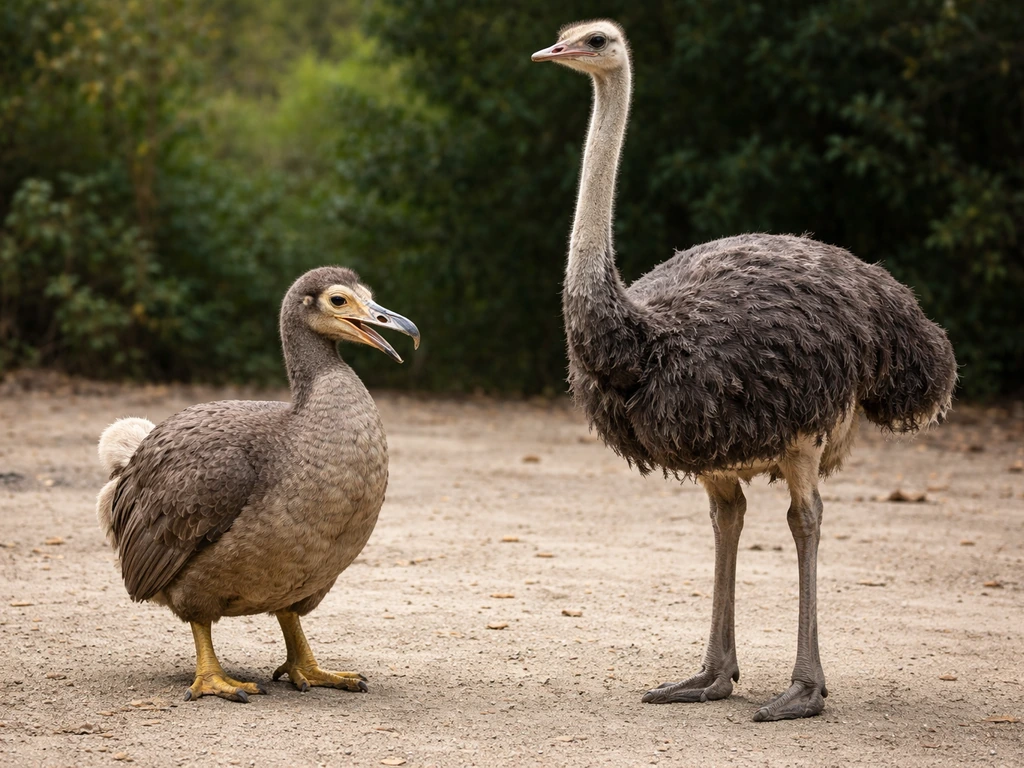
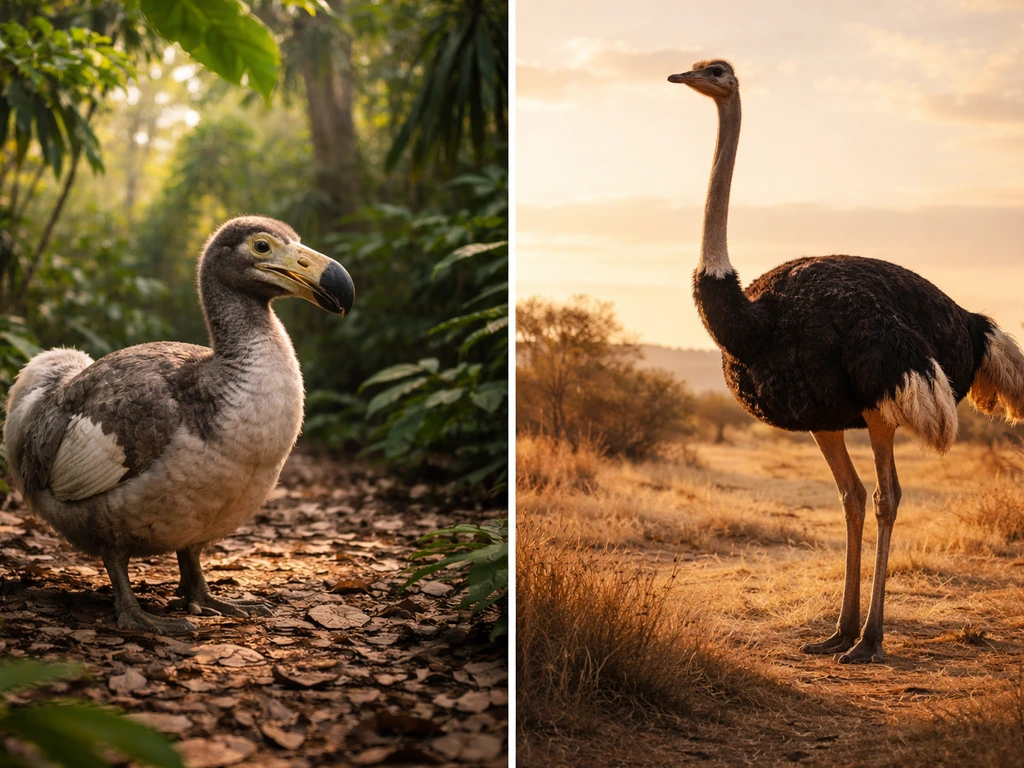
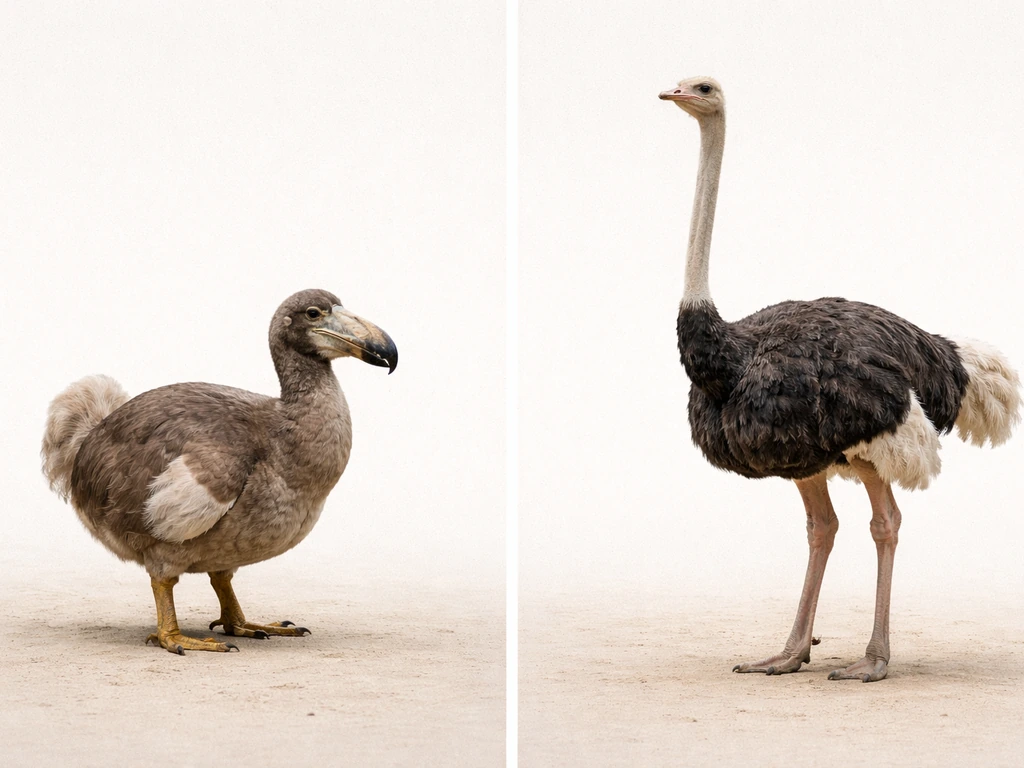
If you placed a dodo and an ostrich side by side, the size difference alone would settle the comparison immediately. The ostrich is the largest living bird on the planet, standing up to 2.8 meters tall and weighing up to around 160 kilograms. The dodo, by contrast, was roughly the size of a large turkey, standing about 1 meter tall and weighing somewhere between 10 and 18 kilograms based on estimates from subfossil remains. If you want to zoom in on the dodo’s scale in plain terms, see how big is a dodo bird for a quick size comparison. The ostrich can look the dodo in the eye from nearly three times the height.
The dodo had brownish-grey plumage, yellow feet, a tuft of curly tail feathers, a grey naked head, and a large black, yellow, and green beak with a distinctly hooked tip. That hooked bill was one of the things that made early European observers stop and stare. Historical accounts from the period 1598 to 1662 are some of our best evidence for what the dodo actually looked like, alongside subfossil bones and period artwork. The beak was robust by pigeon standards, adapted for cracking open hard fruit or seeds on the forest floor. The dodo also had four toes, three pointing forward and one pointing back, with thick black claws.
The ostrich looks nothing like that. Male ostriches are striking: jet-black body feathers contrasted with white wing and tail plumes. Females are a more muted brownish-grey. Both sexes have long, bare necks, small heads with large eyes, and a flat, broad beak suited to grazing vegetation and picking up insects or small vertebrates. Ostriches have only two toes, which is unique among birds, and their legs are enormously powerful, capable of delivering a kick strong enough to kill a lion.
Wings: vestigial vs. still functional in small ways
Neither bird could fly, but their wings tell slightly different stories. The dodo's wings were reduced to tiny, functionless stubs. They were so small relative to its body that they were essentially invisible under its feathers. The ostrich's wings are larger and still serve real purposes: males use them in courtship displays, they help with balance while running, and they can shade chicks from the sun. Neither set of wings provides lift, but the ostrich's are far more active parts of its life.
Behavior and diet: forest frugivore vs. savanna generalist
The dodo is generally understood to have been a frugivore, feeding primarily on fallen fruits, seeds, and roots in the forests of Mauritius. Research into the island's plant ecology supports this: the dodo was one of several large fruit-eating species that helped disperse seeds of endemic Mauritian plants. When the dodo disappeared, that ecological relationship collapsed. The Natural History Museum in London has highlighted how the loss of these large native frugivores continues to affect plant communities in Mauritius today, because invasive species like rats and pigs cannot replicate the seed-dispersal function.
The ostrich is a much more flexible feeder. It eats plants, seeds, succulents, roots, and insects, and will also consume small vertebrates when available. In arid environments, ostriches can use vegetation as a short-term water source, though they need access to open water for long-term survival. Their digestive anatomy is distinctive among birds: ostriches have an unusually long, voluminous colon and long paired caeca, which gives them extended time to ferment and extract nutrients from tough plant material. That kind of gut architecture suits a bird living in sparse, semi-arid habitats where food quality is variable.
Behaviorally, ostriches are social and live in groups, which gives them collective vigilance against predators. Males guard eggs and are known to chase off intruders. The dodo, isolated on an island with no natural mammalian predators before humans arrived, had no real reason to develop strong predator-avoidance instincts. That naivety, combined with its tameness around humans, became one of the factors that made it easy to hunt.
Evolution and flightlessness: two very different roads to the same result
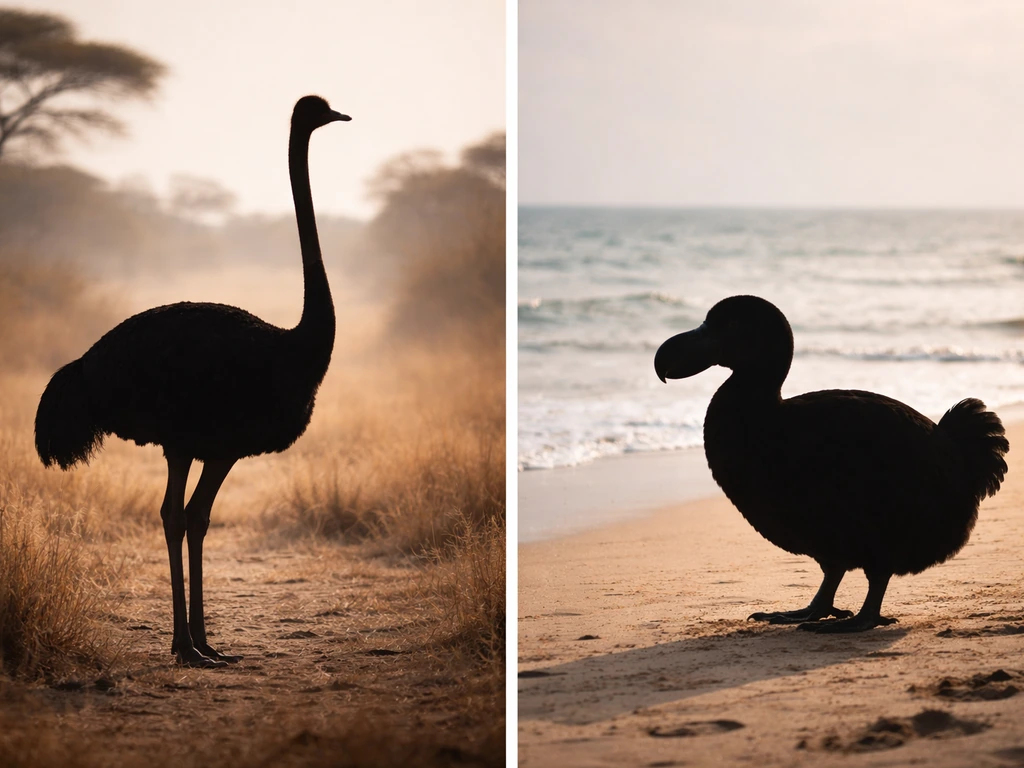
This is one of the most interesting parts of the comparison. Both birds lost the ability to fly, but they got there through completely independent evolutionary paths, which biologists call convergent evolution.
The ostrich belongs to the ratites, an ancient group of flightless and weakly-flying birds that also includes emus, rheas, cassowaries, kiwis, and tinamous. Ostriches are classified in the order Struthioniformes. Their flightlessness is deeply embedded in this lineage's evolutionary history, tied to the breakup of the supercontinent Gondwana and the divergence of these bird families across the southern continents over tens of millions of years. The ostrich is the largest living bird on Earth partly because its ratite body plan was already committed to ground-dwelling long before humans appeared.
The dodo took a completely different route. Scientists have confirmed it belongs to the order Columbiformes, meaning it is essentially a giant flightless pigeon. The Oxford University Museum of Natural History identifies the Nicobar pigeon (Caloenas nicobarica) as the closest living relative among currently studied comparisons. What happened is that a pigeon ancestor colonized Mauritius, found an island free of mammalian predators and rich in fruit, and over generations lost its ability to fly as the metabolic cost of flight outweighed any benefit. This kind of island-driven flightlessness happens independently in many bird lineages, and the dodo is one of the most famous examples.
In short: the ostrich never flew because it is part of an ancient ratite lineage. The dodo stopped flying because island life made flight unnecessary. These are two separate evolutionary stories that happened to produce two flightless birds.
Human impact and fate: why one survived and the other didn't
Portuguese sailors reportedly first encountered the dodo around 1507. By 1662, it was gone. That is a window of less than 160 years between first contact and total extinction. The mechanisms were multiple: direct hunting by sailors and settlers who found the dodo easy to catch, and the introduction of animals that had never existed on Mauritius before, including dogs, pigs, cats, rats, and crab-eating macaques. These introduced species raided nests and competed for food resources. The dodo nested on the ground and laid only one egg at a time, which meant its reproductive rate could not possibly keep up with the new pressure. The island offered no refuge and no escape.
The ostrich faced sustained hunting pressure too, particularly from the 19th century onward for its feathers, which were highly fashionable in European markets. Wild populations declined significantly during that period. But the ostrich had something the dodo never did: continental scale. A species spread across the open landscapes of an entire continent has geographic resilience. Local populations can be wiped out and the species still survives elsewhere. The ostrich also has speed (up to around 70 km/h in short bursts), size, and a powerful kick that gives it real defensive options against predators, which the dodo simply lacked.
The contrast between these two species is almost a textbook illustration of why island species are so much more vulnerable than continental ones. The dodo had evolved in a bubble; the ostrich had evolved in an ecosystem full of predators and competitors that kept it sharp.
Where things stand today for the ostrich
The common ostrich is currently listed as Least Concern on the IUCN Red List, which means it is not considered endangered as a species. That is genuinely good news, but it does not mean ostriches face no threats. IFAW highlights that ostriches still face pressure from hunting and from ongoing habitat loss as human land use expands across African savannas and semi-arid zones. In some parts of their range, wild populations are smaller and more fragmented than historical baselines. The North African subspecies (Struthio camelus camelus) has disappeared from large portions of its former range across the Sahara.
The dodo, of course, is beyond any conservation help. But its extinction continues to have ripple effects on Mauritius today. Research from the Natural History Museum in London has shown that endemic plants on Mauritius that depended on large frugivores for seed dispersal are now struggling, because no available species can fully replace what the dodo and other lost fruit-eaters once did. The dodo's absence is still an active ecological problem, not just a historical footnote.
What to explore next
If the dodo-versus-ostrich comparison has you thinking about flightless birds more broadly, there is a lot more to dig into. For the latest dodo bird news, check reputable science and museum updates as new research and discoveries continue to emerge. The question of why the dodo could not fly connects directly to island evolution and how flightlessness evolves independently in isolated bird populations. How fast the dodo could actually move is another detail that surprises people given the popular image of it as slow and bumbling. And if you want to place the ostrich in its ratite context, comparing it with other living flightless birds like cassowaries and kiwis reveals just how diverse and widespread this pattern of flightlessness really is across the bird family tree.
FAQ
Did the dodo bird ever fly, even a little?
No. The dodo’s extinction is around 1662, and its flightlessness is confirmed by anatomy and evolutionary placement. The “can a dodo fly?” question is usually a myth check, because dodos had wing stubs that could not generate lift.
If ostriches can’t fly, what are their wings used for?
Ostriches can’t fly, but their wings still help them. Males use wing displays during courtship, and both sexes use the wings for balance while running and to shade chicks, even though they still cannot produce lift.
Are dodos and ostriches closely related?
A common mistake is treating “flightless bird” as a single family trait. The dodo is a pigeon relative (order Columbiformes), while the ostrich is a ratite (Struthioniformes), so their flightlessness evolved independently for different reasons.
Why was the dodo more vulnerable than the ostrich, even though both are flightless?
The dodo was confined to Mauritius, so any environmental or human change hit the entire species at once. By contrast, ostriches occupy much of sub-Saharan Africa and the Horn of Africa, so local losses do not automatically mean global extinction.
Was the dodo extinct because it was simply slow and defenseless?
Not to the degree people often assume. Dodos were not just “slow,” but rather poorly adapted for predator avoidance in a predator-free environment before humans. Their tameness and ground-nesting also made them easy to hunt once people arrived.
How did their diets affect their ability to survive changing conditions?
Feeding differences matter for survival. Dodos relied heavily on forest fruit and seeds, while ostriches are more of a generalist, eating a wider mix of plants, insects, and even small vertebrates, which helps them persist in variable habitats.
Does Least Concern for ostriches mean they are safe everywhere?
Yes, conservation status depends on the scale. “Least Concern” means the species as a whole is not currently considered highly endangered, but individual populations can be reduced locally from hunting and habitat fragmentation.
What ecological effects are still happening because the dodo went extinct?
In many ecosystems, large seed-dispersers strongly influence plant recruitment. Mauritius lost that function when the dodo (and other large frugivores) disappeared, so some endemic plants still struggle without equivalent dispersers.
Who is faster, the ostrich or the dodo, based on the best evidence we have?
If you are comparing size or speed claims, make sure you use consistent categories. Ostriches can reach high sprint speeds in short bursts, while dodo movement is harder to infer because it comes from limited fossil evidence and reconstructions.
How can you tell a dodo from an ostrich in terms of basic anatomy?
Both can be misidentified in popular descriptions, but their toe counts are a quick check. Ostriches have two toes, while dodos had four, with three facing forward and one back.