
Yes, the Kauaʻi ʻōʻō (Moho braccatus) is almost certainly extinct. The kakapo bird is critically endangered, not extinct is the kakapo bird extinct. The last confirmed sighting was in 1987, and four rounds of dedicated surveys in 1989, 1994, 1996, and 2000 found nothing. The U.S. Fish & Wildlife Service eventually delisted the species on the grounds that it is "no longer extant," which is federal shorthand for extinct. What killed it was a combination of introduced predators, mosquito-borne disease, habitat destruction, and the particular bad luck of being a highly specialized bird living on a single island with no backup population anywhere else.
How Did the Kauai Bird Go Extinct? Causes and Evidence

Maya Hennessy
7 May 2026
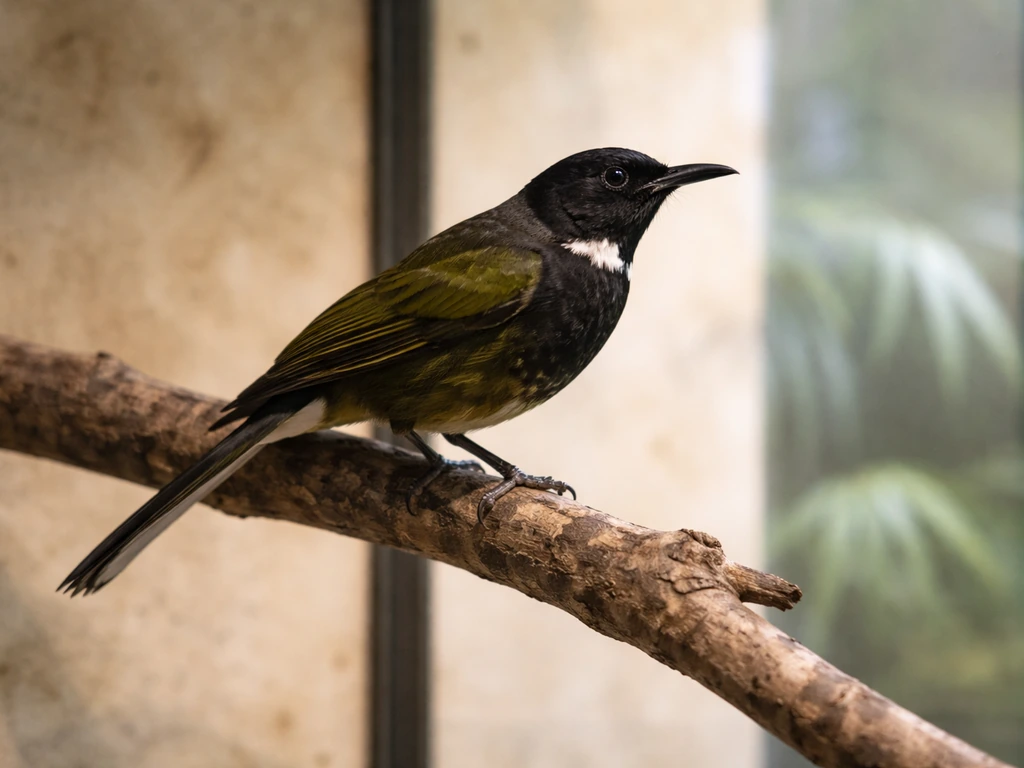
Which "Kauaʻi bird" are we talking about?
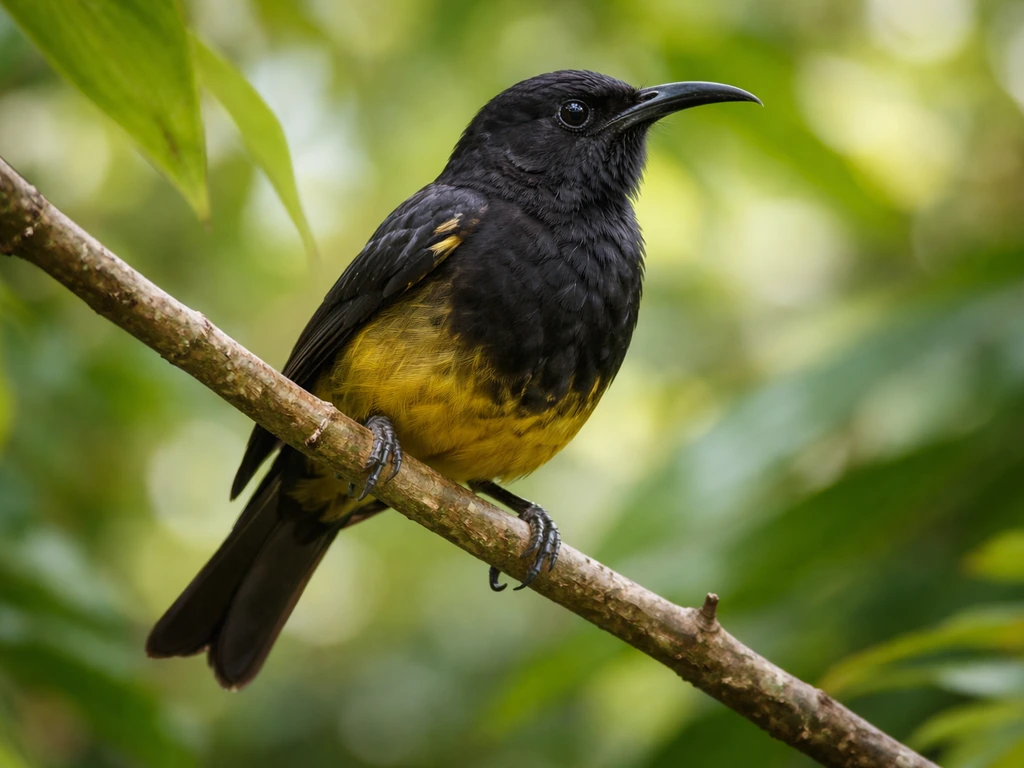
When people search for "the Kauai bird" that went extinct, they almost always mean the Kauaʻi ʻōʻō, scientific name Moho braccatus. The USFWS lists it under several spelling variants: "Kauai 'O'o," "Kauai Oo," and "O'o A'a" all refer to the same species. This matters because Kauaʻi is home to many endemic birds, some extinct and some still clinging on, so mixing up common names leads you to completely different stories. If you're looking up the species in a database, always pair the common name with Moho braccatus to make sure you're tracking the right bird.
The ʻōʻō was a member of the honeyeater family, a striking black bird with small yellow patches. It was the last surviving member of the entire Moho genus, which once held four species across the Hawaiian islands. That context is important: the extinction of the Kauaʻi ʻōʻō didn't just wipe out a species, it wiped out an entire genus.
Where it lived on Kauaʻi
Historically, the Kauaʻi ʻōʻō lived in forest habitat across the whole island. By the time of its last observations, it had been pushed into the dense ʻōhiʻa forests of the Alakaʻi Wilderness Preserve, specifically the stream valleys of that high-elevation swamp. This is one of the most remote and rugged landscapes in Hawaiʻi, which says a lot about how far the bird had been squeezed.
Its diet relied heavily on native plants, including ʻieʻie, a climbing plant whose flowers and fruit it fed on. Here's a telling detail from the DLNR/DOFAW factsheet: ʻieʻie doesn't grow at the upper elevations where the ʻōʻō was last observed. So the bird's final refuge was actually poor-quality habitat from a food-plant perspective. It was essentially cornered in the only place that still had some protection from lowland threats, even though that place couldn't fully support it.
For nesting, the only documented sites were cavities inside large ʻōhiʻa snags, meaning dead or dying standing trees of a specific large size. That's a very narrow nesting requirement, and it made the species acutely vulnerable to anything that damaged the forest structure.
What actually caused the extinction
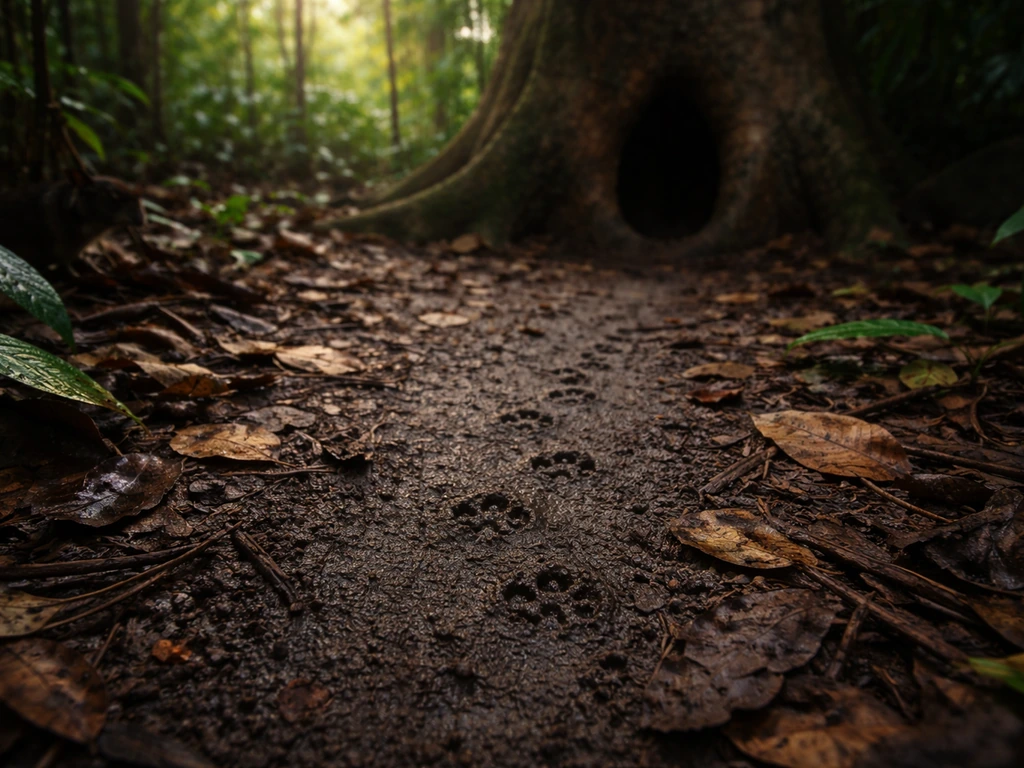
The DLNR/DOFAW's State Wildlife Action Plan factsheet is direct about this: the likely threats were habitat loss and degradation, predation by introduced mammals, and disease. EOL’s Kauaʻi ʻōʻō aggregation page also summarizes these likely causes and notes that a combination of factors likely produced the final death toll likely threats were habitat loss and degradation, predation by introduced mammals, and disease. These are framed as "likely" rather than confirmed with experimental certainty, which is typical for island bird extinctions where you can't run controlled trials. But the weight of evidence for each is substantial.
Introduced predators and competitors
Rats, mongooses, and feral cats arrived in Hawaiʻi through human activity and devastated ground-nesting and cavity-nesting birds. The ʻōʻō nested in tree cavities, which are exactly the kind of sites rats raid for eggs and chicks. Pigs and goats tore up native understory plants, degrading the forest structure the bird depended on. These aren't hypothetical pressures: introduced mammals are the single most documented driver of Hawaiian bird extinctions across the board.
Avian disease
Disease is the factor the factsheet flags most explicitly for this genus. The document states that "the precipitous decline of all Hawaiian Moho species suggests that disease played a role." Avian malaria and avian pox, both spread by introduced mosquitoes, have been catastrophic for Hawaiian forest birds. Native species evolved with no exposure to these diseases and have essentially no immunity. Mosquitoes thrive at lower elevations, which is part of why high-elevation refuges like the Alakaʻi briefly protected some species. But as mosquito ranges crept upward over decades, that protection eroded.
Habitat loss and forest degradation
Beyond predators and disease, the forest itself was being dismantled. Lowland and mid-elevation forests on Kauaʻi were cleared for agriculture and development, progressively shrinking the available habitat. This is what pushed the ʻōʻō into the Alakaʻi highlands in the first place. What remained was patchy, and because the bird needed large ʻōhiʻa snags specifically for nesting, even small-scale forest disturbance had outsized effects.
What about hunting?
Other ʻōʻō species were historically hunted for their yellow feathers, used in Hawaiian featherwork. The DLNR/DOFAW factsheet addresses this directly for Moho braccatus and concludes that hunting's role was "equivocal, but likely minimal" given the Kauaʻi ʻōʻō's plumage. So while feather exploitation devastated related species, it probably wasn't a primary driver here.
The timeline: when it disappeared and what the surveys show

| Year | Event |
|---|---|
| Pre-1900s | Kauaʻi ʻōʻō present in forest habitat across the island |
| 20th century | Progressive habitat loss pushes population to Alakaʻi Wilderness Preserve |
| 1981 | Bird surveys document the species; included in USGS Kauai Bird Surveys dataset |
| 1982 | Hurricane Iwa causes significant damage to high-elevation forests |
| 1987 | Last confirmed observation of a living Kauaʻi ʻōʻō |
| 1989 | Extensive survey: species not detected |
| 1992 | Hurricane Iniki causes additional severe damage to Kauaʻi forests |
| 1994 | Survey: species not detected |
| 1996 | Survey: species not detected |
| 2000 | Survey: species not detected |
| Post-2000 | USFWS delists as "no longer extant"; DLNR lists as "possibly extinct" |
The 1987 last sighting is the anchor date most sources use, and it's worth understanding what happened immediately before and after. Hurricane Iwa in 1982 had already hammered the high-elevation forests the bird depended on, destroying large ʻōhiʻa snags needed for nesting. Then Hurricane Iniki in 1992 hit again, five years after the last sighting. Even if a tiny population had somehow survived into the early 1990s, the 1992 hurricane would have been devastating for a bird with such specific nesting requirements.
Other factors that made extinction more likely
Even setting aside the big direct threats, the Kauaʻi ʻōʻō had several characteristics that made it especially vulnerable once population numbers started dropping. Small, isolated populations suffer from what biologists call demographic stochasticity: random bad luck in breeding seasons, sex ratios, or disease outbreaks that a larger population would absorb, but a tiny one can't. With no related populations on other islands and no captive breeding program established in time, there was no safety net.
The food-plant situation added another layer. Being forced into upper-elevation habitat where ʻieʻie wasn't present likely meant nutritional stress on top of everything else. A stressed, malnourished bird is more susceptible to disease and less likely to breed successfully. These factors don't show up as a single dramatic cause of extinction, but they compound each other in ways that can tip a small population over the edge quickly.
It's also worth noting that the entire Moho genus collapsed. All four species are gone. That pattern across multiple islands and multiple related species, all declining steeply after human arrival and the introduction of predators and disease, is the kind of evidence scientists use to reconstruct cause even without direct observation of every death.
How to confirm this today: your verification checklist
If you want to verify the status yourself or dig deeper, here's a practical approach. The key is using the right scientific name (Moho braccatus) so you're not accidentally reading about a different Kauaʻi endemic. Kauaʻi has many species with Hawaiian names that look similar in a quick search.
- Search USFWS species records for "Moho braccatus" or "Kauai O'o" to find the federal delisting notice, which confirms the species is considered "no longer extant" under the Endangered Species Act.
- Check the Hawaiʻi DLNR Division of Forestry and Wildlife (DOFAW) Wildlife Program page and the State Wildlife Action Plan (SWAP) factsheet for the Kauaʻi ʻōʻō. These give the exact last-observation year (1987) and the survey years that came up empty (1989, 1994, 1996, 2000).
- Look up the USGS Kauai Bird Surveys dataset (1981-2012) on data.gov. It documents the survey effort across years and is useful for understanding how thoroughly the species was searched for after 1987.
- Cross-reference the survey failure dates with the hurricane timeline (1982, 1992) to understand the habitat context of the final years.
- To confirm you're not confusing "extinct" with "extirpated" (gone from one area but surviving elsewhere): check whether any other island populations existed. The Kauaʻi ʻōʻō was endemic to Kauaʻi only, so gone from Kauaʻi means gone entirely.
- For the disease hypothesis specifically, search for literature on avian malaria (Plasmodium relictum) and avian pox in Hawaiian forest birds. The evidence base for disease as a driver of Hawaiian honeycreeper and honeyeater declines is well-documented in peer-reviewed literature.
One distinction worth keeping straight: DLNR/DOFAW still officially uses the phrasing "possibly extinct" rather than "extinct" in some documents, reflecting scientific caution when no body has been recovered from such remote terrain. The [USFWS delisting language of "no longer extant"](https://www. fws. gov/policy/library/2000/00fr20760.
html) is the stronger federal statement. The Kauaʻi ʻōʻō is widely treated as extinct in the federal sense. For practical purposes, the combination of a 1987 last sighting, four failed surveys over 13 years, and two major hurricanes hitting the last known habitat makes the extinction conclusion solid.
USGS-hosted publication listings note that the Oʻahu and Hawaiʻi ʻōʻō and the Kioea are now definitely extinct, while the Kauaʻi and Bishop’s ʻōʻō are probably extinct the USFWS delisting language of "no longer extant". It was declared extinct because there are no confirmed sightings after that period.
If you're comparing this situation to other birds like the kakapo (critically endangered but still alive with active conservation) or species like the kagu, the difference is that the ʻōʻō had no managed population and no protected breeding program before numbers collapsed to zero. In contrast, the kagu is not considered extinct, though it has faced serious conservation challenges in New Caledonia is kagu bird extinct. If you're wondering is kagu bird extinct, the current conservation status is more nuanced than the Kauaʻi ʻōʻō’s clear disappearance.
The Kauaʻi ʻōʻō is a painful case study in what happens when multiple threats converge on a small-island specialist with nowhere left to go. If you are asking whether a living Kauaʻi bird like the Kauaʻi ʻōʻō is still alive today, the short answer is no. The causes are understood well enough to be confident about the diagnosis, even if the precise final moment can't be pinned down. That's usually the best science can do with island extinctions, and it's the kind of honest, evidence-based conclusion that should shape how we approach the birds still left.
FAQ
If the last sighting was in 1987, what does that tell us about the exact cause and timing of extinction?
No. What the 1987 date does is define the last time the species was credibly observed, and then later surveys failing to find it establish “no longer present.” For remote species, absence of sightings over a multi-year period is typically treated as stronger evidence than trying to infer an exact “death day.”
How does knowing the entire Moho genus went extinct change the explanation for how did the Kauai bird go extinct?
Genus collapse matters because it reduces the odds that one odd local event wiped out just this species. When multiple Moho species across islands show steep declines after the arrival of humans, predators, and mosquito-borne disease, scientists treat the pattern as ecosystem-level cause rather than a one-off accident affecting only Moho braccatus.
Why isn’t there direct proof showing the exact death mechanism (like malaria causing a specific bird to die)?
Not usually. Because the species is gone, there were no “before and after” measurements of immunity, infection rates, or breeding success that could be tracked directly. Instead, evidence is built from the consistent decline pattern across Moho species, the known spread of avian malaria and pox by mosquitoes, and the timing of mosquito range expansion into higher elevations.
Were Hurricane Iwa and Hurricane Iniki the main reason how did the Kauai bird go extinct, or were they just the final blow?
Hurricanes are best understood as accelerators, not single causes. The Kauaʻi ʻōʻō already faced long-term pressure from habitat loss, introduced predators, and disease. Hurricane Iwa (1982) likely damaged nesting structure and food resources early, and Hurricane Iniki (1992) then hit again after the population was already likely very small.
What evidence supports introduced predators as a driver rather than just a contributing factor?
They are relevant, but many details are hard to confirm. With tiny populations and no bodies recovered, scientists rely on habitat and nest-site vulnerability (cavity nests raided by rats), known behaviors of introduced mammals, and parallels across other Hawaiian extinctions where those predators are strongly implicated.
How can I avoid mixing up different “Kauaʻi bird” stories when researching how did the Kauai bird go extinct?
It can, especially when you mix common names. “Kauai ‘O‘o,” “Kauai Oo,” and “O‘o A‘a” refer to Moho braccatus in official lists, but Kauaʻi also has other endemic birds with visually similar Hawaiian names. The practical rule is to verify the scientific name first (Moho braccatus) before comparing threat stories.
Why do some sources say possibly extinct, while others treat the Kauaʻi ʻōʻō as extinct?
Yes, but only in a limited sense. The species may be described as “possibly extinct” in some scientific or state documents because researchers did not recover a body from inaccessible terrain. “Extinct” in the federal sense corresponds to the conclusion that it is no longer present, supported by last-confirmed observations and repeated survey failures.
How many surveys are enough to conclude a Hawaiian bird like the Kauaʻi ʻōʻō is gone?
You should not rely on a single failed survey. In this case, multiple targeted surveys over a span of more than a decade found no evidence after the last confirmed sighting, which is a stronger standard than “we looked once.” That repeated negative evidence is what makes the extinction conclusion robust.
Could the Kauaʻi ʻōʻō have been saved if people had started captive breeding earlier?
A captive breeding program is the key difference. The article indicates there was no managed population established in time before declines drove numbers to zero. For other birds, recovery sometimes becomes possible when captive breeding or intensive management begins while the species still exists.
Why did high-elevation habitat help at first, and why did it stop helping later?
High elevation did provide a temporary refuge because mosquitoes generally thrive at lower elevations, but the refuge was not permanent. Over decades, mosquito ranges expanded upward, meaning the disease threat effectively followed the remaining habitat, shrinking the last safe zones for Moho braccatus.
How did the loss of ʻieʻie at higher elevations influence how did the Kauai bird go extinct?
It likely worsened the situation rather than causing extinction alone. If the bird was pushed into areas where its key food plant (such as ʻieʻie) was not present, that would create nutritional stress. In small populations, stress can reduce breeding success and make infection outcomes worse, turning multiple threats into an extinction spiral.
Why does nesting in large ʻōhiʻa snags make a species more vulnerable than generalist cavity nesters?
The narrow nesting requirement (cavities in large ʻōhiʻa snags) makes the bird disproportionately sensitive to forest structure damage. Even if some forest remains, the loss of large standing dead trees from storms, logging, or degradation can remove the specific breeding sites needed to reproduce.