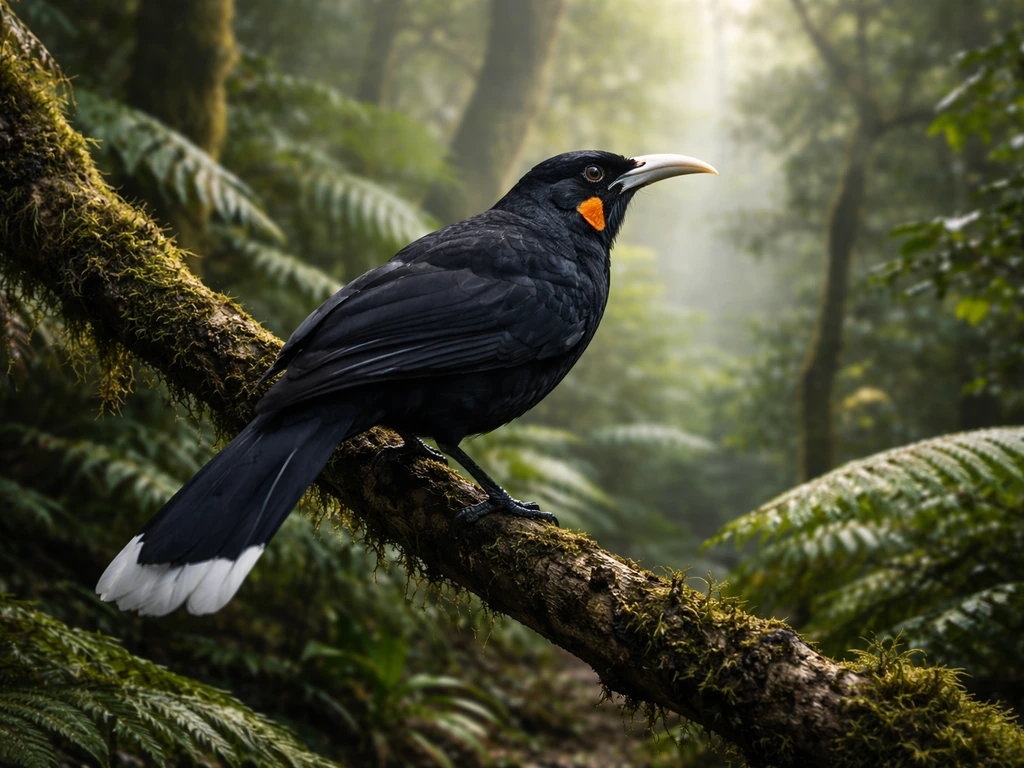
Yes, the o'o bird is extinct. That kind of interest is also why ortolan bird trade and hunting are heavily restricted or illegal in many places. The species most people mean when they search this term is the Kauaʻi ʻōʻō (Moho braccatus), a small, striking Hawaiian songbird that was last seen in 1985 and last heard on a recording in 1987. The IUCN Red List officially classifies it as Extinct (EX), a status that was formally assessed around 2000 and has not changed since. There are no credible confirmed sightings after the late 1980s, and intensive surveys of its last known habitat have turned up nothing.
Is the O-O Bird Extinct? What the Evidence Says Now

Maya Hennessy
22 May 2026
Which bird does 'o'o / o-o actually refer to?
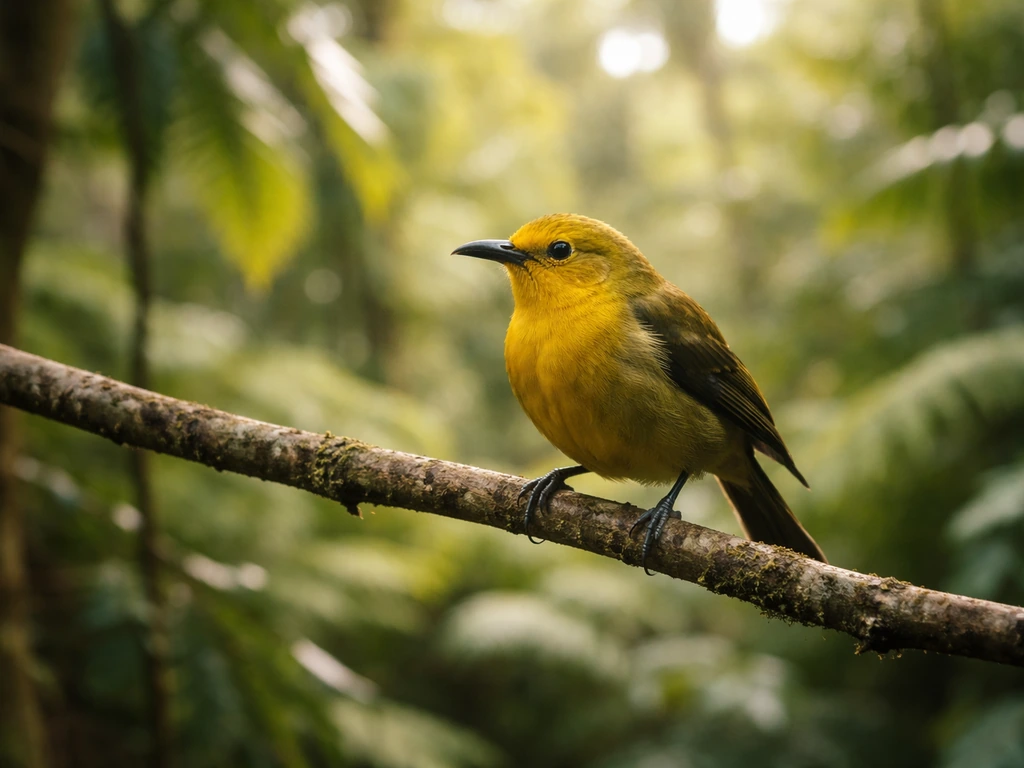
This is where things get genuinely confusing, so it's worth pausing here. 'O'o, o-o, o'o, and ʻōʻō are all spelling variants of the same Hawaiian word used as a common name for a group of birds in the genus Moho, family Mohoidae. There were four recognized species in this group, all endemic to the Hawaiian Islands, and all of them are now extinct. When modern sources or casual searches refer to 'the o'o bird,' they almost always mean the Kauaʻi ʻōʻō specifically, scientific name Moho braccatus (Cassin, 1855), because it was the last surviving member of the group and the one with the most recent documented records. GBIF’s species entry for Moho braccatus (Cassin, 1855) treats it as a distinct species within the genus Moho (family Mohoidae).
The four Moho species were each tied to a specific island: Moho braccatus on Kauaʻi, Moho bishopi (Bishop's ʻōʻō) on Maui and Molokaʻi, Moho apicalis (Oʻahu ʻōʻō) on Oʻahu, and Moho nobilis (Hawaiʻi ʻōʻō) on the Big Island. All four went extinct, but the Kauaʻi ʻōʻō held on longest and left behind the most compelling modern evidence, including that haunting 1987 audio recording of a lone male singing a duet call with no female to answer. That recording alone is why this species gets so much attention and why 'the o'o bird' has become shorthand for the whole group's tragedy.
The official answer: extinct, and what that classification actually means
The IUCN Red List places Moho braccatus in Category EX, meaning Extinct. This is the highest-certainty extinction classification the IUCN uses, reserved for species where 'there is no reasonable doubt that the last individual has died.' Both the Hawaii DLNR species fact sheet and GBIF's occurrence database confirm this status. The assessment year most commonly cited in the literature is 2000, which is when the IUCN formally moved the species to EX following the absence of any credible post-1987 records and years of failed surveys.
It's worth knowing what 'Extinct' means in practice versus 'Critically Endangered (Possibly Extinct),' which the IUCN uses when some uncertainty remains. Moho braccatus doesn't carry that hedge. The evidence was deemed sufficient to drop the qualifier. For a small island bird with a very restricted range that was intensively surveyed, that's a reasonable scientific call.
What the timeline of disappearance actually looks like

The Kauaʻi ʻōʻō was endemic to a single Hawaiian island, Kauaʻi, and by the 20th century it had retreated to the high-elevation ʻōhiʻa forests of the Alakaʻi Swamp, one of the last refuges for native Hawaiian forest birds. Here's how the decline played out:
- 19th century: The species was already considered rare relative to other Hawaiian birds; museum specimens were collected and documented, forming the physical evidence base used in later accounts.
- Mid-20th century: Population was declining steadily as habitat degradation, introduced predators (rats, mongoose, feral cats), and mosquito-borne diseases spread further into high-elevation forest.
- 1985: Last confirmed visual sighting of the Kauaʻi ʻōʻō in the Alakaʻi Swamp area.
- 1987: Last known audio recording captured, a male singing its duet call alone, a sign that no females remained.
- Post-1987: Repeated surveys of the Alakaʻi Swamp and surrounding high-elevation habitat produced no detections.
- 2000: IUCN formally assessed Moho braccatus as Extinct (EX).
The causes weren't mysterious. Hawaii DLNR's species account points to the same cluster of threats that wiped out dozens of Hawaiian forest birds: habitat loss and degradation, predation by introduced mammals, and disease. For Moho braccatus specifically, disease is flagged as a particularly likely driver, with the rapid, nearly simultaneous collapse of all Moho species suggesting avian disease played a central role. The Kauaʻi ʻōʻō is often discussed alongside other island extinctions, but what killed the elephant bird, in particular, is usually linked to human activity and habitat disruption disease. Introduced mosquitoes brought avian malaria and avian pox to Hawaii, and native birds had no evolutionary immunity to either. Hunting and feather exploitation, which devastated some other ʻōʻō species historically, was considered minimal for Kauaʻi ʻōʻō given its plumage, so that factor is largely ruled out for this species. Hurricanes affecting Kauaʻi's high-elevation forest are also noted as a potential secondary factor that may have further reduced suitable habitat in the species' final years.
How to verify the status yourself using authoritative sources
If you want to check this yourself rather than take anyone's word for it, here's exactly how to do it. Three sources will give you the clearest, most up-to-date picture:
- IUCN Red List (iucnredlist.org): Search for 'Moho braccatus' and you'll land on the species page showing the EX classification, the assessment year, and the threat summary. This is the global standard for conservation status.
- GBIF (gbif.org): Search for 'Moho braccatus (Cassin, 1855)' and filter occurrence records by date. You can see the museum specimens, observational records, and the clustering of records ending in the 1980s. The absence of modern occurrence data is itself evidence.
- BirdLife DataZone (datazone.birdlife.org): BirdLife International is the IUCN's official Red List authority for birds. Their species page for Moho braccatus provides threat categories, range information, and the underlying assessments that feed into the IUCN listing.
- Smithsonian Collections (collections.si.edu): Searching for 'Moho braccatus' here brings up museum specimen records, the physical evidence that anchors historical species accounts and confirms the species was real, well-documented, and not a taxonomic ghost.
- Hawaii DLNR species fact sheet: The Department of Land and Natural Resources maintains a fact sheet for Kauaʻi ʻōʻō that summarizes habitat, threats, and IUCN status in plain language and cites the peer-reviewed literature behind the conclusions.
What counts as proof of extinction in cases like this? Scientists look for the combination of last credible records (the 1985 sighting and 1987 recording), absence of detection across intensive systematic surveys in known habitat, and physical specimens confirming the species' historical existence. Subfossil records can extend this picture back further in time, and genetic evidence from museum specimens can clarify taxonomy. For Moho braccatus, the observational and acoustic records are recent enough that subfossil evidence wasn't the deciding factor. The 1987 recording, the failed subsequent surveys, and the known habitat context were sufficient.
Why the name causes so much confusion

The short version: there are four species, all called 'ōʻō or some variant of it, and they're all extinct. When you add common spelling variations (o'o, o-o, O-O, oo) and the fact that Hawaiian diacritical marks (the ʻokina and the macron) are often dropped in casual writing, searches become genuinely ambiguous. Someone searching 'is the o-o bird extinct' could technically be asking about any of the four Moho species, or even confusing the name with other Hawaiian birds that have similar-sounding names. So if you're asking, “is the ortolan bird extinct,” you'll want to verify that specific species separately from these ʻōʻō examples.
| Species | Scientific Name | Island | IUCN Status |
|---|---|---|---|
| Kauaʻi ʻōʻō (Kauai O-O) | Moho braccatus | Kauaʻi | Extinct (EX) |
| Bishop's ʻōʻō | Moho bishopi | Maui / Molokaʻi | Extinct (EX) |
| Oʻahu ʻōʻō | Moho apicalis | Oʻahu | Extinct (EX) |
| Hawaiʻi ʻōʻō | Moho nobilis | Hawaiʻi (Big Island) | Extinct (EX) |
The safest habit when researching any of these species is to anchor your search on the scientific name. 'Moho braccatus' will take you to Kauaʻi ʻōʻō information regardless of which common-name spelling a source uses. This same disambiguation problem comes up with other Hawaiian species that share similar common-name patterns, and it's worth knowing that Bishop's ʻōʻō (Moho bishopi) is sometimes separately discussed in extinction literature, just as the huia and the mamo are each documented under their own distinct names despite similar fates. The mamo is a different Hawaiian bird with its own extinction timeline, often dated to the late 1800s. The huia is another famous New Zealand bird, and it went extinct in the early 20th century.
What this case teaches us about extinction and why it still matters
The Kauaʻi ʻōʻō story is one of the clearest illustrations of how island birds go extinct in the modern era, and the lessons it offers are directly relevant to species that are endangered right now. The pattern is consistent: an endemic species, restricted to a single island, faces a combination of habitat loss, introduced predators, and novel disease. Any one of those pressures might be survivable. All three together, arriving faster than the species can adapt, usually aren't.
Mosquito-borne avian malaria and avian pox are particularly devastating in Hawaii because native birds evolved in complete isolation from those pathogens. Once introduced mosquitoes established themselves in lower-elevation forests, native birds were progressively pushed upslope into shrinking pockets of high-elevation habitat where temperatures were too cold for mosquito survival. The Alakaʻi Swamp on Kauaʻi was one of those pockets. The Kauaʻi ʻōʻō made it there. It still went extinct. That tells you something about the severity of the pressure.
Long-term monitoring surveys are the scientific tool that lets us track these declines in real time and reduces uncertainty about when a species crosses from 'barely surviving' to 'gone.' Research in Hawaiian forest bird communities, including peer-reviewed work on bird dynamics in the Alakaʻi swamp area, has been critical to understanding both historical losses and current risk for surviving endangered Hawaiian birds. The same monitoring logic applies globally: species like the kiwi or the cassowary face overlapping threats, and the lesson from cases like the Kauaʻi ʻōʻō is that waiting for obvious signs of collapse before acting is almost always too late.
The 1987 recording of that lone male ʻōʻō singing a duet alone is now widely used in conservation education precisely because it makes the abstract concept of extinction emotionally concrete. But beyond the emotional weight, the case offers a practical framework: identify the threat combination early, protect high-elevation refuges before disease vectors reach them, control introduced predators, and invest in systematic monitoring so you know what you're losing before it's fully gone. That's the actionable takeaway from the most famous extinction sound recording in ornithology.
FAQ
When someone searches “is the o-o bird extinct,” which exact species are they usually talking about?
If you mean “o-o” as a Hawaiian name, it most often refers to Moho braccatus (Kauaʻi ʻōʻō), which was last seen in 1985 and last heard on a recording in 1987, with extinction status formally assessed around 2000. If a source uses “o-o” without diacritics, you should treat it as ambiguous until the scientific name or island is specified.
What’s the difference between “extinct” and “possibly extinct” for birds like the Kauaʻi ʻōʻō?
No. “Extinct” (EX) means there is no reasonable doubt the last individual has died, while “Possibly Extinct” is reserved for cases where extinction is suspected but not fully confirmed. The Kauaʻi ʻōʻō was classified without that qualifier, based on the combination of recent last records and repeated non-detections.
How can conservationists be confident from surveys that a species is truly extinct and not just hard to find?
“Not detected” is not the same as “extinct” unless surveys were systematic in appropriate habitat, over a sufficient period, and matched the species’ likely detectability. For Moho braccatus, multiple follow-up survey efforts in the relevant habitat failed after the late 1980s, and that weight of evidence is what supported an EX call.
Why do searches for “o-o bird” often give conflicting answers?
Because “o’o,” “o-o,” “O-O,” and “ʻōʻō” can refer to any of the Moho genus members, you can easily end up mixing timelines. The safest approach is to search by scientific name (for example, Moho braccatus for Kauaʻi ʻōʻō) or by the specific island tied to the bird in that source.
Do extinction classifications always require physical specimens or subfossil bones?
Physical specimens matter most when observational evidence is old or sparse. In the Kauaʻi ʻōʻō case, scientists relied more heavily on recent historical records (including that 1987 audio) and the lack of confirmed detections afterward, so subfossils were not the deciding line of evidence.
What specific threats are most often linked to the Kauaʻi ʻōʻō’s disappearance?
The main drivers are the same cluster across Hawaiian forest extinctions, with disease highlighted for Moho species. Introduced mosquitoes brought avian malaria and avian pox, and birds with no prior exposure were highly vulnerable, with habitat shrinkage upslope into pockets like the Alakaʻi Swamp.
If I see a result about “Bishop’s ʻōʻō” or “Oʻahu ʻōʻō,” is it still about the same “o-o” bird?
You can use the title phrase to look for the right island, but don’t rely on titles alone. “Bishop’s ʻōʻō” (Moho bishopi) and “Oʻahu ʻōʻō” (Moho apicalis) have their own extinction accounts, and sources may discuss them separately even though common spelling variants cause search confusion.
How should I evaluate a claim that “the o-o bird” was recently seen again?
If a claim says “it was spotted recently,” check whether the post includes verifiable details like location, time, number of observers, and whether the identification is tied to the correct scientific name. For Moho braccatus, the documentary record ends with the late 1980s, and credible confirmed sightings after that window are not supported.
What are the most common mistakes people make when researching “o-o” or “ʻōʻō”?
Yes. A common mistake is treating “o-o” as a single universal bird across all writing, even though it’s a shared Hawaiian common-name element used for multiple species in Moho. Another mistake is ignoring diacritics and assuming two articles about different islands are talking about the same species.
Next Article
When Did the Huia Bird Go Extinct? Timeline and Causes
Learn when the huia went extinct and what evidence dates it, plus the human-caused causes behind its decline.