
Terror birds (family Phorusrhacidae) as a group went extinct somewhere between roughly 1. 8 million years ago and as recently as 25,000 years ago, depending on which lineage and which region you are looking at. The most commonly cited endpoint is about 1. 8 million years ago (Ma), which is the last appearance datum for Titanis walleri, the only terror bird known from North America.
When Did the Terror Bird Go Extinct? Timeline, Causes

Maya Hennessy
26 Apr 2026
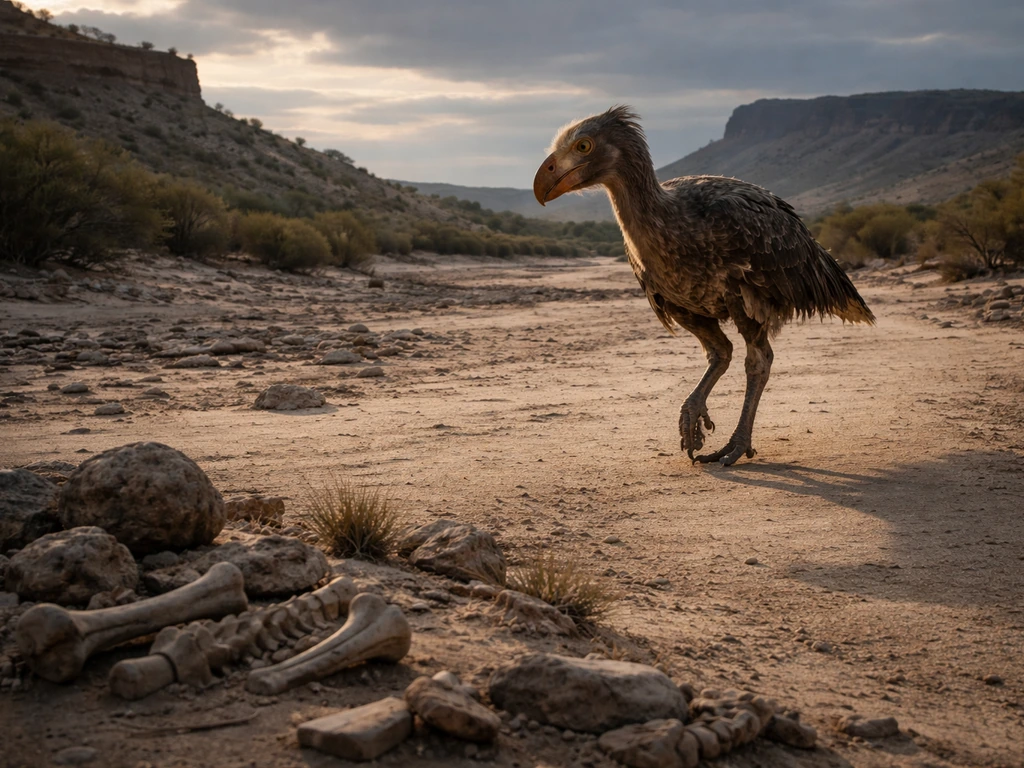
But fossil evidence from South America pushes that boundary considerably later, with late Pleistocene records from Uruguay and a directly radiocarbon-dated Brazilian species suggesting some lineages survived until roughly 25,000 years before present. So the honest answer is: the classic "1. 8 Ma" figure applies to one well-studied North American species, while the full group may have lingered in South America until the end of the last Ice Age.
The extinction date range: what we can actually say

Phorusrhacidae were a remarkably successful group of large, flightless, predatory birds that dominated South American ecosystems for tens of millions of years, from roughly the Eocene through to the Pleistocene. The group as a whole did not disappear in a single event. Different genera went extinct at very different times, which is why you will see wildly different dates depending on which source you consult and which terror bird they are talking about.
Here is the practical breakdown of the most important extinction markers in the fossil record:
| Species / Lineage | Age / Last Appearance | Location | Notes |
|---|---|---|---|
| Phorusrhacos (classic genus) | Miocene (~13–5 Ma) | South America | One of the most famous genera; gone well before Pleistocene |
| Titanis walleri | ~5 to 1.8 Ma (LAD = 1.8 Ma) | Florida and Texas, USA | Only North American terror bird; best-dated North American endpoint |
| Unnamed phorusrhacid (Uruguay) | Late Pleistocene (end of Pleistocene) | Uruguay, South America | Reported in a dedicated study; extends the group's survival significantly |
| Eschatornis aterradora | ~25,326–25,733 calibrated years BP | Northeastern Brazil | Directly radiocarbon dated via bioapatite; youngest well-documented record |
What this means in practice: if someone asks "when did terror birds go extinct" and wants a single round number, around 1.8 million years ago is the traditional textbook answer tied to Titanis walleri in North America. If you are asking about the bird from Rio, the timeline depends on which species and region the fossils are from. But if they want the most complete picture, the answer edges as close as roughly 25,000 years ago based on South American fossil evidence. That is a meaningful difference, and it changes how we think about what wiped them out.
What "the last terror bird" actually means
This is worth slowing down on, because the phrase "last terror bird" can mean two very different things depending on context. It can refer to the last known individual or population of any phorusrhacid species anywhere on Earth, which is the true group-wide extinction. Or it can mean the last appearance of a specific, well-studied species in a particular region, which is easier to pin down from the fossil record but is not the same thing.
Paleontologists use a technical term called the "last appearance datum" (LAD) to mark the youngest fossil confidently assigned to a given taxon. The LAD is not necessarily the moment the animal actually died out; it is simply the youngest stratigraphic layer where we have found its remains. The true extinction almost certainly happened sometime after the LAD, because fossilization is rare and the chances of preserving the very last individual are essentially zero. So when researchers state that Titanis walleri has an LAD of 1.8 Ma, that is the youngest confirmed fossil, not a guaranteed extinction date.
The distinction between local and total extinction also matters. Terror birds disappeared from North America long before they vanished from South America. Titanis walleri's range was always limited to parts of Florida and Texas during the Pliocene, and it appears to have died out there around 1.8 Ma without spreading further or leaving descendants. Meanwhile, South American phorusrhacid lineages continued, at least in some form, potentially right into the megafauna extinction event at the end of the Pleistocene.
How scientists figure out when terror birds lived and died

Dating terror bird fossils relies on two main approaches. The first is stratigraphy: figuring out the age of the rock layer (formation) where a fossil is found, using known geological timescales, index fossils from other species in the same layer, or radiometric dating of the surrounding rock. This is how most Phorusrhacidae dates are established, including the classic Miocene dates for genera like Phorusrhacos.
The second approach is direct dating of the fossil material itself. For recent enough specimens, radiocarbon dating (carbon-14) can be applied directly to bone or tooth enamel (bioapatite). This is exactly what was done with Eschatornis aterradora from Brazil, yielding a remarkably precise date of roughly 25,326 to 25,733 calibrated years before present. Direct radiocarbon dating is only possible for materials younger than about 50,000 years, so it works for late Pleistocene specimens but not for the older Miocene or Pliocene terror birds.
One complication worth knowing: some fossil sites produce a mix of ages. The Florida Museum of Natural History notes that the Titanis walleri type locality produced early Pliocene and late Pleistocene vertebrate fossils together, creating some uncertainty about exactly how old specific Titanis specimens are. This kind of stratigraphic mixing is a known challenge in paleontology and is one reason dates for the same species can appear inconsistent across sources.
Why terror birds went extinct
No single cause wiped out the terror birds. Like most large animal extinctions across geological time, the decline of Phorusrhacidae was almost certainly driven by a combination of factors playing out over millions of years. Here are the main ones the evidence points to:
Climate and habitat shifts

The Late Cenozoic was a period of significant global cooling and drying. South American ecosystems shifted from the warm, relatively stable environments of the Eocene and Oligocene toward the cooler, more variable climates of the Pliocene and Pleistocene. Open grassland biomes expanded while the kinds of habitats that supported large cursorial predators changed in structure. Terror birds were built for pursuit predation on open ground, and as both vegetation structure and prey communities shifted, the ecological niche they occupied became harder to fill profitably.
Prey availability
Terror birds were apex predators that hunted the large herbivores available in South America during their reign. As the continent's fauna changed through the Cenozoic, and especially after the Great American Biotic Interchange (GABI) around 2. A 2007 peer-reviewed study reassessed Titanis walleri’s age in relation to the Great American Interchange and discusses its youngest North American occurrence in the ~1. 8 Ma timeframe [Great American Biotic Interchange (GABI) around 2.
](https://www. researchgate. net/publication/249521166RevisedageofthelateNeogeneterrorbirdTitanisinNorthAmericaduringtheGreatAmerican_Interchange). 7 to 3 million years ago when North and South America were connected by the Isthmus of Panama, prey communities were reshuffled dramatically.
New mammalian herbivores arrived from the north while endemic South American prey species declined. This restructuring of the prey base would have placed pressure on any predator specialized for particular prey types or sizes.
Competition with new predators
The GABI was arguably the single most disruptive event for terror bird survival. Before the land bridge formed, South America was an island continent, and terror birds faced limited competition from other large predators at the top of the food chain. After the interchange, large placental carnivores from North America, including big cats, bears, and canids, moved south and occupied the apex predator role alongside (and eventually instead of) terror birds. The competitive pressure from these mammals, combined with the prey restructuring mentioned above, likely accelerated the decline of terror bird populations across their range.
End-Pleistocene megafauna collapse

If the South American fossil evidence is correct and some terror bird lineages survived to around 25,000 years ago, they would have been caught up in the broader late Pleistocene megafauna extinction event that wiped out large animals across the Americas, Australia, and elsewhere. The causes of that event are themselves debated, with climate change and human hunting pressure (or a combination of both) being the leading hypotheses. A predatory bird that depended on large prey would have been especially vulnerable as those prey species themselves disappeared.
How the decline probably unfolded over time
Think of the terror bird extinction not as a sudden event but as a slow geographic contraction playing out over millions of years. At their peak during the Miocene, phorusrhacids were diverse, widespread across South America, and dominant. As the Miocene gave way to the Pliocene, some lineages, like the famous genus Phorusrhacos, had already disappeared. The group was thinning out species by species.
When the GABI opened up South America to North American fauna, terror birds had one notable moment of expansion: Titanis walleri made it into North America, reaching Florida and Texas. But that expansion did not last. North America proved inhospitable in the long run, and Titanis appears to have died out there by around 1.8 million years ago, leaving no descendants.
Back in South America, the remaining phorusrhacid lineages retreated into smaller ranges as mammalian competitors established themselves and prey communities shifted. The fossil record from Uruguay and Brazil suggests some populations hung on in refugia, possibly in areas where they still had competitive advantages or access to specific prey. By the late Pleistocene, these remnant populations were likely small, isolated, and vulnerable. The extinction of large prey animals in the megafauna collapse would have been the final blow, cutting off the food supply for any surviving terror bird populations. The last ones probably disappeared somewhere between 25,000 and 10,000 years ago, though we may never have fossil evidence precise enough to say exactly when.
This pattern of slow range contraction followed by final collapse is actually common among large Cenozoic predators. If you are comparing timelines with other iconic flightless birds, see when did the elephant bird go extinct for a closely related “last survival” comparison point. It is reminiscent of how other iconic prehistoric giants, like the elephant birds of Madagascar or the moas of New Zealand, persisted in isolated regions long after their relatives had vanished elsewhere, only to succumb to a combination of habitat change and, in those cases, direct human impact.
How to verify the exact timeline you need
If you need a specific, citable date for a particular terror bird species or context, here is how to track down the most reliable information and navigate conflicting claims.
Search terms that will actually find what you need
- "Phorusrhacidae" (the formal family name) instead of just "terror bird" for scientific literature
- "Titanis walleri" for the North American species specifically
- "Eschatornis aterradora" for the youngest directly dated specimen
- "last appearance datum Phorusrhacidae" to find papers explicitly addressing extinction timing
- "Phorusrhacidae Pleistocene South America" for the late-survival evidence
- "Great American Biotic Interchange terror bird" for research on competition and decline
Where to find credible sources
- PubMed Central (PMC) and Google Scholar: Search for open-access paleontology papers on Phorusrhacidae. A 2024 open-access study on the evolution and ecology of gigantism in terror birds is a good starting point and explicitly uses LAD methodology.
- Florida Museum of Natural History (Florida Vertebrate Fossils database): Best resource for Titanis walleri specifically, with clear stratigraphic context for the North American record.
- ResearchGate: Search for the Ubilla et al. study on late Pleistocene phorusrhacids from Uruguay for the South American survival evidence.
- Britannica and museum databases: Useful for genus-level overviews (Phorusrhacos, for instance) but check the primary literature for dates rather than relying solely on encyclopedia entries.
- Wikipedia species pages: Often a reasonable starting point for finding the primary literature citations, especially for species like Eschatornis where the radiocarbon date is documented.
How to handle conflicting dates
When you find two sources giving different extinction dates for terror birds, the first thing to check is whether they are talking about the same species or the same region. A date for Titanis in North America and a date for a Pleistocene phorusrhacid in Uruguay are both correct; they just refer to different animals in different places. Second, check the methodology: stratigraphic estimates carry more uncertainty than direct radiometric dates, so prefer direct dates where they exist. Third, look for the most recent peer-reviewed revision of the taxon in question, since older dates are sometimes revised as new fossils are found or dating techniques improve. A 2024 paper supersedes a 1990s paper on the same question.
One practical tip: when a source gives a date without citing the specific formation, dating method, or primary paper, treat it with some skepticism. The best sources will tell you not just when, but how they know. If you are asking about the Moa bird instead of terror birds, the extinction timeline is different and depends on archaeological and radiocarbon evidence Moas of New Zealand.
FAQ
What single year should I quote for when terror birds went extinct?
If you need one date, use the context-specific meaning. For the terror bird group in the strict sense, pick the latest reliable Last Appearance Datum across phorusrhacid fossils, which the article places near the end of the last Ice Age (around 25,000 years ago). If you specifically mean the North American lineage Titanis walleri, the traditional citable figure is about 1.8 million years ago, but that is the youngest confirmed fossil, not the exact moment of extinction.
Does the last appearance date mean the bird died out immediately?
“Last terror bird” can refer to the last confirmed fossil of a species (LAD) or the final extinction of the entire family across all regions. A LAD can be thousands of years older than the true disappearance because the last individual is unlikely to be preserved. So if a source claims a sudden extinction at the LAD date, treat it as an upper bound, not a death day.
How do I tell whether an extinction date is based on radiocarbon or older methods?
For recent-looking dates, verify the dating tool. Radiocarbon dating applies only up to about 50,000 years, so any claim near 20,000 to 30,000 years ago should be tied to direct carbon-14 on bone or tooth enamel. Older dates, including the classic millions-of-years figures, must rely on rock-layer age from stratigraphy or other geologic dating, not carbon-14.
Why do some sources give conflicting extinction dates for terror birds?
Be cautious about mixing “species” and “group.” Titanis walleri disappearing in North America does not mean all terror birds vanished, because South American lineages could persist in refugia. When comparing sources, confirm they are using the same taxon name and the same geographic scope before concluding they disagree.
Could a fossil site mix different time periods and make dates wrong?
A lot of inconsistency comes from stratigraphic mixing at fossil sites. If a locality contains layers or reworked deposits spanning different periods, fossils can appear in the wrong age context, which can shift the inferred LAD for particular specimens. The practical fix is to look for studies that state the formation boundaries and how the specimens were assigned to specific stratigraphic units.
What should I check when a source lists an extinction date without explaining how it was measured?
If someone quotes a date but does not say the formation, specimen type, or dating approach, it is harder to trust. Better-quality summaries typically explain whether the age comes from rock-layer correlation, index fossils, radiometric dating, or direct radiocarbon and which material was dated. When those details are missing, treat the number as tentative.
Is it possible that terror birds went extinct in one place but survived longer elsewhere?
Yes. “Local extinction” is when a species disappears from part of its range, while “total extinction” is worldwide disappearance. The article’s North America versus South America contrast is an example of local versus group-wide timing, so a correct-seeming North American extinction date can still coexist with later survival elsewhere.
What evidence-based cause is most important if terror birds survived into the late Pleistocene?
If the extinction involves the late Pleistocene, look for whether the claim is about extinction of large prey and climate shifts, and whether humans are included as a pressure. For cursorial predators dependent on large herbivores, the key sensitivity is food availability, so the most defensible narratives connect prey collapse to predator decline rather than attributing everything to one single trigger.