
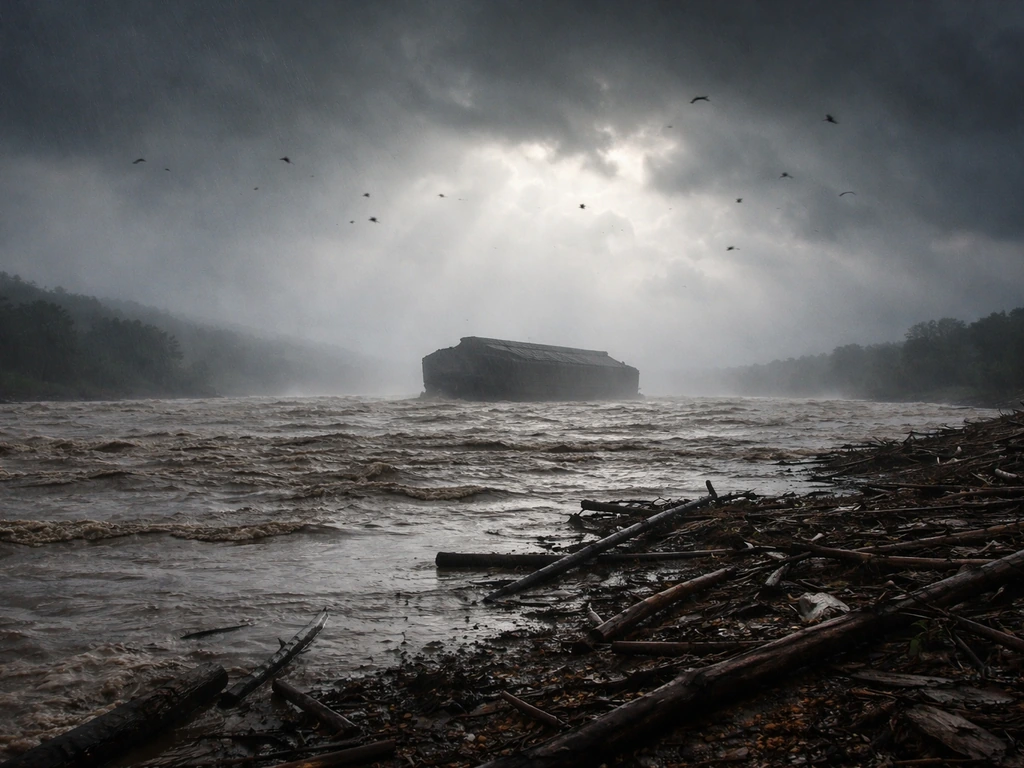
"Man Is Not a Bird – Survived the Great Flood" is the debut album title from the band Man Is Not a Bird, released in early 2015 (the single dropped March 2, 2015, with the full LP following). If you searched for this phrase expecting theological debate or a natural-history argument about who survived Noah's flood, you were likely sent here by a search engine connecting the words, not by any ancient text or scientific paper. But the question is genuinely worth unpacking, because it sits at the crossroads of band names, flood mythology, bird biology, and what science can and can't tell us about catastrophic flooding events.
Man Is Not a Bird After the Great Flood: Meanings and Evidence

Maya Hennessy
15 May 2026
What the phrase actually means and where it comes from
The phrase pulls together three separate ideas: "man," "not a bird," and "survived the Great Flood." As a band name and album title, Man Is Not a Bird is simply a poetic, slightly absurdist name, the kind indie acts tend to favor. Their debut LP, Survived the Great Flood, uses flood imagery the way a lot of rock and folk records do, as a metaphor for endurance, hardship, or starting over after destruction. The track "D.I.P." was taken from that album, and music review sites covered the release cycle through late 2014 and into spring 2015.
That said, the phrase also echoes a real tension that shows up in flood traditions: birds and humans survive differently. In the Genesis narrative, Noah releases a raven and then a dove to test whether the floodwaters have receded, which means birds are literally woven into the survival story as ecological scouts. The image of "man is not a bird" as a contrast, therefore, isn't random. It maps onto something real: birds and people face floods in fundamentally different ways, and that difference has been debated in both religious commentary and natural history for a long time.
Religious and theological readings vs literal survival history

In theological tradition, the Great Flood is explained through divine selection, not biology. Noah and his family survived because they were chosen and instructed to build the ark. The raven sent out in Genesis 8:7 (described in verse-by-verse commentaries as going "forth, going forth and returning") and the dove that eventually didn't return served a practical narrative purpose: they were living barometers of habitability. The birds weren't surviving by instinct alone in this reading; they were instruments of divine communication.
Preaching traditions have used bird-versus-human comparisons independently of flood stories too. The proverb "as a bird that wanders from her nest, so is a man who wanders from his home" (Proverbs 27:8) appears in countless sermons. BibleHub sermon pages on Proverbs 27:8 use the proverb about “a bird that wanders from her nest” to illustrate the “bird vs man” comparison that appears in preaching traditions as a bird that wanders from her nest. Charles Spurgeon's collected sermons include language distinguishing "a man" from "a bird" in moral and spiritual contexts. So the contrast of man and bird in religious literature is a long-standing rhetorical device, not just a flood-specific idea.
Literal survival-history readings are a different matter. Some traditions, particularly young-earth creationist frameworks, interpret the flood as a real, globe-covering event in which only the ark's passengers survived. Under this reading, the distinction between bird survival (winged creatures aboard the ark) and human survival (Noah's family) is straightforward: both groups were preserved by the same mechanism. The contrast "man is not a bird" wouldn't imply any advantage for either; it would just emphasize that all land-dwelling creatures needed the ark equally.
What paleontology and ecology can actually tell us about birds, floods, and survival
Here's where the natural history angle gets genuinely interesting, and where this site's focus on birds and extinction starts to connect to the question. Birds and floods have a real, documented relationship, and it's more complicated than "birds can fly away from floods, so they're fine."
blank" rel="noopener noreferrer">Research published in Scientific Reports (2016) documented how birds adjust their space use and foraging behavior during extreme flooding events, but also recorded dramatically reduced breeding success in some years when nesting was disrupted. A study of shearwater colonies showed that heavy rainfall alone, without any "flood" in the traditional sense, could cause catastrophic breeding failure across an entire colony in a single season. Aquatic birds can actually benefit from floods, using inundated habitats for breeding when conditions allow, but terrestrial and ground-nesting birds face severe disruption. Flightless birds, with no ability to relocate aerially, are particularly vulnerable, which is directly relevant to this site's focus on species like the kiwi, cassowary, and extinct flightless birds like the moa and dodo. If you came here from the What Happened to Flightless Bird Podcast angle, this bird-and-flood mismatch is the key thread you’re trying to understand Flightless birds.
The paleontological record does show that megaflooding events happened. USGS research on the Missoula and Bonneville floods describes repeated, regionally massive floods in the Columbia River basin during the last ice age, with deposits separated by volcanic ash layers and soil formation that allow scientists to date and sequence the events. These were genuinely catastrophic on a regional scale. But they were regional, not global, and the fossil record around them reflects that: localized disruption, not a worldwide extinction bottleneck.
What we can infer about bird survival in a major regional flood is that flying species had options that flightless species did not. Species with wide ranges or strong dispersal abilities could relocate. Species tied to specific habitats, low-lying islands, or single nesting sites were (and are) far more vulnerable. This is actually one of the core drivers of extinction in island birds: habitat disruption from flooding, storms, and sea-level change hit island endemics hardest because there's nowhere else to go. The dodo on Mauritius didn't go extinct from flooding, but the same island-bound vulnerability logic applies.
Human survival in flood traditions: how different cultures explain it

The claim that "man survived the Great Flood" appears across multiple traditions, not just Genesis. The Epic of Gilgamesh has Utnapishtim; Hindu texts describe Manu surviving a deluge with divine guidance; Greek mythology has Deucalion. In every case, human survival is explained by divine warning and human obedience, not by any biological advantage over other species. The "man is not a bird" framing, interpreted through these traditions, would actually underscore human vulnerability: unlike birds, humans couldn't simply fly to safety. Survival required intervention.
Some modern scholars and archaeologists have proposed that real regional floods, such as a possible catastrophic flooding of the Black Sea basin around 5600 BCE (the Ryan-Pitman hypothesis), may have inspired flood myths across cultures. This doesn't confirm a literal global flood, but it does suggest that memories of genuinely catastrophic local flooding events could be preserved and amplified in oral and written tradition over generations. Under this reading, the human survivors of such an event would have been people who lived at higher elevations, received early warning, or happened to have boats, not people with supernatural assistance.
Where the evidence runs out
The scientific consensus on a global flood is clear and consistent. This is why Flappy Bird was removed, largely due to its sudden popularity and the controversy it sparked. Geologist David Montgomery has stated directly that "the one thing we know for sure from geology is that a global flood never happened." The fossil record doesn't show the simultaneous deposition pattern you'd expect from a single catastrophic worldwide flood. A 2025 analysis in SpringerOpen pointed out that there simply isn't enough water on Earth for a global flood of the scale described in Genesis, and that the geological and oceanographic evidence doesn't support it. The NCSE has documented the specific "fatal flaws" in flood geology models in detail, including the problem of explaining the ordered fossil record (which shows evolutionary progression over time, not chaotic mixing) through a single catastrophic event.
What science can confirm is that large regional floods happened, that they left physical records, and that catastrophic flooding events do cause real population disruptions and extinctions in birds and other wildlife. What it cannot confirm is a single, worldwide, historically recent flood that covered all land and killed all non-ark life. Those are two very different claims, and conflating them is where a lot of confusion in this conversation originates.
The evidence gap matters especially for birds. If you're trying to understand how flightless birds like the moa survived (or didn't) through prehistoric catastrophes, the honest answer is that extinction events affecting those species were driven by a combination of factors: habitat change, climate shifts, sea-level fluctuation, and, ultimately, human arrival and hunting. No single flood explains the moa's extinction. The geological record is detailed enough to rule that out.
How to verify claims and think like a natural history reader

If you landed on this question because you're genuinely trying to research either the band or the theological/scientific debate, here's a practical path forward. If you are wondering specifically why Big Bird is not on Sesame Street, it helps to separate the show's casting and production decisions from the flood-and-birds symbolism discussed here this question. So, if you’re wondering what happened to Flappy Bird, the short answer is that it was pulled from app stores in 2014 amid attention and controversy.
If you're researching the band
- Search "Man Is Not a Bird band" along with "Survived the Great Flood album" on music databases like AllMusic, Discogs, or streaming platforms to find the correct release dates, tracklists, and reviews.
- The single "Survived the Great Flood" has a documented release date of March 2, 2015, and the album followed in late March/early April 2015.
- Music review sites like IDIOteq and Unis Son covered the release cycle if you want critical context for the album.
If you're researching the theological or historical flood question
- Start with the primary texts: Genesis 6-9 for the biblical account, and the Epic of Gilgamesh (tablet XI) for the Mesopotamian parallel. These give you the actual source material, not interpretations.
- For scientific critique of flood geology, the NCSE (National Center for Science Education) maintains detailed, peer-reviewed articles that are free to access and specifically address the geological claims.
- For geological evidence of real megafloods, USGS publications on the Missoula and Bonneville floods (Geological Circular 1254) are authoritative and publicly available.
- Distinguish between claims about a local/regional flood (scientifically plausible) and claims about a worldwide flood (not supported by evidence). This is the most important distinction to keep in mind when evaluating sources.
If you're researching bird survival and extinction dynamics
- USGS National Wildlife Health Center maintains an ongoing database of wildlife mortality events, including bird die-offs, which gives you real documented data rather than speculative claims.
- For peer-reviewed research on how birds respond to flooding specifically, search Google Scholar for terms like "avian response to flooding," "bird breeding failure extreme weather," or "island bird extinction habitat disruption."
- For extinct and endangered flightless birds, the IUCN Red List is the most authoritative source for current conservation status and extinction causes.
- When evaluating any claim about birds and catastrophic events, ask: Is this species flighted or flightless? Is it a habitat generalist or a specialist? Is it island-endemic or continent-wide? These factors predict vulnerability far better than any single event narrative.
A quick comparison: theological vs scientific vs ecological frames

| Frame | How "man survived the flood" is explained | How birds fit in | Testability |
|---|---|---|---|
| Theological (Genesis tradition) | Divine selection; Noah's obedience; ark as preservation mechanism | Birds carried on ark; raven/dove used as scouts | Not empirically testable; faith-based |
| Literal flood geology | All land life killed except ark passengers; humans and birds both needed the ark | Winged creatures preserved by boarding the ark | Contradicted by fossil record and geology |
| Local/regional flood hypothesis | Survivors were at higher ground or had boats; mythologized over generations | Flying species could relocate; flightless species at high risk | Partially testable; some archaeological support |
| Ecological/natural history | Human behavioral flexibility (tools, shelter, migration) aids survival | Flight gives mobility advantage; flightless species highly vulnerable | Fully testable; documented in modern flood studies |
The phrase "man is not a bird survived the great flood" is doing several things at once depending on where you encountered it: it's a band name and album title, it echoes a real theological contrast between human and avian survival mechanisms, and it touches on a genuinely interesting ecological question about how different creatures fare when catastrophe hits. If you are wondering about why Flappy Bird was banned, that is a different kind of cultural debate about content policy than the flood and bird symbolism discussed here. The honest answer is that birds and humans survive (or don't) through very different mechanisms, that the geological record can't support a single global flood, and that the traditions preserving flood stories are doing theological and cultural work rather than recording natural history. Keeping those lanes separate is what makes the question answerable.
FAQ
Does “man is not a bird” claim that humans would have been safer in a flood than birds?
Not in a biological sense. The phrase mixes a poetic band title with a rhetorical contrast found in religious writing. In the flood story reading, birds are “instruments” or markers of conditions, while humans are portrayed as recipients of instructions or divine selection, so the comparison is about narrative roles rather than comparing who is more evolutionarily suited to survive.
If the flood myths reflect regional catastrophes, how would survival differ for humans versus birds?
If you interpret the flood as regional, the “man vs bird” contrast often flips depending on habitat. Flying birds with dispersal options can relocate, while ground-nesting birds, island endemics, and flightless birds are more likely to suffer breeding collapse or local extirpation. Humans can also be vulnerable, but at least in many regional scenarios, survival depends on elevation, boats, and early warning rather than flight.
Are the raven and dove in Genesis meant to be literal biology lessons about bird behavior?
The Genesis raven and dove details are commonly discussed as a practical test of habitat usability, not a statement about bird physiology being superior. That said, birds do respond behaviorally to floodwater changes in real life, which can make the story’s “scouting” logic feel plausible even though the overall flood claim remains separate.
What’s the biggest mistake people make when using flood myths to argue about science?
Yes, mixing “global flood” and “local flood myth inspiration” leads to errors. A regional flood can leave physical deposits and still inspire widespread legends, but that does not mean the same event fits a worldwide, single-day hydrology model. Treat myth formation as one step and flood geology as another.
Under creationist readings, does “man is not a bird” have a different meaning than in scientific or historical interpretations?
Young-earth creationist models treat the ark as the survival mechanism for both birds and humans, so “man is not a bird” does not grant humans an inherent survival advantage over birds. A key nuance is that even within such frameworks, the rhetorical contrast usually addresses divine selection and human role, not a differential survival likelihood based on anatomy.
When studies talk about birds during floods, do they focus on immediate survival or longer-term breeding outcomes?
In flood-related research, “breeding failure” can matter more than immediate survival. Extreme flooding can disrupt nesting sites and foraging, causing long-term population impacts even if some individuals survive. So even when you hear “birds survive floods,” the critical question is survival of young and next breeding season.
Are flightless birds always the most vulnerable in catastrophic flooding scenarios, and why?
Flightless species are often the highest-risk comparison point because they cannot relocate by flying. However, outcomes still depend on timing and geography, for example whether the species relies on low-lying nesting grounds or has a refuge area. For island species, there is often nowhere to move to, making habitat disruption especially damaging.
Does the “human cannot fly away like birds” idea explain every part of the flood survival stories?
Not necessarily. Some myths involve humans surviving via divine warning, boats, or higher ground, which are human-environment factors rather than “bird-like” escape capabilities. If you want a meaningful analogy, focus on what each group can do under stress (disperse, navigate, relocate), not on whether one can literally fly.
Why does this phrase show up in so many unrelated search results, and how should I approach it?
Because many people search the exact phrase expecting a single thesis, but the phrase itself carries multiple functions: it is also an album title and a cultural motif. A good next step is to decide which lane you are in (music, theology, or ecology) before interpreting the words as evidence for anything.
Next Article
Why Is Big Bird Not on Sesame Street or Sesame Place?
Learn why Big Bird may not appear on Sesame Street or Sesame Place and how to check schedules and licensing fast.