
Emus are found almost everywhere in mainland Australia, from the red sand plains of central Australia to tropical northern woodlands and even the cold high-country snowfields. If you're wondering whether something like “emu” is actually a real bird, it helps to separate emus from look-alikes and myths, and this overview keeps the focus on the real emu species. In the wild, emus live across mainland Australia, with their range stretching from tropical northern regions to cooler southern areas. They're one of the continent's most geographically widespread birds, recorded in every Australian jurisdiction including the ACT, NSW, Northern Territory, Queensland, South Australia, Tasmania, Victoria, and Western Australia. Outside Australia, you'll find them in zoos on every continent and on farms, particularly in the United States where roughly one million are commercially raised.
Where Emu Bird Is Found: Native Range and Habitats

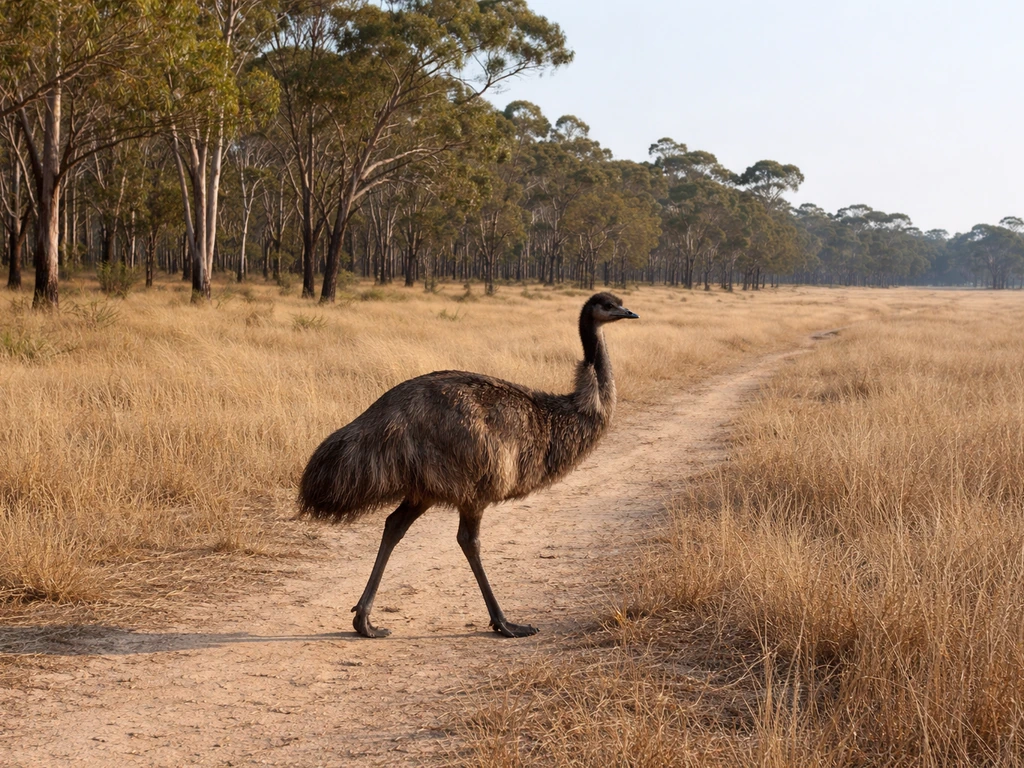
Emu's native range: Australia is essentially the whole story

The emu (Dromaius novaehollandiae) is a continent-wide species. BirdLife Australia describes it as occurring broadly across the continent, and the Australian Faunal Directory confirms its presence across all major jurisdictions. That breadth is actually remarkable for a large flightless bird. Think about how constrained other big flightless species are: the kiwi is locked to New Zealand, the cassowary clings to tropical rainforest edges. The emu, by contrast, has figured out how to thrive across an enormous, climatically variable landmass.
There are some important caveats to that 'everywhere' claim, though. Tasmania now hosts only introduced or zoo birds because the original Tasmanian emu subspecies went extinct after European settlement. The King Island emu subspecies was last seen in the wild in 1802. So the species' current Tasmanian presence is not the same as its historical one. The mainland bird, however, remains globally listed as Least Concern by the IUCN, meaning the overall population is in reasonable shape even if certain local populations face pressure.
Habitat types and where emus live within Australia
The single clearest rule about emu habitat is this: open landscapes, not dense forest. Emus avoid thickly forested regions almost entirely. If you mean their natural range, the emu lives across mainland Australia, where the habitat can vary from arid inland areas to coastal regions In dry Australia, emus will travel hundreds of miles to find food or water.. Within that constraint, they are remarkably flexible. Museum Victoria lists their habitats as including plains, scrublands, open woodlands, pastoral lands, semi-desert, and the margins of lakes. The Smithsonian National Zoo adds eucalyptus forest edges, heathland, desert shrublands, and sand plains. Essentially, if you're looking at a landscape with low vegetation, a clear sightline, and some ground-level food, an emu can probably live there.
Water access is a major constraint, especially in the arid interior. In dry Australia, emus will travel hundreds of miles to find food or water. Interestingly, the expansion of cattle and sheep farming across the inland has actually helped emus in some areas. Permanent stock watering points gave emus reliable access to water in regions that were previously too dry for them to use consistently. That's a useful detail for understanding why you sometimes see emus near pastoral infrastructure in the outback.
- Plains and open grasslands: classic emu territory across inland Australia
- Open eucalyptus woodland: common throughout eastern and southern Australia
- Scrublands and mulga shrublands: widespread across arid and semi-arid zones
- Semi-desert and sand plains: used during nomadic movements, especially following rain
- Pastoral land and roadsides: frequently observed along fence lines and road corridors
- Heathland and lake margins: used opportunistically for food and water
Regional distribution patterns: inland vs coastal, and how climate shapes things
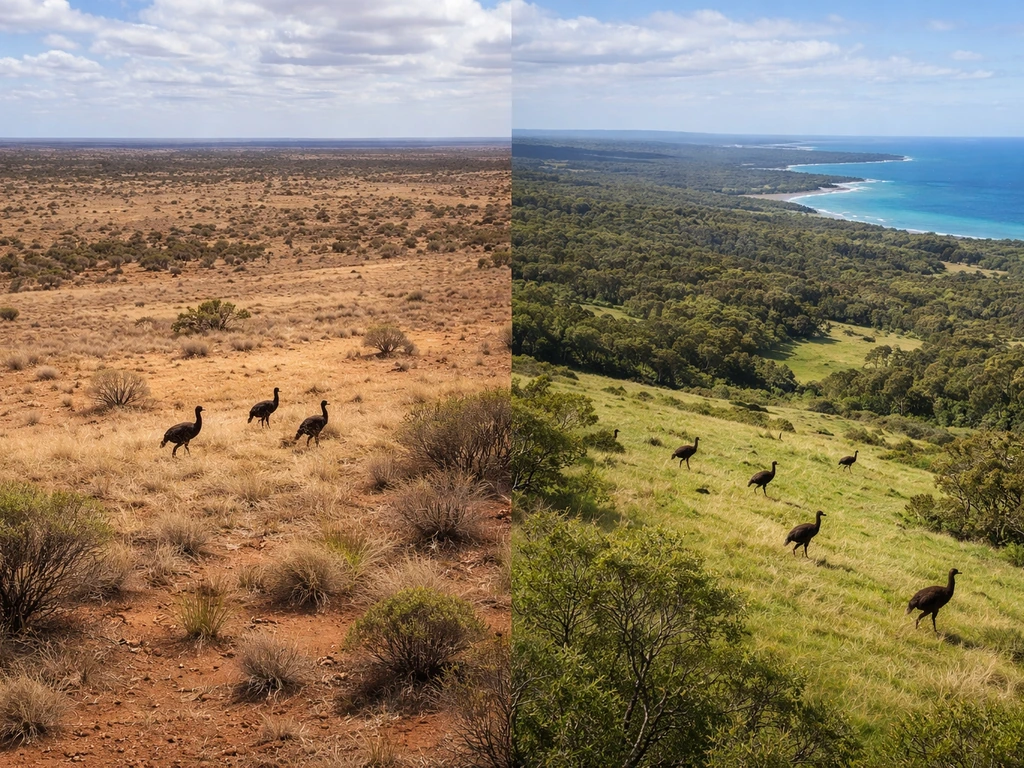
Emus are not evenly spread across Australia. Research linked to CSIRO found that emu density was highest in the north-east of the pastoral zone and lowest in the more arid north-west. Summer and autumn rainfall was identified as a key driver of emu density, likely because it determines food availability during the breeding season. A Murdoch University study reinforced this, noting that density patterns were linked to climatic factors affecting food availability, access to surface water (both natural and artificial), and the prevalence of dingoes.
Along the coasts, the picture gets more complicated. Coastal populations tend to be patchier. The most concrete example of this is the emu population in the NSW North Coast Bioregion and Port Stephens Local Government Area, which was listed as an Endangered Population in 2002. That population sits near the limit of the emu's geographic range, its habitat had been drastically reduced, and it had become disjunct from other emu populations. So while emus thrive inland across vast stretches of Australia, coastal-edge populations can be quite fragile.
One of the most important things to understand about emu distribution is that it shifts. BirdLife Australia notes that emus move within their range according to climatic conditions, essentially tracking food and water. In good seasons, after rain produces a flush of new vegetation, emus concentrate in an area. In dry years, they move on. This makes them semi-nomadic across much of their range, which means seeing lots of emus in one spot one year doesn't mean they'll be there the next.
Where emus are found outside the wild
Outside Australia, emus exist mainly in three contexts: zoos, farms, and one notable introduced breeding population. Globally, emus are held in approximately 121 zoos worldwide, making them one of the more commonly displayed large flightless birds internationally. On the farming side, the scale is genuinely surprising: around one million emus are commercially farmed in the United States alone, with additional farming operations in Peru and China. Emu farming focuses on oil, meat, and leather, and the industry has created large captive populations far removed from the bird's Australian homeland. Vultures live in open habitats such as grasslands and savannas, where they can easily spot carrion where vulture bird live.
The more ecologically interesting outside-Australia case is Kangaroo Island, off the South Australian coast. Emus were introduced there during the 20th century and have successfully established a self-sustaining breeding population. Kangaroo Island is home to unique wildlife, and the emu's presence there today is a result of deliberate introduction rather than natural dispersal. It's worth noting for anyone interested in the biogeography of these birds that this is distinct from the historical island subspecies, which no longer exist.
Quick guide to spotting emus by landscape
If you're trying to actually see an emu in the wild, here's the practical version. BirdLife Australia makes it very simple: most people see emus along roadsides, near fences, or near other barriers. Emus move along landscape corridors, and roads and fence lines function as corridors. This means some of the best casual emu sightings happen from a car window in outback or rural Australia, not necessarily deep in a national park.
| Landscape type | Emu likelihood | Best strategy |
|---|---|---|
| Outback plains and semi-desert (central/inland Australia) | High | Look near any permanent water source, stock troughs, or after recent rainfall |
| Open woodland and pastoral land (eastern/southern Australia) | High | Drive rural roads at dawn or dusk; scan open ground near fence lines |
| Tropical savanna and woodland (northern Australia) | Moderate to high | Visit in the dry season when animals concentrate near water |
| Coastal scrub and heath (eastern seaboard) | Low to moderate | Patchy distribution; national parks with open heath are your best bet |
| Dense forest or rainforest | Very low | Emus avoid these; don't expect to find them here |
| Kangaroo Island (South Australia) | Present | Introduced breeding population; check wildlife areas on the island |
National parks across inland and regional Australia are reliable locations: places like Mungo National Park in NSW, Flinders Ranges in South Australia, and Undara Volcanic National Park in Queensland regularly feature emus. NSW National Parks describes emus as widespread across NSW, which aligns with the idea that inland and regional national parks with suitable open habitat can be reliable places to spot them. In Western Australia, Kalbarri National Park and Nambung National Park are known emu spots. In Victoria, you can find emus in the Grampians and Little Desert National Park. The key across all of these is open, low-vegetation habitat with some access to water.
Conservation and land use: where emus are thriving vs where they're under pressure
The emu's global Least Concern status is reassuring, but it doesn't tell the whole story at the local level. Research published in peer-reviewed literature has shown that emu distributions have been shaped by altered fire regimes, historical hunting, habitat clearing, and changes in land use since European settlement. Land clearing for agriculture reduced suitable habitat in coastal and agricultural zones, which is directly why that NSW North Coast population ended up endangered. Areas that were once viable emu habitat became too fragmented to support sustainable populations.
On the other hand, some land-use changes have benefited emus. The spread of livestock farming created permanent watering points that allowed emus to push into previously inaccessible arid regions. This complexity is actually a common theme in Australian wildlife ecology: the same continent that has driven several bird species to extinction (including the emu's own island subspecies) has also inadvertently expanded habitat for others. The emu sits in a reasonably stable position today largely because of how adaptable it is, but that adaptability has limits, as the coastal population cases demonstrate.
Protected areas play a real role in emu conservation, particularly for populations at the edge of the range. Australian Wildlife Conservancy sanctuaries and national parks that preserve open savanna, grassland, and semi-arid landscapes are the most important refuges for local emu populations under pressure. If you're interested in the conservation dimension of flightless bird geography more broadly, the emu's story sits in useful contrast to species like the cassowary, which has a much narrower habitat tolerance and faces more acute local threats. The emu's wide range and behavioral flexibility have kept it off the critical list, but it's not immune to the kinds of habitat fragmentation that have pushed other Australian birds toward the edge.
FAQ
Is the emu native everywhere in Australia, or are there places where it disappeared?
If you mean the historic “found throughout Australia” claim, it depends on what you count as present. Tasmania is an exception because the native subspecies disappeared after European settlement, so modern emus there are introduced or captive. That means where emu bird is found today will not match where the species originally occurred historically.
Why do emus seem less common on the coast than inland?
Coastal areas can be where emus seem to vanish locally, even within the same state. Expect patchiness near the edges of the range, and if a site is heavily cleared or fragmented, density can drop quickly. The NSW North Coast case shows how limited habitat and disconnection between populations can lead to endangered local status.
Can I rely on seeing emus in the same spot year after year?
Yes. Emus are semi-nomadic across much of their range, so an area that had many birds in one season can be nearly empty in the next, especially when rain fails. If you are planning a trip, aim for post-rain windows when new vegetation and food availability increase.
Where should I look if I want to see an emu but I am not going into dense bush?
For casual sightings, the most effective approach is to look for open corridors that connect water and food, such as roadside verges, fence lines, and other low-vegetation pathways. Even without a national park, these linear habitats can function like movement routes, which is why sightings often happen near roads.
What factor most strongly affects emu presence in dry inland areas?
The biggest on-the-ground predictor is water access in arid regions, because emus may travel very long distances to reach it. In dry interior landscapes, artificial water points tied to farming can concentrate emus, so the “best” location may be near stock watering infrastructure rather than deep wild habitat.
What does “open habitat” practically mean for emu habitat?
Emus avoid dense, closed forest, but they do not require completely treeless land. Look for landscapes with low vegetation and a clear sightline, including scrublands, open woodlands, heathland edges, and semi-desert margins of lakes. They can use habitat mosaics, especially where there is ground-level food.
Do emus occupy the whole continent evenly, or are some regions consistently higher density?
Density is not uniform across the mainland. Studies cited in the article indicate higher density in the north-east pastoral zone and lower density in the more arid north-west, with summer and autumn rainfall linked to breeding-season food availability. That means “where emu bird is found” can include large areas with very different bird numbers.
Where are emus found outside Australia, and are those populations natural?
If you are outside Australia and trying to interpret “where they are found,” the answer is often zoos, farms, and a limited introduced breeding population rather than natural range. Kangaroo Island is the notable self-sustaining introduced case, but it is distinct from former island subspecies that no longer exist.
Why can emus be common overall but scarce in a specific local area?
Local threats matter even when the overall species is not threatened. Habitat clearing, altered fire regimes, hunting history, and fragmentation can reduce local populations, particularly at the edge of the range. So if you are assessing where emu bird is found in a specific region, look for signs of reduced habitat connectivity.