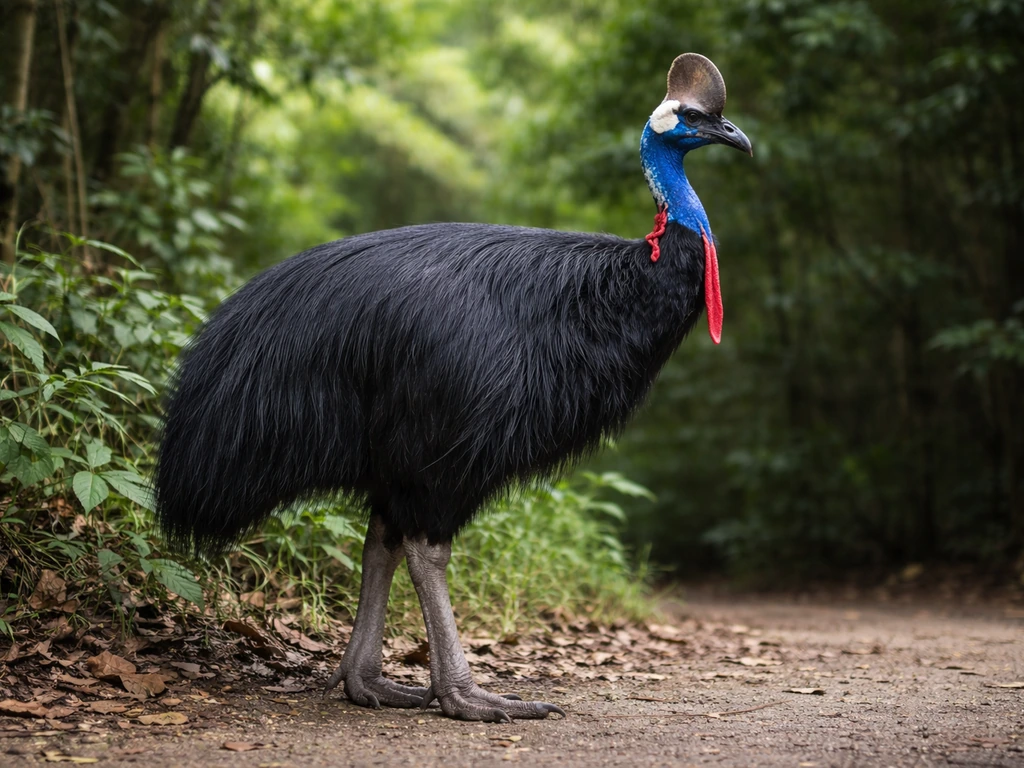
A fully grown southern cassowary stands between 150 and 200 cm tall (roughly 5 to 6.5 feet), making it one of the tallest birds alive today. The dwarf cassowary, the smallest of the three species, tops out closer to 99 to 135 cm (about 3.3 to 4.4 feet). So if someone asks "how tall is a cassowary," the honest answer is: it depends on the species, but you're looking at a bird that ranges from about waist-height to well above the head of an average adult human.
How Tall Is a Cassowary Bird? Adult Height by Species

Maya Hennessy
3 May 2026
Height by species: southern, dwarf, and northern cassowary
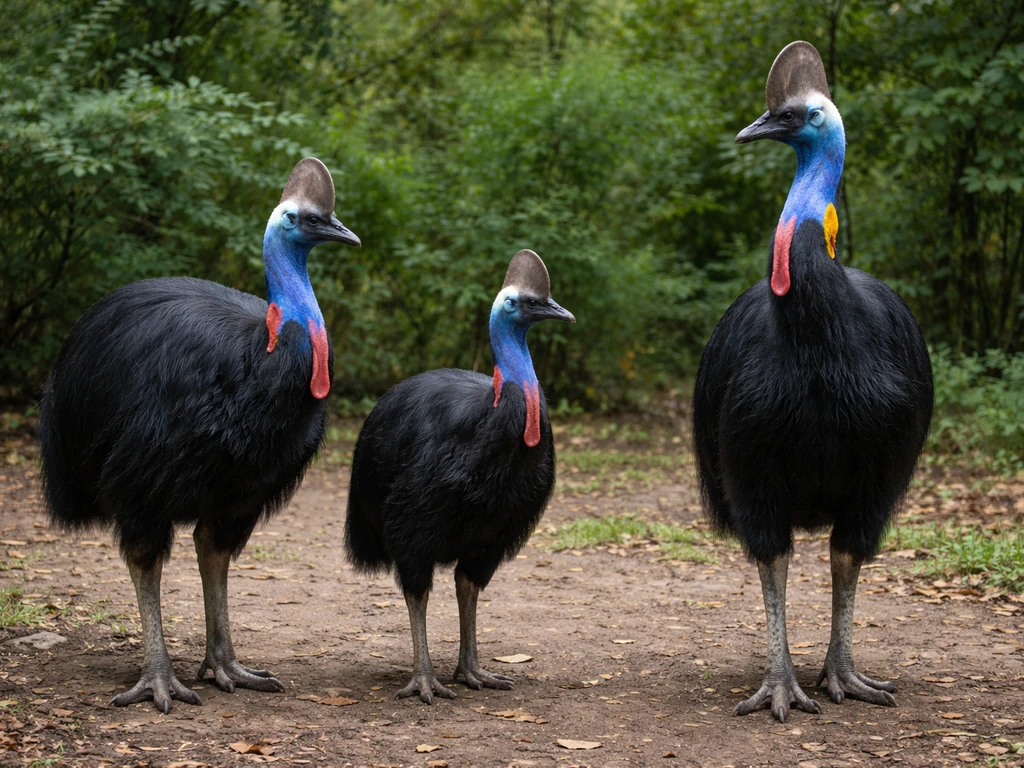
There are three living cassowary species, and their sizes differ enough that it's worth knowing which one you're asking about. The southern cassowary (Casuarius casuarius) is the largest and the one most people picture. The northern cassowary (Casuarius unappendiculatus) sits in the middle. The dwarf cassowary (Casuarius bennetti) is the smallest of the three.
| Species | Common Name | Standing Height Range | Approximate Weight |
|---|---|---|---|
| Casuarius casuarius | Southern cassowary | 150–200 cm (5–6.5 ft) | Up to 70–85 kg |
| Casuarius unappendiculatus | Northern cassowary | 130–170 cm (4.3–5.6 ft) | Up to ~70 kg |
| Casuarius bennetti | Dwarf cassowary | 99–135 cm (3.3–4.4 ft) | ~18 kg |
The southern cassowary is the one that gets the most attention, and for good reason. The Australian Museum puts its standing height at 150 to 200 cm, and the Denver Zoo's species sheet describes adults as "five to six feet tall." Females are noticeably larger than males in all three species, which is worth keeping in mind when you see a height range with a wide spread. A large female southern cassowary genuinely can look down on many adult humans. The dwarf cassowary, measured to the top of the head according to Animal Diversity Web, ranges from about 99 to 135 cm. That's closer to a child's height, though the bird is anything but delicate.
What "height" actually means for a cassowary
This is where conflicting numbers start to make sense. In ornithology, "standing height" typically refers to the measurement from the ground to the top of the bird's head or crown. For cassowaries, that gets complicated by the casque, the bony helmet-like structure that sits on top of the skull. The Denver Zoo notes the casque can reach up to six inches (roughly 15 cm) in height on its own. Whether a measurement includes the full casque or just the crown of the skull can easily shift the reported number by several centimeters.
There's also the difference between standing height and body length. Guinness World Records, for instance, lists 99 to 150 cm for Bennett's (dwarf) cassowary, but that figure appears to refer to body length rather than standing height. These two measurements are completely different, and mixing them up is one of the most common reasons you'll see conflicting numbers across sources. When you're reading a cassowary fact sheet, always check whether the number given is standing height (vertical, ground to top of head) or body length (horizontal, beak to tail).
Age matters too. Juvenile cassowaries are significantly shorter than adults, and they grow steadily over their first few years. A young cassowary that looks surprisingly small next to a photo caption claiming "up to 6 feet" is simply not fully grown yet. Adults reach their full height after a few years, with females eventually surpassing males in size.
Putting that height in perspective
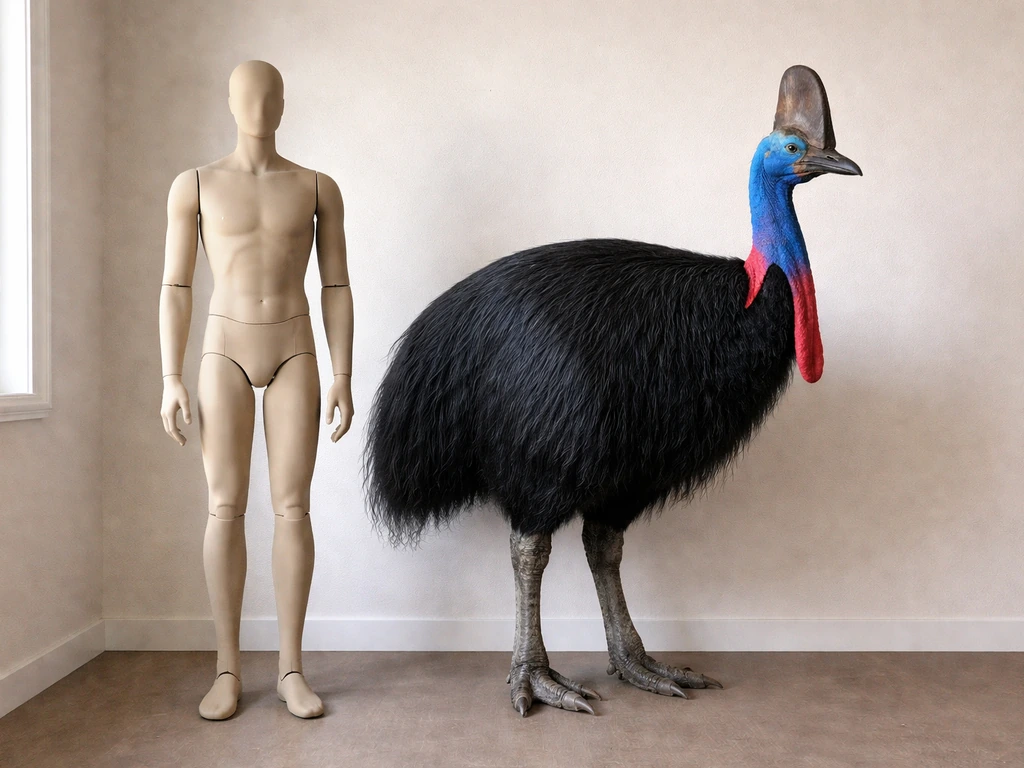
Numbers on a page are one thing. Here's how to actually picture a cassowary's height using things you can visualize easily.
- A large female southern cassowary at 180–200 cm stands taller than most adult humans. The average adult human height globally is around 165–175 cm, meaning a big female cassowary would be looking over the top of your head.
- A typical adult southern cassowary at 150–170 cm is roughly the height of a standard interior door handle to doorframe, or about level with the chin to the top of the head of an average adult.
- A dwarf cassowary at 100–120 cm is about the height of a 7-to-9-year-old child, or roughly hip-to-chest height on most adults.
- National Geographic has described the experience of standing near an adult male southern cassowary as the bird looking down at a person standing at about five feet five inches (165 cm), which matches the upper end of the average adult height range.
What makes the size feel even more striking in person is the build. This is not a slender bird. The southern cassowary has a dense, muscular body, powerful legs with a dagger-like inner claw, and a presence that makes the height feel even more imposing than the raw centimeters suggest. If you want to understand why the cassowary has a reputation as a dangerous bird, the size is a big part of that story. In fact, the most dangerous bird in Australia is widely considered to be the cassowary due to its size and powerful threat displays. If you're wondering why is the cassowary the most dangerous bird, the key is how its size and build translate into real physical risk why the cassowary has a reputation as a dangerous bird.
What kind of bird is a cassowary, and where does it live
Cassowaries are ratites, the same group of large flightless birds that includes ostriches, emus, rheas, and kiwis. Their wings are vestigial, reduced to small stiff feather shafts that serve no flight purpose. All the energy that would go into flight muscles has gone instead into powerful legs and a compact, heavy body. This is what makes cassowaries so physically formidable and why size comparisons with humans are genuinely relevant.
The southern cassowary lives in the tropical rainforests of northeastern Queensland in Australia, as well as New Guinea and some surrounding islands. Goliath bird-eaters, like Cassowaries, are found in New Guinea and nearby island habitats. The northern and dwarf cassowaries are found in New Guinea and nearby island habitats. These are dense, humid forest environments, and cassowaries play a critical ecological role as seed dispersers. They swallow large fruits whole and deposit the seeds far from the parent plant, which means the forest's regeneration depends in part on them moving through it.
Conservation status for cassowaries is a genuinely complicated picture right now. The Australian Museum lists the southern cassowary as Vulnerable on the IUCN Red List and Endangered under Australia's Environment Protection and Biodiversity Conservation (EPBC) Act. However, as of 2025, some sources including Bush Heritage Australia note that the global IUCN status was updated to Least Concern, even while acknowledging a decreasing population trend. That gap between global and national assessments reflects how localized the threats are. In Australia particularly, habitat loss, vehicle strikes, and dog attacks remain real pressures on the population. The dwarf cassowary is listed as Near Threatened. These are not birds in immediate freefall globally, but they're not thriving either.
Why different sources give different heights
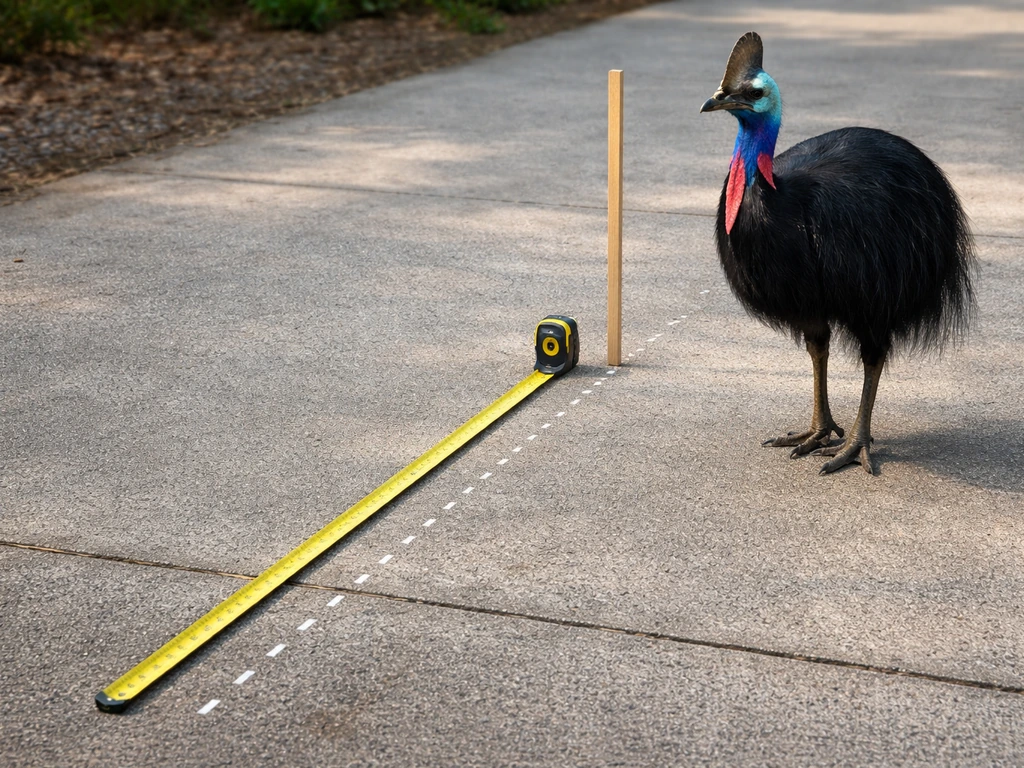
If you've already done some searching and found numbers that don't match up, here's a practical checklist for figuring out which figure to trust.
- Check whether the number is standing height or body length. These are fundamentally different measurements and are often mislabeled or unlabeled in secondary sources.
- Check whether the casque is included. Some measurements run to the crown of the skull; others include the full casque. The Denver Zoo notes the casque alone can be up to 15 cm tall, which is a meaningful difference.
- Check the species. A number for the dwarf cassowary will not match a number for the southern cassowary. If the source just says "cassowary" without specifying, it's probably referring to the southern cassowary, but not always.
- Check the sex. Female cassowaries are larger than males. A height range that spans 150–200 cm often reflects the male-to-female spread within a single species.
- Check whether it's an adult. Juvenile heights are significantly lower and occasionally appear in species descriptions alongside adult ranges without clear labeling.
- Prefer primary or institutional sources. The Australian Museum, Animal Diversity Web (University of Michigan), and Denver Zoo species sheets all provide cited, species-specific measurements. General wildlife sites and encyclopedias frequently repeat each other's errors.
The short version: if a source says a cassowary is "about 5 to 6 feet," that's a reasonable ballpark for an adult southern cassowary. If a source says "around 3 to 4.5 feet," they're most likely describing the dwarf cassowary. Both numbers are correct. They're just describing different birds.
There's a lot more to this bird than its height
Height is what most people search for first, but it's usually the starting point of a bigger question about what cassowaries actually are and why they matter. The size connects directly to why the southern cassowary is considered one of the most dangerous birds on the planet, a topic worth exploring alongside the numbers. To understand the biggest predatory bird people ask about, it helps to compare how hunting styles and threats differ across large species dangerous birds. And if you're comparing cassowaries to other large flightless or predatory birds, size comparisons across species get genuinely interesting. What's clear from the numbers alone is that a cassowary is not a bird you'd encounter and underestimate. Standing up to two meters tall, dense-bodied, and built for the forest floor, it's one of the most physically impressive birds alive today.
FAQ
When a fact sheet says “height,” does it include the casque on a cassowary?
If the source is giving “standing height,” assume it is measured from the ground to the top of the head or crown. For cassowaries, that may or may not include the casque, which can add roughly 15 cm (about 6 in) depending on how the observer defined the measurement point.
Why do cassowaries look shorter or taller in photos and videos than the listed numbers?
In most outdoor encounters, you are seeing a posture-driven measurement problem. A cassowary can raise or lower its head and neck, so a bird that looks “short” in a video may still match adult height ranges when measured upright.
How can I tell whether a “99 to 150 cm” figure for a dwarf cassowary is standing height or body length?
Guinness-style records may mix body length and standing height. A practical rule: if the number is closer to beak-to-tail distance, it is likely body length rather than ground-to-head height, and you should not compare it directly to the 150 to 200 cm “standing height” range.
Do female cassowaries really grow taller than males, and does that change the height range?
Most height ranges in the literature are adult, and females are typically taller than males. If you are estimating height from a random sighting, using the upper end of the range is safer for females, while the lower end is more consistent with males.
Could a cassowary that looks under 4 feet tall still be an adult?
Juveniles can be dramatically smaller than adults, and the growth gap is biggest in the first few years. If the bird in question looks “kid-sized” next to adult humans, the odds are good it is not fully grown yet.
How should I compare a cassowary’s height to a human height in real life?
Yes, but it is less about how tall it is and more about whether the bird is standing straight. For human comparisons, compare the “top of head” (or casque top if included) rather than body length, and keep in mind the cassowary’s head can be positioned for attention or threat displays.
Is a cassowary’s height enough to judge risk, or are there other factors I should consider?
If your goal is safety, don’t rely only on listed height. Cassowaries also have a powerful inner claw and strong threat displays, so a tall bird that is lower to the ground because of posture can still be dangerous due to reach and striking capability.
What’s the fastest way to figure out why different sources give different cassowary heights?
A quick way to resolve conflicting numbers is to identify the species first. Southern cassowaries are roughly 150 to 200 cm standing height, while dwarf cassowaries are roughly 99 to 135 cm, so mismatched species will automatically produce “contradictory” results that are actually correct.