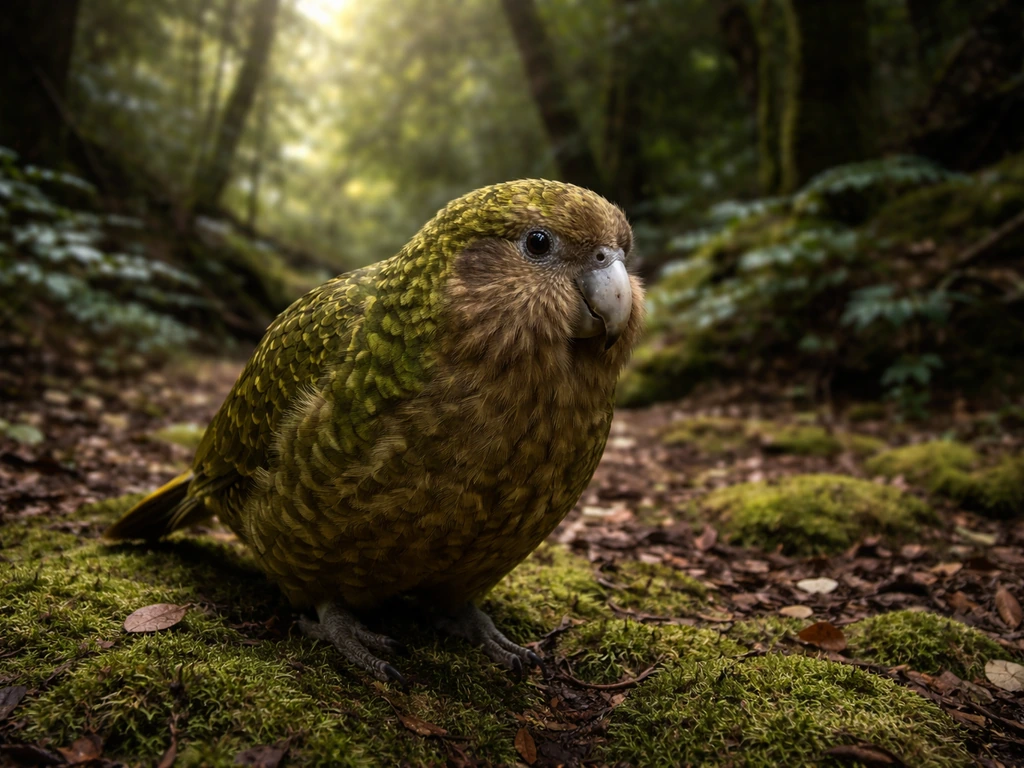
The kakapo is not extinct. As of June 30, 2025, there are 242 living kakapo in the world, all of them in New Zealand and all carefully managed on predator-free islands. The species is Critically Endangered, which is the most severe threat category before extinction, but it is very much alive and slowly recovering thanks to one of the most intensive bird conservation programmes on the planet.
Is the Kakapo Bird Extinct? Current Status and Conservation

Maya Hennessy
29 May 2026
What "extinct" actually means, and where the kakapo sits

"Extinct" has a precise meaning in conservation science: it means no individuals of a species remain alive anywhere on Earth. That is not the kakapo's situation. The IUCN Red List, which is the global authority on species threat status, uses a tiered system. From least concern at one end to extinct at the other, the categories run: Least Concern, Near Threatened, Vulnerable, Endangered, Critically Endangered, Extinct in the Wild, and Extinct. The kakapo sits at Critically Endangered (sometimes written CR), assessed under IUCN Red List Categories and Criteria Version 3.1.
Critically Endangered means the species faces an extremely high risk of extinction in the wild if the pressures driving its decline are not addressed. It does not mean the bird is gone. There is also a separate category called Extinct in the Wild, which covers species that survive only in captivity or under fully managed conditions. The kakapo occupies a grey zone here: every individual lives on managed islands with human support, but they are not caged animals. They breed, forage, and behave naturally in wild habitat that just happens to be intensively protected.
It is worth knowing why people assume the kakapo is extinct. The bird is flightless, nocturnal, slow-breeding, and once came perilously close to total disappearance. At various points in the 20th century, the entire known population could be counted on one hand. That near-miss planted the idea in popular culture that the kakapo was gone, and search results can sometimes be ambiguous. It is not gone. But the margin between where it is and where extinction begins is still uncomfortably narrow.
Where kakapo actually live right now
Every single kakapo in the world lives on one of three remote, predator-free islands in the deep south of New Zealand (Aotearoa). The New Zealand Department of Conservation (DOC) manages the population across Whenua Hou (Codfish Island), Pukenui (Anchor Island), and Te Kāhaku (Chalky Island). Whenua Hou is described as the centre of the Kākāpō Recovery Programme. Whenua Hou is described as the centre of the Kākāpō Recovery Programme, and the programme relies on predator-free habitats protected from introduced mammals such as stoats, cats, and rats. These islands were chosen and maintained specifically because they are free of introduced mammals like stoats, cats, and rats, which are the animals most responsible for pushing kakapo to the brink.
The 242 individuals recorded at the end of June 2025 represent a real, measurable recovery from a low point of around 51 birds in the 1990s. Between 2016 and 2026, the population climbed from 124 to 235, with new chicks pushing numbers higher each breeding season. That trajectory is genuinely encouraging, but 242 birds is still an extraordinarily small population for a species whose long-term survival depends on genetic diversity and continued protection.
How the kakapo nearly disappeared
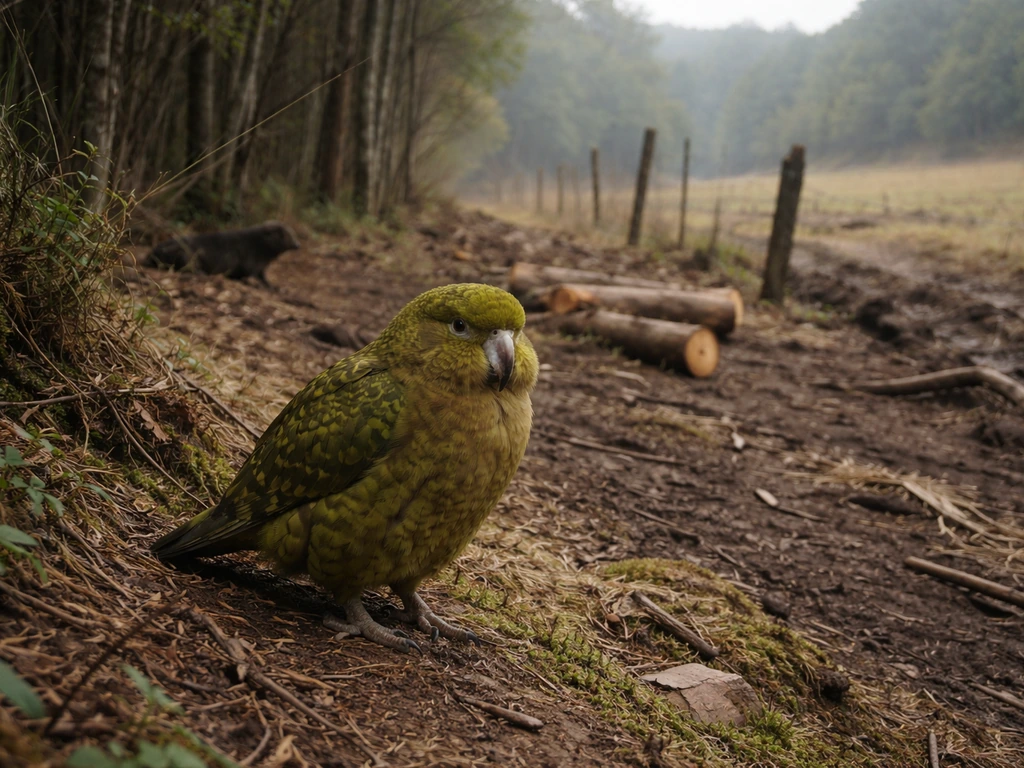
The kakapo's biology made it uniquely vulnerable the moment humans arrived in New Zealand. It is the world's heaviest parrot, fully flightless, and it evolved in an island environment with no land mammals. It had no instinct to flee ground predators because, for millions of years, there were none. When Polynesian settlers arrived and later European colonists, they brought with them cats, stoats, and multiple rat species, all of which found the slow-moving, ground-nesting kakapo easy prey. Stoats and cats kill adult birds directly. Rats destroy eggs and chicks in the nest. A species that was already slow to reproduce, with females breeding only every two to four years when rimu trees produce a large fruit crop, could not replace its losses fast enough.
Habitat loss compounded the predator pressure. As New Zealand's forests were cleared for farming and settlement, kakapo lost the ancient lowland forest they depended on. By the time a formal recovery effort began, the species existed in just a few tiny pockets. Their natural behavior, staying still and relying on camouflage when threatened, which works perfectly against birds of prey, is completely useless against a mammal hunting by smell.
Inbreeding is an ongoing concern as well. With a population that has been so small for so long, genetic diversity is low. Genomic research has confirmed the signatures of inbreeding in the current population, which can reduce fertility and resilience. This is something programme managers actively work to address through careful pairing decisions.
What the recovery programme actually does
The Kākāpō Recovery Programme, which has been running formally since 1995, is one of the most hands-on wildlife recovery efforts in the world. There is essentially no aspect of kakapo life that goes unmonitored. Every bird wears a radio transmitter and is tracked continuously. The whole population is handled at least once a year for health checks and transmitter changes. Breeding seasons get even more intensive management.
- Supplementary feeding to bring females into breeding condition, particularly when the rimu mast crop fails
- Nest management and nest cameras to monitor eggs and chicks in real time
- Artificial incubation and hand-raising of chicks when needed, with the goal of reducing this over time through better nest management
- Artificial insemination, attempted every breeding season since 2008, to manage genetic pairing and address fertility challenges
- Smart Eggs: prototype electronic eggs that teach broody females how to respond correctly to hatching chicks
- Smart traps using camera and microchip detection to protect island boundaries from any predator incursion
- Candling of eggs to assess fertility and decide which need intervention
- Translocations between the three islands to manage genetic mixing
The programme is also developing a pellet diet that mothers can feed chicks during rimu crop failures, reducing the dependence on human hand-rearing. DOC has been trialling new island sites and enhancing stoat monitoring as part of planning for future population expansion. A 2024 media release described testing new control techniques on a prospective additional island, which matters because housing all 242 birds on three islands is logistically tight and limits how much the population can grow.
This level of intervention is extraordinary but necessary. The kakapo cannot currently survive without it. People also ask whether the Kauaʻi bird is still alive, so it is worth checking the latest conservation updates for its current status. The long-term goal is to eventually reduce that dependency, but no one in the programme pretends that is imminent.
How to check the latest kakapo status yourself
Conservation status can change, and population numbers update after each breeding season. If you want the most current information, here is exactly where to look and what to expect.
- DOC's Kākāpō Recovery pages (doc.govt.nz): This is the primary source for population counts, breeding season updates, and programme news. The population reporting page gives the official headcount with a date, so you can see exactly how current the figure is. The conservation blog publishes seasonal updates during breeding years.
- IUCN Red List (iucnredlist.org): Search for Strigops habroptila (the kakapo's scientific name) to find the formal threat assessment. The page shows the current category (Critically Endangered), the assessment date, and an assessment history for any previous amendments. Use the assessment date to judge how recent the evaluation is.
- Kakapo Recovery on social media: DOC runs dedicated kakapo channels that post real-time updates during breeding seasons, sometimes more current than the main website.
- Meridian Energy's partner page: Meridian is a major programme sponsor and publishes accessible summaries of programme milestones and innovations.
When reading IUCN pages, the category label is the key thing to check. If the kakapo ever moved from Critically Endangered to Endangered, that would signal meaningful recovery. A move to Extinct in the Wild would signal disaster. Right now, it is still CR, and that has been stable. One other thing worth noting: IUCN categories are assessed periodically, not in real time, so the IUCN page may lag slightly behind DOC's annual population counts. For the raw headcount, DOC is always the fresher source.
The kakapo in the wider picture of flightless birds
The kakapo shares its story of vulnerability with a lot of company. Flightlessness evolved independently in many bird lineages, often on islands where ground predators were absent, and almost every flightless species suffered badly when humans arrived with invasive mammals. New Zealand lost its entire moa family, nine species of giant flightless birds, to hunting and habitat change after Polynesian settlement. The huia and the Haast's eagle followed. Today, the kiwi remains endangered across its various species, and other flightless or island-specialist birds around the world face similar pressures. The kakapo story is not unique in its causes; what is unusual is the scale and sophistication of the response.
Other birds that appear in these kinds of searches, like the kagu of New Caledonia and various extinct Kauai bird species, show the same pattern: island evolution, introduced predators, rapid collapse. Whether the kagu is extinct is a separate question, but it is also shaped by island evolution and introduced predators. In those cases, the endings vary from total extinction to precarious survival. The kakapo is, so far, a survival story, but it is one that requires constant, expensive, technically sophisticated effort to keep that way. Whether 242 birds is enough of a foundation to secure the species' long-term future depends heavily on how the next few breeding seasons go, how genetic diversity holds up, and whether New Zealand can keep those island habitats intact.
FAQ
If the kakapo is “extinct,” why do conservation programs still track and protect it?
No. “Extinct” in conservation terms means there are zero living individuals anywhere on Earth. The kakapo’s current status is Critically Endangered, meaning it still exists, but the wild-risk is extremely high without ongoing protection.
Are kakapo living in captivity, or are they wild birds on protected land?
It is managed in a way that is not the same as being caged. The birds live in natural behaviors like foraging and breeding on predator-free islands, with humans doing supporting roles such as monitoring, health checks, and predator control. That managed-but-not-captive setup is a key reason the species is not “Extinct in the Wild.”
Why might IUCN say one thing, but the population numbers in news look different?
There is a common confusion between global threat categories and yearly population counts. IUCN categories are updated on a schedule (so they can lag), while DOC’s headcounts after each breeding season reflect the most current numbers. For “is it changing right now,” DOC counts are the more immediate signal.
Is 242 birds a sign of safety, or can the population still crash again?
The most practical way to judge near-term risk is to watch trends over multiple breeding seasons, not a single year. With kakapo’s slow breeding (often every two to four years depending on conditions), a one-season jump or dip can be misleading, so look for sustained increases or declines.
What does inbreeding mean for kakapo survival if their numbers are increasing?
Yes, genetics can matter even if the headcount rises. With low genetic diversity, managers use careful pairing decisions to reduce inbreeding effects, but fertility and resilience can still be impacted. That is why breeding success and chick survival rates often receive as much attention as total bird numbers.
How do conservation teams help kakapo reproduce during years when their natural food supply drops?
Population growth is strongly tied to food availability, especially fruiting patterns of rimu trees. When natural rimu crop years fail, the program’s pellet diet approach helps mothers feed chicks, reducing reliance on emergency hand-rearing and lowering the risk of breeding failures.
Why not just move kakapo to more islands immediately?
All three islands are predator-free, but the bottleneck is that there are only three major sites currently holding the whole population. Expansion to additional sites is important because it spreads risk, improves long-term security, and allows the program to scale beyond what three islands can realistically support.
Do transmitters and annual handling harm kakapo, and how is that managed?
Radio transmitters are routinely used, and handling is part of the monitoring system. However, it is not “set and forget,” the program schedules frequent checks, replaces equipment, and intensifies oversight during breeding to minimize disease and ensure data quality.
What would have to go wrong for the kakapo to move from Critically Endangered toward extinction?
It is possible for a species to be Critically Endangered and still be alive, while its extinction risk remains immediate if threats return. The reason the kakapo is still alive is that invasive predators like stoats, cats, and rats have been kept out. Any failure in biosecurity or island protection can quickly change the outlook.
People ask about other island birds, does the kakapo status automatically mean those other species are also safe?
Yes, it is a related but separate question. The article mentions other birds that people confuse with the kakapo, but their statuses can differ widely. If you hear a specific “island bird” claim, check that bird’s own current conservation status rather than assuming it matches the kakapo’s outcome.
Next Article
Is the Cuckoo Bird Extinct? Species Status, Evidence, Next Steps
Find whether any cuckoo species are extinct, how to verify evidence, and why cuckoos vanished in some regions.