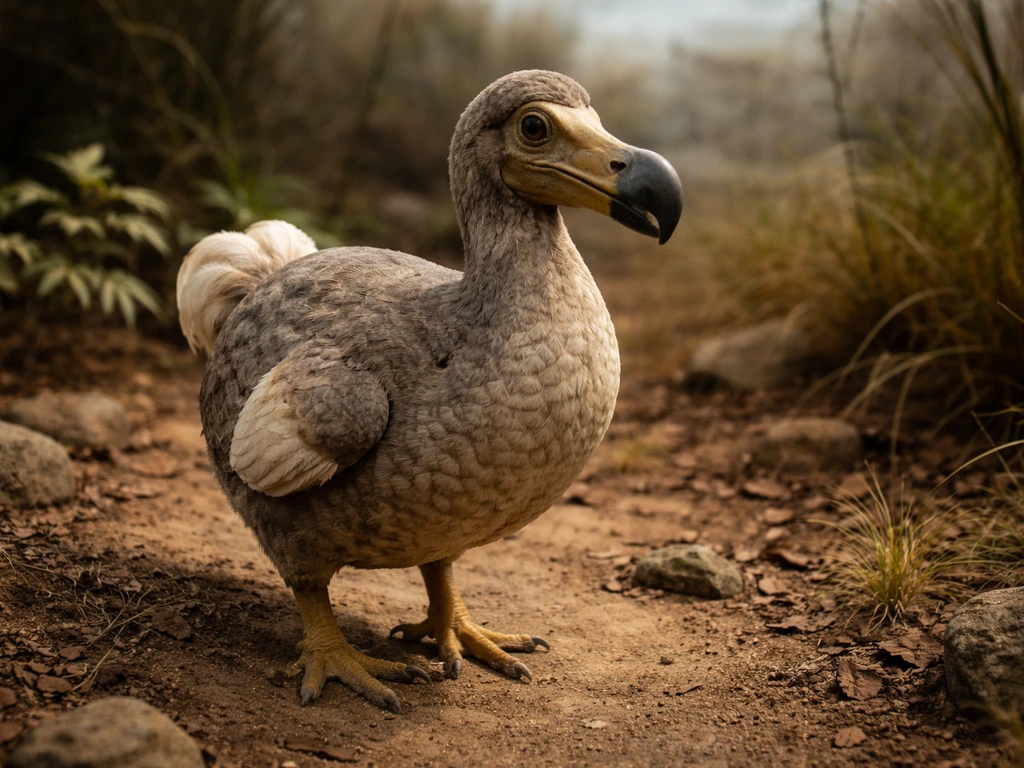
The dodo's main defense was running away. While the dodo could bite when cornered, its main defense was not fighting humans, which is why the question of whether a dodo bird can really kill you depends on the situation can a dodo bird kill you. Because of this mismatch with new predators and humans, the dodo is better described as easy to approach and not truly dangerous to people is the dodo bird dangerous.
How Did the Dodo Bird Defend Itself in Island Life?

Maya Hennessy
3 Jun 2026
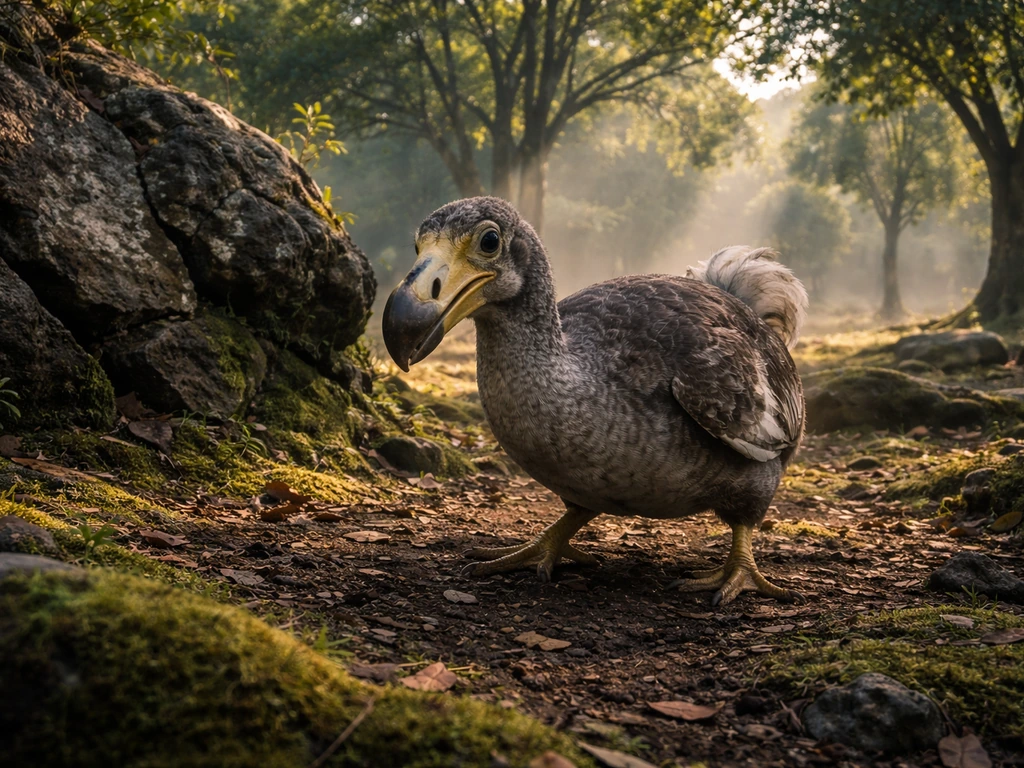
It could move quickly on foot, likely outpacing a person across rocky terrain. Beyond that, it probably used its beak to strike at threats when cornered, relied on the cover of dense Mauritian forest, and simply had no reason to develop strong predator-avoidance instincts before humans arrived.
That last point is really the key to the whole story: the dodo's defenses were shaped by an island environment where serious predators barely existed, so when real threats showed up, those defenses were nowhere near enough.
Where dodos lived and why that shaped their defenses

The dodo (Raphus cucullatus) lived exclusively on Mauritius, a volcanic island in the southern Indian Ocean. A closely related bird, the Rodrigues solitaire (Pezophaps solitaria), lived on the nearby island of Rodrigues. Both birds evolved in the same basic situation: island isolation with few, if any, mammalian predators. That ecological context is everything when you're trying to understand how a bird defends itself, because defense strategies evolve in direct response to the threats an animal actually faces.
Mauritius was covered in dense tropical forest, including tambalacoque trees (Sideroxylon grandiflorum), Pandanus, and endemic palms. Scientists reconstructed this picture largely from a remarkable fossil site called Mare aux Songes, an ancient swamp in south-eastern Mauritius that acted as a kind of natural bone trap, preserving dodo remains alongside plant matter, seeds, and other animal fossils. The 2015 review of [Mare aux Songes](https://www. tandfonline.
com/doi/abs/10. 1080/02724634. 2015. 1113803) describes it as a vertebrate concentration Lagerstätte and notes that plant remains, including seeds and fruits, dominate the bonebed record, helping researchers reconstruct the dodo ecosystem context.
This site is essentially a window into the dodo's world, and what it shows is a forested, seasonally variable island where food availability shifted with rainfall cycles. The dodo's behavioral toolkit, including how it responded to threats, evolved within that specific setting.
The critical takeaway from this island context: without wolves, big cats, or other ground-level mammalian hunters, the dodo had no evolutionary pressure to develop flight, extreme speed, or aggressive anti-predator behaviors. What it had was enough to survive in the world it actually inhabited, right up until that world changed dramatically.
What dodos actually did to protect themselves
The most direct historical evidence we have for dodo defense comes from François Leguat, who wrote in 1708 that dodos were quite able to outrun a person among the rocks. That single observation matters a lot. It tells us that at least some dodos, when faced with a human pursuer, used speed and terrain to escape rather than standing still or fighting back. The rocky, uneven ground of Mauritius would have given a low-slung, sturdy bird a real advantage over a person trying to chase it.
Beyond running, the dodo almost certainly had a functional beak that could deliver a hard bite. Its closest living relative is the Nicobar pigeon, and while the dodo was far larger and more robustly built, the pigeon baseline gives researchers a starting point for understanding beak mechanics and behavior. A bird the size of a large turkey with a hooked beak could inflict a meaningful strike if cornered. This likely served as a short-range deterrent, especially when defending a nest or chick.
Nesting on the ground, the dodo would also have relied on concealment within the forest understory. Dense vegetation, fallen logs, and rocky outcrops all provided cover. There is no strong evidence dodos were territorial in an aggressive sense, but ground-nesting birds generally show some level of nest defense behavior, and it would be reasonable to expect the dodo did too.
How the dodo's body helped and hurt it
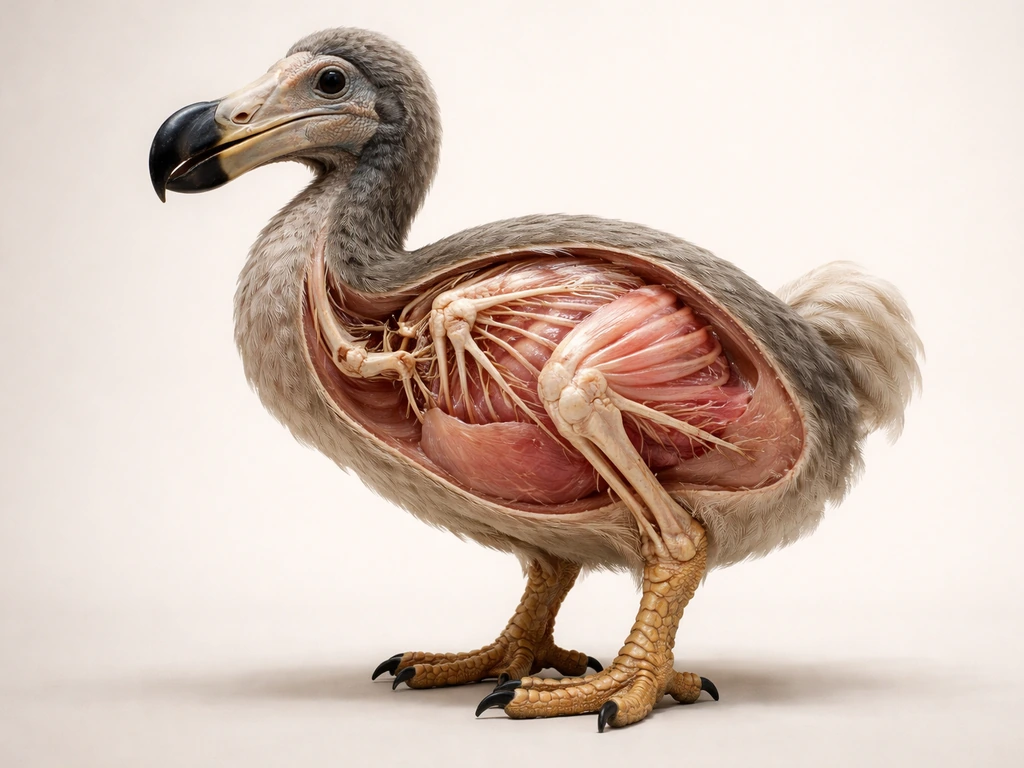
Flightlessness is the obvious starting point. The dodo could not fly, full stop. Its wings were small and vestigial. In a world without serious predators, losing flight is not a disaster. It frees up enormous metabolic resources, lets body size increase, and allows a bird to thrive as a ground forager. But it also means that when a real threat appears, the escape options narrow dramatically. No launching into the canopy, no relocating quickly across water.
The dodo's exact size and weight has been genuinely contested. Skeletal reconstructions have produced both a lean, muscular bird and a rounder, heavier one depending on which measurements researchers prioritize. This matters for the defense question because a heavier animal runs less efficiently and would tire faster under pursuit. What most researchers agree on is that the dodo was roughly turkey-sized, probably weighing somewhere between 10 and 18 kilograms, and was built for walking and foraging rather than sustained sprinting. Short bursts across rocky ground? Plausible. Outrunning a motivated dog over open terrain? Much less likely.
Studies on flightless birds like emus show they use what's called a grounded run at intermediate speeds, a gait where the body moves with running mechanics but feet maintain longer contact with the ground than in a true run. This kind of locomotion allows a flightless bird to move faster than a walk without the aerial phase of a full sprint, and research on mixed gaits in birds confirms they can shift between locomotion modes under threat. The dodo almost certainly had this capacity, making it more agile as a defensive runner than its stocky frame might suggest.
The threats that actually overwhelmed the dodo
Portuguese sailors discovered Mauritius, and Dutch sailors began hunting dodos in earnest in the late 1600s. Historical accounts consistently describe dodos as unafraid of humans, walking toward them rather than fleeing. That behavioral naivety, which made complete sense on an island without human predators, became catastrophic the moment humans with clubs and weapons arrived. The dodo had no learned or evolved wariness of people, so it simply did not run. Because dodos were unafraid and not adapted to human threats, they were not generally dangerous to people in typical encounters no learned or evolved wariness. Dutch sailors reportedly killed them in large numbers with little effort.
Hunting was only part of the problem. The introduced animals that arrived with European settlers hit the dodo even harder, particularly its eggs and chicks. Rats, dogs, cats, pigs, and monkeys all established themselves on Mauritius. Rats and pigs are relentless nest raiders. Monkeys, associated with Dutch settlement attempts from around 1638 onward, would have been especially effective at finding and destroying ground-level nests. A bird that lays a single egg per clutch on the ground, surrounded by suddenly abundant egg predators with no prior exposure to them, faces a reproductive crisis that no amount of beak-striking or running can solve.
Deforestation by colonists removed the cover that the dodo depended on for concealment and foraging. The combination of direct hunting, egg predation, habitat destruction, and the dodo's own behavioral naivety compressed an extinction that might otherwise have taken millennia into less than a century. The last widely accepted sighting occurred in 1662, though some records suggest individuals persisted until around 1680 or possibly as late as 1688 based on hunting logs kept by a Dutch official named Isaac Joan Lamotius. The dodo was gone, for all practical purposes, within 100 years of first contact.
How scientists piece together dodo behavior from the evidence
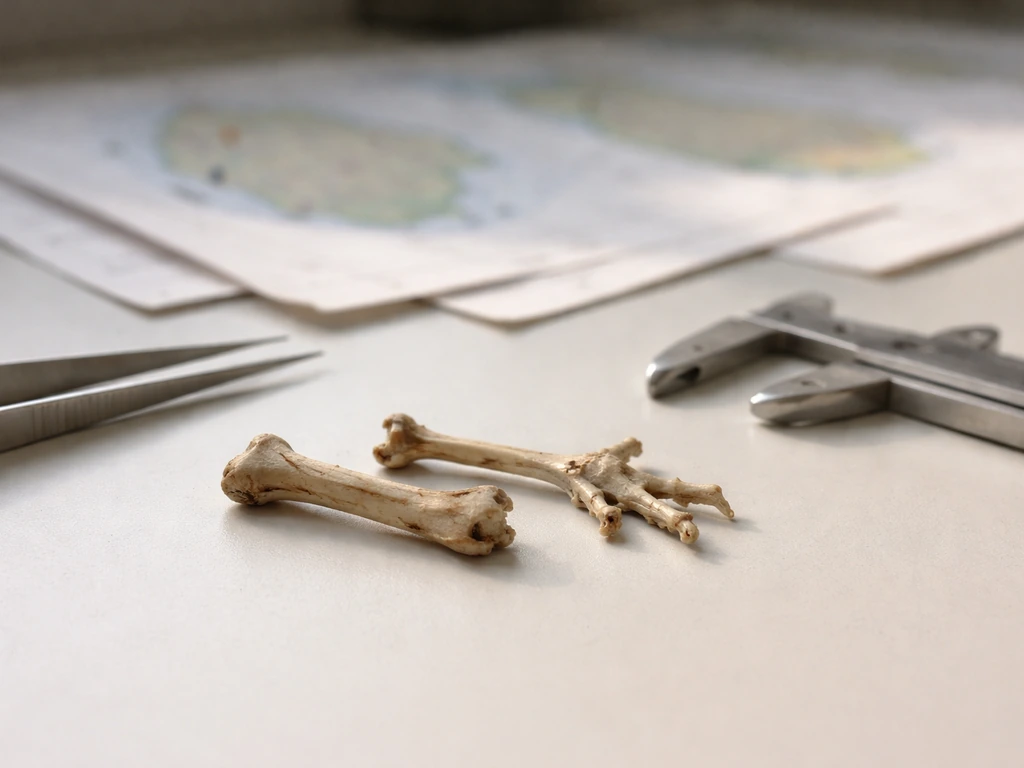
Nobody alive has ever seen a dodo. So how do researchers figure out how it behaved? The answer is a combination of fossil anatomy, historical documents, ecological comparisons, and related living species.
- Subfossil bones from Mare aux Songes and other Mauritian sites reveal body proportions, leg bone structure, and beak morphology, which inform locomotion and feeding mechanics.
- Historical written accounts, including Leguat's 1708 description of dodos outrunning men among rocks and Dutch sailors' notes on hunting ease, provide direct behavioral observations, however brief.
- Hunting records like those of Lamotius between 1685 and 1688 document capture frequency and effort, which researchers use to infer population trends and behavioral patterns under pressure.
- Comparison to the Nicobar pigeon, the dodo's closest living relative, provides a baseline for understanding social behavior, beak use, and habitat preferences.
- Biomechanical research on other flightless birds (emus, cassowaries, and related species) helps researchers model how a bird of the dodo's probable mass and leg length would have moved under different conditions.
- Plant remains and ecosystem reconstruction from Mare aux Songes reveal the foraging environment and the kinds of cover available to nesting birds.
The honest caveat here is that significant uncertainty remains. Portrait variations from the period, contested skeletal reconstructions, and the simple fact that no naturalist ever conducted systematic behavioral observations of a live dodo mean that some details will never be fully resolved. What scientists can say with confidence is built from convergent evidence across multiple lines, not from a single source.
Separating myth from what we actually know
A few misconceptions come up repeatedly when people ask about dodo defense, and they're worth addressing directly.
| Myth or assumption | What the evidence actually suggests |
|---|---|
| Dodos were helpless and passive when threatened | They could run quickly, especially over rocky ground, and likely used their beak in close-range defense. They were not entirely passive. |
| Dodos were too fat and slow to escape anything | Body mass reconstructions are contested. The "fat dodo" image partly reflects overfed captive animals depicted in European illustrations, not necessarily wild individuals. |
| Dodos fought back aggressively against humans | Historical accounts consistently describe them as unafraid and approachable, not aggressive. There is no strong evidence of active threat displays toward humans. |
| Dodos had no defenses at all | They had defenses suited to their original environment: running, concealment, and beak use. Those defenses simply weren't calibrated for the threats humans introduced. |
| Flight loss made the dodo uniquely defenseless | Many island birds lose flight without going extinct. The problem was the sudden introduction of novel predators combined with naive behavior, not flightlessness alone. |
The real story of dodo defense is less about dramatic last stands and more about a mismatch between evolved behaviors and a suddenly changed world. That mismatch is also why people wonder, “Is a dodo bird a dinosaur? ”, even though it is a bird, not a dinosaur. The dodo was not stupid, and it was not completely helpless.
It was a bird that had successfully lived on its island for a very long time, using strategies that worked perfectly well until they didn't. Because the dodo is a bird, people often wonder whether it is a mammal, but it is not is a dodo bird a mammal. That's a pattern worth understanding, because it applies to many endangered island birds alive today.
If you want to go deeper on related questions, it's worth exploring whether the dodo could fly (the short answer is no, but the evolutionary reasons are fascinating), whether dodos posed any danger to humans (they almost certainly did not in any meaningful sense), and how smart the dodo actually was compared to its cartoon reputation. All of those threads connect back to the same core picture of an island bird that was perfectly adapted to one world and completely unprepared for another.
FAQ
When people say the dodo could bite, does that mean it fought humans often?
Not in the way people usually imagine. The account that dodos were “unafraid” of humans suggests they typically relied on walking away or using terrain (rocks and uneven ground) rather than engaging in sustained fights. If a dodo was physically cornered, it could bite with its beak, but the behavior described is more escape-first than attack-first.
Would a dodo defend itself the same way in open terrain versus rocky forest floors?
Yes, but it matters where the encounter happens. On open or flat ground, a flightless bird has fewer options, and pursuit would likely become harder to escape. The historical note about outrunning a person among rocks implies that rocky cover improved the dodo’s chances to evade.
How did the dodo’s defense likely change when it was guarding a nest or young?
Defense would depend on the life stage. Nesting on the ground increases urgency, so beak strikes and aggressive posturing are more likely around nests or chicks than during everyday foraging. For egg vulnerability, even strong physical defense would not solve the problem of predators specializing in finding eggs.
If the dodo could run and bite, why were predators still so overwhelming?
Because introduced predators targeted the nest, the dodo’s “self-defense” shifted from individual tactics to a reproductive bottleneck it could not overcome. Running or biting does little against rats or pigs that raid nests repeatedly, especially when the birds evolved without those threats.
Could a dodo be dangerous in a specific situation even if it was usually not?
It is best to treat “dangerous” as context-specific. The article’s evidence points to low threat during typical human contact because dodos lacked fear learning for people. The main risk would be accidental cornering, especially of a grounded bird near cover or during breeding.
If a dodo could not fly, did it still have a realistic chance to escape pursuit?
No. Flightlessness limited escape options, so the dodo’s defense was mostly based on walking, short bursts, and maneuvering through ground cover. It could not relocate rapidly by taking off, which becomes a major disadvantage when the pursuer has distance, coordination, or weapons.
Was the dodo’s defense strategy more about instinct or about learning to fear predators?
Compared to a cartoon “charging” behavior, researchers emphasize mismatched instincts. The dodo evolved in an environment with few mammalian ground predators, so it likely did not develop strong avoidance of humans. When humans arrived with new tools and hunting methods, that behavioral mismatch made defense much less effective.
How do size and body weight uncertainty affect estimates of how well dodos could escape?
There is some uncertainty, but the overall pattern is that a heavier body would tend to reduce endurance during chases. Even if a dodo could make short, effective escape moves, sustained running against faster pursuers would be less likely if its body type was on the heavier end.
Could beak biting realistically deter predators that hunt in different ways, like nest raiders?
Even if a dodo could bite, beak strikes would be short-range and situational. A cornered dodo might deter a nearby threat briefly, but predators that can grab and kill from awkward angles, or that target the nest indirectly, would still bypass that defense.
How would deforestation affect the effectiveness of the dodo’s main defenses?
The different defense roles likely changed with the environment after colonists. Reduced forest cover would make concealment harder, so running and hiding become less effective, and attacks become more likely to lead to capture. In other words, the same physical defenses would work worse in a more open, disturbed habitat.
Next Article
Is the Dodo Bird Dangerous to Humans? Clear Answer
Find out if the dodo ever posed a threat, and why it cannot endanger humans today due to extinction.